Is Vibe Coding Worth Learning? An Honest Career Guide for India (2026)
Yes, vibe coding is worth learning in 2026 if you treat it as an AI-assisted development skill, not a shortcut around programming. It speeds up prototyping, MVPs and routine coding, and employers increasingly value developers who can direct AI tools well. It is not enough alone: you still need fundamentals, debugging, testing and security awareness to build reliable software.
★★★★★
4.9/5 rated by 1329+ students · Google Verified
Table of Contents
Introduction
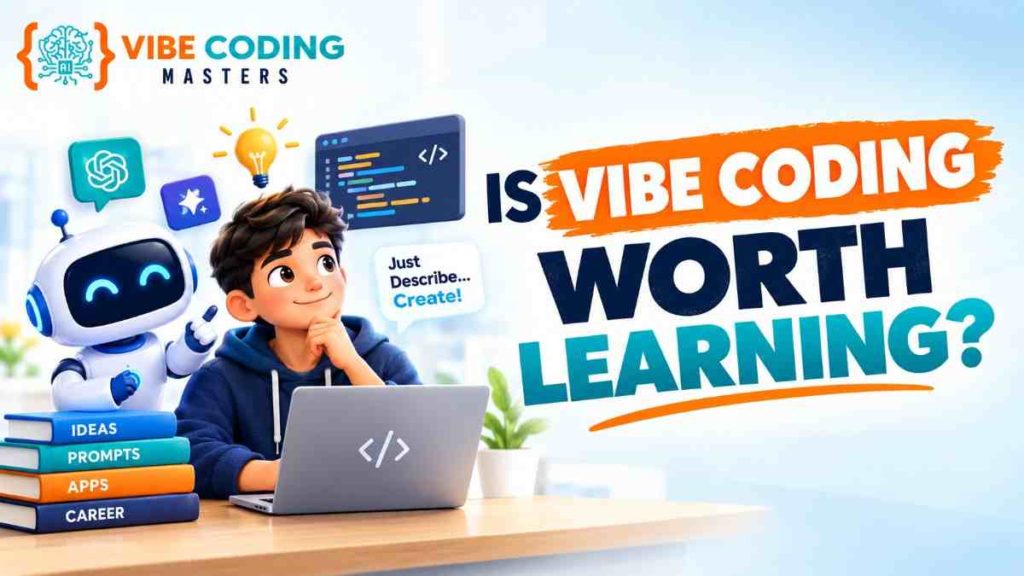
Two years ago, the idea of describing an app in plain English and watching working code appear sounded like a demo trick. Today it is a daily workflow for students, freelancers, startup founders and professional developers.
So is vibe coding worth learning? For most people in tech, yes. But the answer depends on what you mean by “learning” and what you expect from it.
Vibe coding means building software by describing what you want in natural language and letting an AI model generate, modify and explain the code. The term was popularised by AI researcher Andrej Karpathy in early 2025, and Collins Dictionary later named it its Word of the Year. It has moved from a casual phrase to a recognised way of working.
AI-assisted coding is changing software development in three visible ways. Prototypes that took days now take hours. Repetitive work such as boilerplate, form validation and basic CRUD screens is increasingly delegated to AI. And the skill that matters is shifting from typing syntax to specifying, reviewing and verifying.
That is why students, freshers, working developers and career changers are all asking the same question. Students want an edge in a crowded fresher market. Developers want to ship faster. Career changers want a realistic way into tech without spending years on theory first. India’s own policy push on AI skills, visible on the IndiaAI portal, adds to the sense that AI-powered development skills are becoming a core part of the job market.
This guide gives a balanced answer. It covers where vibe coding helps, where it falls short, what it can mean for your career, and how to start without wasting time, including what to look for in a vibe coding course in Hyderabad.
Is Vibe Coding Worth Learning
What Is Vibe Coding?
Vibe coding is a way of building software where you describe the outcome in plain language and an AI model writes the code, while you test, refine and direct the result.
It sits inside the wider field of AI-assisted programming, powered by generative AI and large language models (LLMs). For a full beginner explanation, read what vibe coding is, and for the contrast with more autonomous workflows, see vibe coding vs agentic coding.
Is Vibe Coding Worth Learning in 2026?
Yes, if you learn it as an AI-assisted development skill on top of programming fundamentals. It is much less valuable as a replacement for understanding how software works.
A fair summary has two sides:
- Worth learning because: it speeds up prototyping, lowers the barrier to building real projects, reduces repetitive work and matches how many teams already work.
- Not enough alone because: AI-generated code can be wrong, insecure or badly structured, and someone has to catch that.
The people who benefit most are those who combine AI tools with judgment. A developer who can describe a feature clearly, spot a flawed query, write a test and deploy safely is far more valuable than someone who can only paste prompts.
What vibe coding does well
- Faster prototyping: you can test an idea in an afternoon.
- Faster MVP development: founders and freelancers can validate products before investing heavily.
- Learning through experimentation: seeing working code immediately, then asking the AI to explain it, shortens the feedback loop.
- Reduced repetitive coding: boilerplate, UI scaffolding and routine integrations are well suited to AI.
- Rapid website and app development: landing pages, dashboards and internal tools are now very quick to build. You can see what this looks like in practice in our guide on building a website with vibe coding.
Vibe coding alone is usually not enough for:
- Security-critical systems, such as payments, identity and healthcare.
- High-performance systems, where optimisation and profiling need deep expertise.
- Regulated industries, where audit trails, compliance and governance are mandatory.
- Production software, which needs strict testing, code review and release discipline.
In these settings, AI is a powerful assistant, but accountable humans must design, review and approve what ships.
Why Vibe Coding Is Becoming Popular
It is popular because it makes building faster and more accessible, and because capable AI coding tools are now cheap or free to try.
Several forces are pushing adoption:
- Better models. Modern LLMs handle multi-file changes and explain their own output far better than early autocomplete tools.
- Tools designed for it. Editors and platforms such as Cursor, GitHub Copilot and Gemini Code Assist put AI inside the development environment.
- Startup economics. Small teams can ship products that once needed larger engineering budgets.
- Student and freelancer demand. Portfolios can now show working products, not just tutorials.
- Employer expectations. More job descriptions mention AI-assisted workflows.
Vibe Coding Career Opportunities
Vibe coding is rarely a standalone job title. It is a skill that strengthens roles such as junior developer, full-stack developer, AI-assisted developer, freelancer and startup builder.
Look at the skills a job requires rather than its label. Our guide to career opportunities after vibe coding covers the roles in detail.
Who Should Learn Vibe Coding?
Almost anyone who builds or wants to build software, with different goals at each stage.
Learner | Why it helps | Watch out for |
Students | Builds projects and portfolios faster | Skipping fundamentals |
Freshers | Stand out with practical AI workflow skills | Over-relying on AI in interviews |
Working developers | Productivity gains and modern skills | Accepting code without review |
Freelancers | Faster delivery and more clients | Quality and security gaps |
Career changers | A realistic entry point into tech | Expecting instant jobs |
Founders | Cheap, quick MVPs | Technical debt at scale |
Is Vibe Coding Good for Beginners?
Yes, it is a good starting point for beginners because it lets you build something quickly, but you must still learn the basics alongside it.
Beginners benefit because early wins keep motivation high, and you can ask the AI to explain any line like a patient tutor.
The risk is the “illusion of competence”: the app runs, so you feel you understand it. When it breaks, you cannot fix it. Learn HTML, CSS, JavaScript and basic logic in parallel, and make a habit of asking, “Explain this code and why it works.” If you have no coding background at all, start with our guide on vibe coding for non-programmers.
Vibe Coding vs Traditional Coding
Traditional coding means writing code mostly by hand. Vibe coding delegates much of the writing to AI and focuses on direction and review. Most professionals now blend both.
We cover this comparison in depth in our dedicated guide on vibe coding vs traditional coding.
Vibe Coding vs Manual Coding: Key Differences
Manual coding gives you full control and deep understanding but is slower. Vibe coding is faster but needs strong verification.
The strongest developers use both: AI drafts, and manual judgment is applied where it counts. For a closer look at correctness, read vibe coding vs manual coding accuracy.
Vibe Coding vs Bootcamp Learning
A bootcamp or structured course gives guidance, accountability and feedback. Self-directed vibe coding gives speed and flexibility. The best results usually come from combining structure with real projects.
Whichever route you pick, judge it by the projects you can show and explain. We compare the two options in vibe coding vs coding bootcamp.
Benefits of Learning Vibe Coding
The main benefits are faster development, rapid prototyping, higher productivity, easier experimentation, less repetitive work and quicker portfolio building. They also help freelancers and startups deliver sooner at lower cost. The real advantage comes from combining coding knowledge with AI tools. For the course-side view, see the benefits of a vibe coding course.
Limitations and Risks of Vibe Coding
Honest evaluation matters here, because these risks are where inexperienced vibe coders get hurt.
- Hallucinated code: AI can invent functions, packages or APIs that do not exist.
- Security vulnerabilities: generated code may include injection flaws, weak authentication or exposed secrets.
- Incorrect logic: code can look right and still fail on edge cases.
- Poor architecture: AI often solves the immediate prompt without considering long-term structure.
- Dependency problems: outdated, unnecessary or risky libraries can creep in.
- Debugging challenges: debugging code you did not write or understand is hard.
- Technical debt: quick fixes pile up and make later changes expensive.
- Overdependence on AI: skills can stagnate if you never struggle with problems yourself.
- Lack of fundamentals: without them you cannot judge the output.
- Copyright and licensing: generated code may resemble licensed code, so check your tool’s terms and your company policy.
- Privacy concerns: pasting proprietary code, customer data or credentials into AI tools can breach policy or law. Use approved tools and never share secrets.
To see how to keep AI-generated code reliable, read our guide on vibe coding quality.
Skills Required for Vibe Coding
You need clear communication, programming basics, Git, debugging, testing and security awareness. The AI handles typing; you handle thinking.
Add APIs, databases, code review and deployment as you progress. The full skill list, with use cases, is in our vibe coding roadmap, and the difference between prompting and building is explained in vibe coding vs prompt engineering.
AI Tools Every Vibe Coder Should Know
Tools matter less than workflow. Here is where each one typically fits in a real project.
Planning and thinking
- ChatGPT and Claude work well as conversational partners for planning features, explaining errors, drafting database schemas and comparing approaches. This is “ChatGPT for coding” at its most useful: reasoning before building.
- Gemini and Gemini Code Assist help inside Google’s ecosystem, including IDE assistance and code review.
Building inside the editor
- Cursor and Windsurf are AI-first code editors that understand your whole project, apply multi-file edits and let you accept or reject changes.
- GitHub Copilot provides suggestions and chat inside popular editors, and fits teams already using GitHub.
- Claude Code works from the terminal as an agentic assistant that can read a codebase, run commands and make changes. It is powerful for larger tasks, which makes review discipline even more important.
Rapid app generation
- Replit, Lovable, Bolt and v0 generate working apps or UI components from prompts and often deploy them in a click. They are excellent for prototypes, landing pages and MVPs. Treat their output as a starting point to inspect, not a finished product.
The human layer that never goes away
- GitHub and version control let you commit working states and roll back when AI changes break things.
- APIs connect your app to payments, maps, email or AI models, and you must understand authentication and rate limits.
- Debugging and testing confirm the code does what you asked.
- Code review and software architecture keep the project maintainable.
- Security and deployment decide whether the app is safe to put in front of real users.
A realistic workflow looks like this. Plan with Claude or ChatGPT, scaffold with Lovable or v0, move into Cursor or Claude Code for deeper work, commit to GitHub often, test and review before deploying. At every step, you stay responsible for understanding what the code does.
For tool-by-tool detail, see what software is used for vibe coding, Claude Code vs Cursor, vibe coding with GitHub Copilot and our Lovable AI tutorial.
Vibe Coding Career Path
Start as a builder, grow into a developer who uses AI well, and eventually move into architecture or AI engineering. Progress depends on practice, not time served.
Once you have a few projects to show, it also helps to practise common vibe coding interview questions before you start applying.
Vibe Coding Jobs and Salary in India
Vibe coding skills are usually rewarded within standard developer salary bands. There is no separate “vibe coder” pay scale, and ranges vary widely.
Any salary range is an indicative estimate, not a guarantee. Actual pay varies by company, city, technical skills, years of experience, project quality, negotiation and market conditions. Treat any promise of a guaranteed salary from vibe coding alone as a red flag. For role-wise figures, see salary after learning vibe coding and vibe coding developer salary for freshers in India.
Comparison: Vibe Coding vs Other Paths
Vibe coding is best seen as a layer that makes web development, data work and cloud work faster, not a rival to them. Here is how it compares with three paths we do not cover elsewhere.
Criteria | Vibe Coding | Data Science | Web Development | Cloud Engineering |
Learning curve | Gentle start | Steep (math, stats) | Moderate | Moderate to steep |
Coding knowledge | Basic to moderate | Strong (Python, SQL) | Moderate to strong | Moderate |
AI dependency | High | Moderate | Low to moderate | Low to moderate |
Development speed | Very fast | Slow to moderate | Moderate | Moderate |
Career opportunities | Growing, usually via developer roles | Strong, specialised | Strong, broad | Strong, in demand |
Long-term relevance | High with fundamentals | High | High | High |
Required technical skills | Prompting, Git, debugging | Statistics, ML, data tools | HTML, CSS, JS, frameworks | Cloud platforms, networking, DevOps |
Suitable learners | Builders, freelancers, developers | Analytical learners | Aspiring developers | Infrastructure-minded learners |
For the other comparisons, see vibe coding vs no-code tools, vibe coding vs full stack developer course, and the traditional and manual coding guides linked above.
Future Scope of Vibe Coding
The tools will keep improving, but the need for people who can specify, verify and take responsibility for software is unlikely to disappear.
Expect more agentic tools, AI-native product design, higher expectations for reviewers and stronger company governance on security, privacy and licensing. This is informed opinion, not certainty. The safest assumption is that fundamentals plus AI fluency will stay valuable. Read more in vibe coding: the future of programming.
Choosing a Vibe Coding Course in Hyderabad
A good vibe coding course in Hyderabad should teach programming fundamentals and AI tools together, include real projects, and give you mentor feedback on the code you generate.
Hyderabad has a large IT and startup ecosystem, so many students and working professionals there ask whether a structured course is worth it. Check these points before you enrol
- Fundamentals plus AI tools: the syllabus should cover HTML, CSS, JavaScript, Git and APIs, not only prompting.
- Project-based learning: you should finish with deployed projects you can explain in interviews.
- Review and debugging practice: trainers should teach you to test and question AI output.
- Track that fits your goal: choose between a frontend, backend, Python or Java focus.
- Mode and schedule: compare offline vs online learning, or look at the course for working professionals if you have a job.
- Cost and credentials: review the course fees and what the vibe coding certification includes.
Whatever you choose, treat placement or salary claims from any institute with caution and judge the course by its syllabus, projects and trainer feedback.
How to Start Learning Vibe Coding
Learn basic web fundamentals, pick one AI coding tool, and build small real projects every week.
- Learn the basics. HTML, CSS, JavaScript and simple logic, or Python if you prefer.
- Pick one tool. Start with Cursor, GitHub Copilot or an app builder like Lovable and stay with it for a month.
- Build a tiny project. A to-do app, portfolio page or expense tracker.
- Ask the AI to explain. After each feature, ask what the code does and why.
- Use Git from day one. Commit often and learn to roll back.
- Test, debug and deploy. Break things on purpose, fix them, then put a live project online.
- Get feedback. Mentors, communities or a structured course speed up learning.
How long does it take? Basic comfort often comes in a few weeks of consistent practice, while job-ready skill typically takes several months of project work. Need ideas? Try our vibe coding projects for beginners and vibe coding prompts.
Why Vibe Coding Can Be a Valuable IT Skill
Vibe coding adds value because it multiplies what you already know. A developer with sound fundamentals gets faster. A beginner gets a working start. A freelancer takes on more clients. A founder validates ideas sooner.
It stops being valuable when it replaces understanding. The market rewards people who can explain why their code works, not just show that it runs. Learn it as a force multiplier, and it is a strong investment of your time.
Key Takeaways
- Vibe coding is worth learning when treated as an AI-assisted development skill built on programming fundamentals, not as a shortcut around them.
- Its biggest strengths are faster prototyping, rapid MVPs, reduced repetitive work and an easier start for beginners.
- Its biggest risks are insecure, incorrect or poorly structured code, which is why debugging, testing, code review and security awareness are essential.
- Careers reward vibe coding within existing developer roles, and salary ranges in India are indicative, not guaranteed.
- The best way to start is by building and deploying real projects with tools like Cursor, GitHub Copilot or Claude Code while learning the basics.
Conclusion
So, is vibe coding worth learning? Yes, with one condition: learn it as a skill that works alongside programming knowledge, debugging, testing, security awareness and human judgment. Used that way, it makes you faster, more employable and more capable of turning ideas into working products. Used as a replacement for understanding, it creates fragile software and fragile careers.
The best way to find out is to build. Pick one tool, choose one small project and ship it this week. Whether you are a student, fresher, working developer, freelancer or career changer, a live project you can explain will teach you more than any amount of theory.
If you want guided practice with mentor feedback, explore our vibe coding course in Hyderabad or the full stack with vibe coding course and start building real-world projects with AI-assisted development tools today.
FAQ
- Is vibe coding worth learning?
Yes, if you pair it with programming fundamentals. It speeds up prototyping and routine coding and is increasingly valued by employers. On its own, without debugging, testing and security awareness, it is not enough for production-quality software. - Is vibe coding good for beginners?
Yes. It lets beginners build real projects early and learn by asking the AI to explain code. Beginners should still study HTML, CSS, JavaScript and logic alongside it so they can fix problems when the AI gets things wrong. - Can I get a job by learning vibe coding?
It can help, but it is rarely enough alone. Employers look for projects, fundamentals and the ability to explain your code. Vibe coding strengthens a developer profile rather than guaranteeing a job. - Does vibe coding replace traditional programming?
No. It changes how code is written, not the need to understand it. Traditional skills such as architecture, debugging and security remain essential, especially for production systems. - Is vibe coding the future of software development?
AI-assisted development is clearly a major part of the future, but the likely outcome is a blend: AI generates, humans design, review and take responsibility. This is an informed view, not a certainty. - How long does it take to learn vibe coding?
Basic projects are possible within a few weeks of regular practice. Becoming job-ready usually takes several months of building, testing and deploying real projects, depending on your starting point and practice time. - What skills are needed for vibe coding?
Clear prompting, programming basics, Git and GitHub, APIs, debugging, testing, code review and security awareness. Communication matters because the quality of your instructions shapes the quality of the output. - Which AI tools are best for vibe coding?
Popular options include Cursor, GitHub Copilot, Claude Code, Windsurf, Replit, Lovable, Bolt, v0 and Gemini Code Assist, with ChatGPT and Claude for planning. The best choice depends on your project and budget. Master one before adding more. - Can vibe coding help me become a full-stack developer?
Yes, it can speed up the journey by helping you build front-end, back-end and database features sooner. You still need to understand how the pieces connect to work professionally as a full-stack developer with AI. - What is the salary of a vibe coder in India?
There is no separate “vibe coder” pay band. Salaries follow developer roles and rise with experience, skills and portfolio quality. Any figure is an indicative estimate that varies by company, city and market conditions.