Vibe Coding vs Manual Coding Accuracy: A Complete Comparison
Vibe coding vs manual coding accuracy depends on context: AI-generated code is often faster for simple, well-defined tasks but less reliable for complex logic, security, and large systems. Manual coding tends to be more accurate for intricate business logic but slower to produce. The most accurate results usually come from combining both, with human review of AI output.
★★★★★
4.9/5 rated by 1329+ students · Google Verified
Table of Contents
Introduction
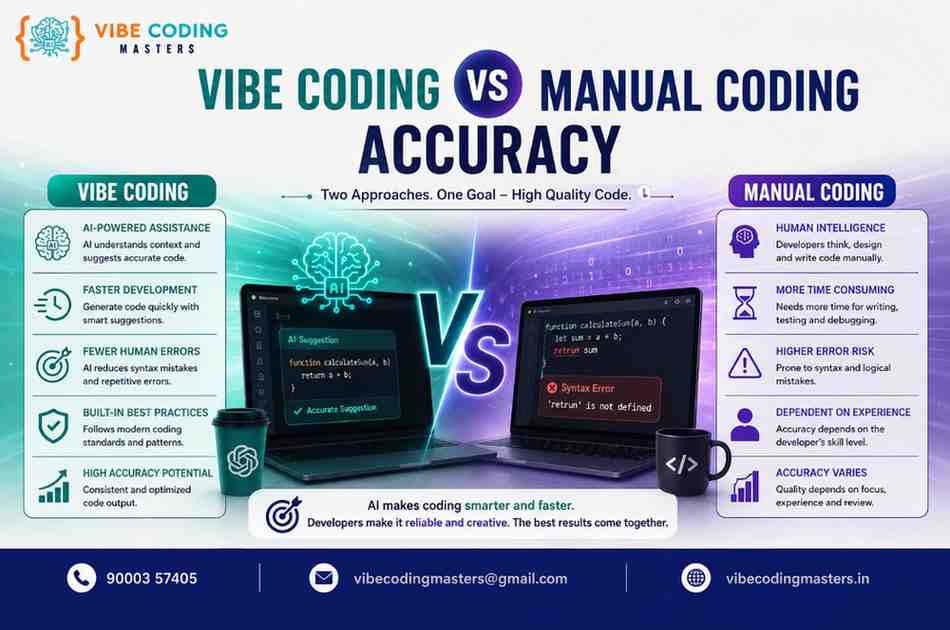
Vibe coding is a modern approach to software development where people explain their requirements in everyday language and use AI tools to create, update, debug, and sometimes test the resulting code. If you’re new to the term, our full breakdown of what vibe coding actually means covers it in more depth. “Manual coding” is the traditional practice: a developer writes, reads, reasons about, and debugs every line themselves, using an AI tool at most as a reference rather than the primary author.
AI coding assistants work by predicting likely code based on patterns learned from enormous amounts of existing code and documentation. They can scaffold an app, wire up a database, write a test suite, or refactor a messy function in seconds. Manual coding works differently — a developer forms a mental model of the problem, writes an implementation, runs it, reads error messages, and iterates until the behavior matches the requirement. Neither process is automatic; both depend heavily on the person directing them.
Coding accuracy matters because incorrect code doesn’t just fail visibly — it often fails silently, producing wrong calculations, subtle security holes, or data corruption that surfaces long after release. This is why the question of vibe coding vs manual coding accuracy has become one of the most debated topics in software development: it affects how fast teams can ship, how reliable that software is, how easy it is to debug later, and how exposed a codebase is to security risk.
Adoption data suggests this comparison isn’t hypothetical anymore. According to the 2025 Stack Overflow Developer Survey, roughly 84% of developers now use or plan to use AI tools in their workflow, and about half of professional developers use them daily. Yet the same survey found that more developers distrust AI tool accuracy than trust it. That gap between heavy use and low trust is the core tension this article addresses.
Vibe Coding vs Manual Coding Accuracy
What Is Vibe Coding?
With vibe coding, you can describe an objective such as “create a login page with email and password” or “add functionality to sort orders by date,” and an AI coding assistant can turn that instruction into working code. The developer’s role shifts from writing every line to prompting, reviewing, and steering.
AI assistants used in vibe coding typically help with
- Code generation — producing functions, components, or entire small applications from a description
- Debugging — suggesting fixes when given an error message or failing test
- Refactoring — cleaning up or restructuring existing code on request
- Documentation — writing comments, docstrings, or README files
- Testing — generating unit tests or sample test cases
- Project scaffolding — setting up folder structures, configuration files, and boilerplate
Vibe coding is fastest for small, well-scoped tasks and slowest to deliver reliable results when the request is vague, the codebase is large, or the logic is highly specific to a business’s internal rules. Most of this depends on the tool itself — see our overview of the AI coding platforms developers use most for vibe coding today.
What Is Manual Coding?
Manual coding is the traditional approach to software development: a person writes the implementation themselves, reasoning through the logic line by line. In traditional development, the programmer writes and controls most of the implementation directly. AI tools can still assist with code completion, suggestions, documentation, or troubleshooting, but the developer remains responsible for writing, reviewing, and fully understanding the codebase.
Manual coding typically involves
- Reading requirements and translating them into a technical design
- Writing the implementation directly
- Manually tracing through logic to check correctness
- Debugging by reproducing issues and inspecting the code path
- Writing and running tests to confirm behavior
- Maintaining and extending the code over time with full context of why it was built that way
Because the developer builds their own mental model of the system as they go, manual coding tends to produce code that its author deeply understands — which matters most when a system needs to be maintained, extended, or audited months or years later.
Vibe Coding vs Manual Coding Accuracy: Which Is More Accurate?
There’s no single answer to which is “more accurate” — accuracy in both approaches depends on several variables working together
- Task complexity — simple, repetitive tasks favor AI; intricate business logic favors human authorship
- Developer expertise — an experienced developer can catch AI mistakes that a beginner would miss
- Prompt quality — vague prompts produce vague or incorrect code; specific prompts produce better results
- AI model capability — newer, larger models tend to make fewer basic errors than older ones
- Code review — reviewed code (AI-written or human-written) is more accurate than unreviewed code
- Testing — both approaches benefit enormously from automated test coverage
- Requirements clarity — ambiguous requirements lead to wrong implementations regardless of who or what wrote the code
- Project architecture — well-structured codebases give AI tools better context to work from
- Security requirements — high-stakes systems need more human security review of AI output
- Human oversight — the single biggest factor in whether AI-generated code ends up accurate in production
In practice, neither vibe coding nor manual coding is automatically accurate. AI-generated code without review can look correct while hiding logic errors. Manually written code without testing can also ship with bugs. Accuracy comes from process — review, testing, and clear requirements — more than from which “wrote” the first draft. If you want the broader picture beyond just accuracy — speed, learning curve, and long-term skill-building — see how vibe coding compares to traditional coding overall.
How Accurate Is Vibe Coding?
AI-generated code accuracy varies sharply by task type
- Simple websites and landing pages — generally reliable; low logic complexity means fewer places for errors to hide
- CRUD applications — usually solid for standard create/read/update/delete patterns, since these are heavily represented in training data
- APIs — often accurate for common patterns (REST endpoints, standard authentication flows) but can misuse less common libraries — tools like GitHub Copilot are commonly used for exactly this kind of scaffolding
- Frontend interfaces — strong for layout and standard components, weaker for complex state management
- Database operations — a common weak point; AI tools can generate queries that run but return subtly wrong data
- Authentication — high risk area; AI-generated auth code can contain security gaps that aren’t obvious without expert review
- Complex business logic — accuracy drops significantly here, since this logic is unique to each company and rarely appears in training data
- Large enterprise systems — AI struggles without extensive context about the existing architecture
- Security-sensitive applications — requires mandatory human security review; AI output alone is not sufficient
How Accurate Is Manual Coding?
Manual coding’s accuracy depends heavily on the individual developer and the process around them
- Developer expertise — more experienced developers write more accurate code on the first attempt and catch their own mistakes faster
- Understanding of requirements — misunderstood requirements lead to “correct” code that solves the wrong problem
- Architecture decisions — good upfront design prevents entire categories of bugs
- Debugging — manual coders typically have a deeper mental model, which speeds up root-cause analysis
- Testing — manual code is only as accurate as its test coverage, same as AI code
- Human errors — typos, off-by-one mistakes, and overlooked edge cases are common even among experienced developers
- Code review — a second set of eyes catches mistakes the original author missed
- Long-term maintainability — manually written code, when well-documented, tends to be easier for the original author (and sometimes others) to maintain accurately over time
Manual coding isn’t inherently more accurate — it’s simply a different source of errors. Where AI tends to hallucinate APIs or misjudge business context, humans tend to make fatigue-driven mistakes, typos, and overlook edge cases.
Vibe Coding vs Manual Coding: Accuracy Comparison
Factor | Vibe Coding | Manual Coding |
Code Correctness | High for simple/common patterns, lower for complex logic | Depends on developer skill and testing rigor |
Development Speed | Fast for boilerplate and standard features | Slower, especially for repetitive tasks |
Debugging | Faster with AI suggestions; risk of “almost right” fixes | Slower but grounded in full system understanding |
Testing | Can generate tests quickly; coverage quality varies | Manually designed tests often target real edge cases |
Security | Requires mandatory human review; can miss vulnerabilities | Depends on developer security knowledge |
Complex Logic | Weaker; unique business rules are hard for AI to infer | Stronger; developer understands full context |
Maintainability | Can vary; may need cleanup for long-term use | Generally consistent if documented well |
Scalability | Good for prototypes; enterprise scale needs review | Strong when architecture is planned deliberately |
Human Error | Lower typo rate, but risk of hallucinated logic | Higher risk of typos and oversight under fatigue |
AI Hallucinations | Possible — invented APIs, outdated methods | Not applicable |
Code Review | Still essential, arguably more so | Standard best practice |
Learning Curve | Low to start, but risks shallow understanding | Higher upfront, builds deeper skill |
Productivity | High for prototyping and repetitive work | Steady, more predictable for complex systems |
Best Use Cases | Prototypes, MVPs, boilerplate, CRUD apps | Complex systems, security-critical apps, core architecture |
Factors That Affect Vibe Coding Accuracy
Several variables directly shape how accurate AI-generated code turns out to be:
- Prompt engineering — specific, detailed prompts produce more accurate output than vague ones
- Context provided to the AI — sharing relevant existing code, schemas, and conventions improves results
- Project documentation — well-documented codebases give AI more accurate grounding
- Existing codebase quality — AI tends to mirror the patterns already present, good or bad
- AI model capability — model choice and version affect reasoning quality and error rate
- Developer knowledge — a developer who understands the domain can catch AI mistakes immediately
- Testing strategy — automated tests catch errors that manual review alone would miss
- Error handling — explicitly asking for robust error handling improves reliability
- Code review — a mandatory human review step remains one of the strongest accuracy safeguards
- Security validation — dedicated security review is essential, especially for auth and data handling
Common Accuracy Problems in Vibe Coding
Developers frequently report these issues with AI-generated code
- Hallucinated APIs — the AI references functions or libraries that don’t actually exist
- Incorrect library usage — real methods used with wrong parameters or outdated syntax
- Outdated code — patterns from older library versions that no longer apply
- Logic errors — code that runs without crashing but produces the wrong result
- Security vulnerabilities — missing input validation, weak authentication handling, exposed secrets
- Incorrect assumptions — the AI fills gaps in an unclear prompt with guesses that don’t match intent
- Poor error handling — missing edge cases or silent failures
- Inconsistent architecture — generated code that doesn’t match existing project patterns
- Duplicate code — repeated logic instead of reusable functions
- Hidden bugs — subtle issues that pass a quick visual check but fail under real usage
- Incorrect database queries — queries that execute but return wrong or incomplete data
- Over-engineered solutions — unnecessarily complex code for a simple problem
Recent developer survey data illustrates the scale of this: Stack Overflow’s 2025 survey analysis found that the top frustration, reported by 45% of respondents, is AI output that seems close to correct but isn’t, which slows down debugging. That same survey found 66% of developers now spend extra time fixing this kind of near-miss AI-generated code. Many of these issues trace back to the input rather than the model — see our guide on writing better prompts for fewer of these near-miss results.
Common Accuracy Problems in Manual Coding
Manual coding has its own well-documented failure modes
- Human errors — simple mistakes made under time pressure or fatigue
- Typographical mistakes — a misspelled variable or operator that breaks logic
- Incorrect assumptions — misunderstanding a requirement and building the wrong thing correctly
- Logic bugs — flawed reasoning that produces consistently wrong output
- Poor architecture — decisions early in a project that cause accuracy problems later
- Incomplete testing — shipping code without covering key edge cases
- Security mistakes — overlooking validation, encryption, or access control
- Lack of documentation — undocumented decisions that lead future maintainers to introduce new bugs
- Developer fatigue — accuracy drops measurably during long sessions or under deadline pressure
Vibe Coding vs Manual Coding for Different Projects
Project Type | Better Fit |
Websites / landing pages | Vibe coding — low complexity, fast turnaround |
Mobile applications | Hybrid — AI for UI scaffolding, manual for core logic |
CRUD applications | Vibe coding — well-represented pattern |
REST APIs | Hybrid — AI for boilerplate, manual review for security |
SaaS products | Hybrid — manual for core business logic and architecture |
E-commerce applications | Hybrid — manual review essential for payments and inventory accuracy |
Data-driven applications | Manual-heavy — data integrity requires careful logic |
Enterprise software | Manual-heavy — complexity and integration needs exceed AI’s reliable range |
Security-sensitive applications | Manual-heavy — mandatory human security review |
AI applications | Hybrid — AI accelerates development, manual expertise tunes and validates models |
Is Vibe Coding Reliable for Production Applications?
Vibe coding can be appropriate for production use, but only inside a disciplined process. On its own, AI-generated code is a first draft, not a finished product. To be production-ready, it typically needs
- Automated testing — unit and integration tests that verify actual behavior, not just that the code runs
- Unit testing — isolating individual functions to confirm correctness
- Integration testing — confirming components work together correctly
- Code review — a human confirming the logic matches requirements
- Security testing — checking for vulnerabilities the AI may have introduced
- Performance testing — confirming the code performs acceptably at real scale
- Deployment validation — staged rollouts rather than direct-to-production deployment
- Monitoring — tracking behavior after release to catch issues testing missed
Skipping these steps is where most “vibe coding went wrong” stories originate — not from the AI itself, but from treating unreviewed AI output as finished software.
Can Vibe Coding Replace Manual Coding?
Not entirely, at least not with current tools. AI-assisted development can dramatically speed up implementation, but several things still depend on human judgment
- Programming fundamentals — understanding what the generated code actually does
- Software architecture — deciding how systems should be structured, which AI can suggest but shouldn’t decide alone
- Problem solving — translating an ambiguous business need into a precise technical requirement
- Debugging — especially for issues that span multiple systems or have no obvious error message
- Testing — deciding what actually needs to be tested and why
- Security — reasoning about threat models, not just following common patterns
- System design — planning for scale, cost, and maintainability over years, not just the current sprint
- Human decision-making — prioritizing trade-offs that depend on business context an AI doesn’t have
Vibe coding is best understood as a powerful accelerant for implementation, not a replacement for engineering judgment.
Vibe Coding vs Manual Coding: Developer Productivity
AI-assisted coding can meaningfully speed up certain tasks — boilerplate, prototypes, repetitive CRUD work, and documentation. But the productivity picture is more nuanced than “AI makes everyone faster.” A controlled study widely referenced in 2025–2026 industry reporting found that experienced developers who expected AI to speed them up by roughly a quarter instead took about 19% longer to finish tasks once review, debugging, and fixing time were counted — even though those same developers still felt they had worked faster.
That doesn’t mean AI never helps productivity; for simpler, well-scoped tasks it clearly does. It does mean that review time is a real cost that has to be counted, not an afterthought. This lines up with findings from Google’s DORA 2025 State of AI-assisted Software Development report, which found that AI tends to amplify a team’s existing strengths and weaknesses rather than fixing process problems on its own. Teams that treat AI output as “done” rather than “drafted” tend to see productivity gains erode into rework later.
Vibe Coding vs Manual Coding for Beginners
For beginners, vibe coding offers real advantages and real risks
Advantages:
- Faster experimentation — beginners can see working results quickly, which builds motivation
- Learning opportunities — reading and questioning AI-generated code can accelerate understanding of new patterns
Risks:
- Dependency on AI — leaning on generated code without understanding it can stall fundamental skill growth
- Weaker debugging skills — if a beginner never manually traces through broken code, they never build that muscle
- Gaps in fundamentals — accepting AI output without understanding why it works can leave conceptual holes that surface later
The healthiest approach for beginners is usually to use AI as a tutor that explains its output, not just a generator that produces it. A good starting point is working through a few vibe coding projects for beginners that are small enough to fully understand end to end.
Vibe Coding vs Manual Coding for Experienced Developers
Experienced developers tend to get the most reliable results from AI tools because they can evaluate output critically. For them, AI works best as a productivity assistant while the developer retains control over
- Architecture and system design
- Security-critical decisions
- Code review standards
- Technical trade-offs specific to their product
- Final responsibility for what ships to production
Experienced developers are also better positioned to notice the subtle “almost right” errors that make AI-generated code risky for less experienced teams. If you’re already working professionally and want to add these skills without starting from scratch, our course for working professionals is built specifically for that.
How to Improve Accuracy When Vibe Coding
- Write clear, specific prompts instead of vague requests
- Provide sufficient project context — existing code, schemas, conventions
- Break large tasks into smaller, reviewable components
- Ask the AI to explain generated code, not just produce it
- Review every change that affects logic, data, or security
- Run automated tests on all AI-generated code before merging
- Perform dedicated security checks on sensitive code paths
- Validate database operations against real data, not just sample data
- Use Git so every change can be reviewed and reverted
- Never deploy untested AI-generated code directly to production
These steps work best as part of a repeatable process rather than one-off habits — see our breakdown of a structured vibe coding workflow for how to apply them consistently on real projects.
Best Practices for Combining Vibe Coding and Manual Coding
A hybrid approach — using AI for speed and humans for judgment — tends to produce the best balance of speed and accuracy.
Where AI adds the most value:
- Boilerplate code
- Code suggestions and autocomplete
- Documentation
- Test generation
- Refactoring ideas
- Debugging assistance
Where developers should stay in control:
- Architecture decisions
- Requirements interpretation
- Security decisions
- Code review
- Testing strategy
- Business logic validation
- Production deployment decisions
This division isn’t about mistrust of AI — it’s about assigning each task to whichever process handles it most reliably.
Vibe Coding Accuracy vs Manual Coding Accuracy: Final Verdict
Vibe coding can be highly accurate for common, well-scoped tasks: standard CRUD operations, boilerplate, prototypes, and code patterns that are heavily represented in what the AI model has learned from. Manual expertise and human review matter most for complex business logic, security-sensitive systems, and situations where the requirements are ambiguous or unique to one organization.
Neither approach wins outright. The clearest pattern in the vibe coding vs manual coding accuracy debate is that accuracy comes from process — clear requirements, testing, and human review — applied consistently, regardless of who or what wrote the first draft.
Why the Future of Coding Is Likely to Be Hybrid
The direction of the industry points toward collaboration rather than replacement. Developers are increasingly expected to act as
- AI collaborators who direct and refine generated code
- Code reviewers who catch what automated checks miss
- System designers who make architecture decisions AI can’t make alone
- Prompt engineers who know how to get accurate output from AI tools
- Technical decision-makers who weigh trade-offs specific to their product
- Software architects who plan for scale, security, and maintainability
Adoption trends support this shift: a 2026 Sonar State of Code developer survey found that 61% of developers agree AI often produces code that looks correct on the surface but isn’t actually reliable, which is precisely why the reviewer and architect roles are becoming more important, not less, as AI use grows.
Career Opportunities in the AI-Assisted Coding Era
Developers who combine strong fundamentals with AI-assisted development skills are well positioned for the current job market. Growing areas include vibe coding jobs and AI-assisted development jobs that specifically value people who can direct, review, and correct AI output; AI coding careers built around prompt engineering and AI programming skills; and traditional software developer careers that now expect fluency in full stack development with AI tools as standard practice. For a closer look at where these roles are heading and what they pay, see our guides to career paths after learning vibe coding and expected salaries after learning vibe coding — and once you’re ready to interview, it helps to prepare with common vibe coding interview questions. A growing number of vibe coding courses and AI-focused bootcamps reflect this shift, but employers still consistently value candidates who understand programming fundamentals first and AI tools second — a point echoed in JetBrains’ State of Developer Ecosystem 2025 report, which found developers increasingly want to stay in control of complex, creative work even as they delegate routine tasks to AI.
Key Takeaways
- Accuracy in the vibe coding vs manual coding debate depends on task complexity, developer expertise, and process — not on which approach is used alone.
- AI-generated code is generally reliable for simple, common patterns like CRUD apps and boilerplate, but less reliable for complex business logic and security-critical systems.
- Manual coding avoids AI-specific errors like hallucinated APIs, but introduces its own risks like human error and fatigue-driven mistakes.
- Testing, code review, and clear requirements matter more to final accuracy than whether the first draft came from a human or an AI.
- A hybrid workflow — AI for speed, humans for judgment — currently produces the most reliable results for most real-world projects.
Conclusion
The vibe coding vs manual coding accuracy question doesn’t have a one-size-fits-all winner. AI-generated code can be impressively accurate for simple, well-defined, and common tasks, while manual coding remains stronger for complex, business-specific logic and security-critical systems. Human review remains essential either way — accuracy comes far more from testing, review, and clear requirements than from which method produced the first draft.
.
The most practical path forward for most developers is to learn both: strong programming fundamentals to evaluate and correct AI output, and fluency with AI-assisted development to work efficiently at modern speed. Start by practicing vibe coding on a small project, review every line it produces, and pair it with the core coding skills that let you catch what the AI gets wrong — that combination is what turns speed into real accuracy. If you’d rather learn this hands-on with structured guidance, explore our vibe coding certification program at Vibe Coding Masters.
Sources / References
- Stack Overflow 2025 Developer Survey
- Stack Overflow Blog: “Developers remain willing but reluctant to use AI” (December 2025)
- DORA 2025 State of AI-Assisted Software Development Report (Google Cloud)
- Sonar State of Code Developer Survey Report 2026
- JetBrains State of Developer Ecosystem 2025
- GitHub Copilot (official product page)
FAQ
Is vibe coding more accurate than manual coding?
Not universally. Vibe coding is often faster and reliable for simple, common tasks, but manual coding tends to be more accurate for complex, business-specific logic where human understanding of context matters most.Can vibe coding produce error-free code?
No approach produces guaranteed error-free code. AI-generated code can contain hallucinated APIs, logic errors, or security gaps, which is why testing and review remain essential regardless of who wrote the code.Is manual coding better than AI coding?
Manual coding isn’t universally better — it’s a different set of trade-offs. It tends to be more accurate for complex logic and architecture, but slower for repetitive or well-defined tasks that AI handles efficiently.Can AI-generated code be trusted?
It can be trusted after review and testing, not by default. Survey data shows a large share of developers actively distrust unreviewed AI output, which is why human validation remains a standard step.Why does vibe coding sometimes produce bugs?
AI models predict likely code patterns rather than reasoning through a system’s full context, which can lead to hallucinated functions, outdated syntax, or logic that doesn’t match a project’s specific requirements.How can developers improve vibe coding accuracy?
Writing clear, specific prompts, providing relevant project context, reviewing generated code carefully, and running automated tests are the most effective ways to improve AI-generated code accuracy.Is vibe coding suitable for professional software development?
Yes, when paired with proper testing, code review, and security validation. It becomes risky mainly when AI output is deployed without that review process.Will vibe coding replace programmers?
Unlikely in the near term. AI tools accelerate implementation but still depend on human judgment for architecture, security, debugging complex issues, and interpreting ambiguous requirements.Should beginners learn coding before vibe coding?
Learning core programming fundamentals first helps beginners evaluate and understand AI-generated code rather than accepting it without knowing whether it’s correct.What is the best approach: vibe coding, manual coding, or both?
A hybrid approach generally performs best — using AI to accelerate routine work while relying on manual coding, review, and testing for complex logic, security, and architecture decisions.