Vibe Coding: The Future of Programming
Vibe coding is an AI-assisted programming approach where developers describe intent in natural language and AI tools generate, refine, and debug code. It blends prompt engineering with traditional development skills, speeding up prototyping, lowering entry barriers, and reshaping how software gets built across industries worldwide.
★★★★★
4.9/5 rated by 1329+ students · Google Verified
Table of Contents
Introduction
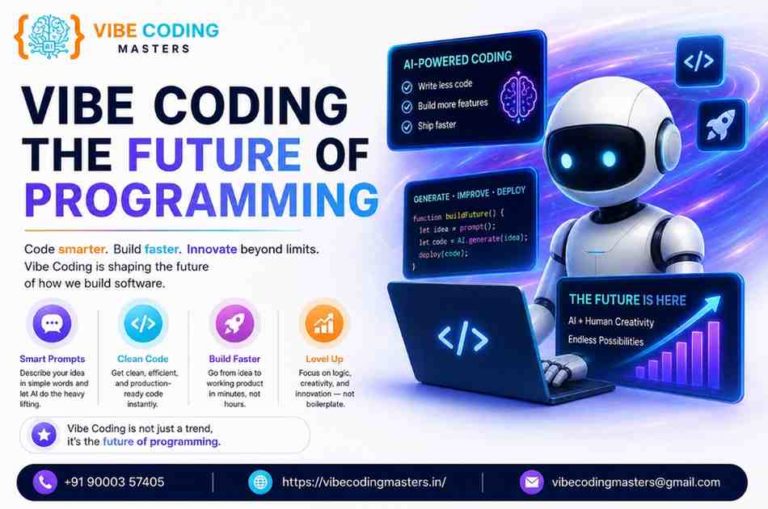
The world of software development is undergoing one of its most dramatic changes in decades. For most of programming’s history, writing software meant typing precise syntax, memorizing language rules, and manually wiring together every function. That is changing fast. A new approach called vibe coding is emerging, one where developers describe what they want in plain language and let AI models translate that intent into working code.
This shift isn’t a passing trend. It reflects a deeper transformation in how humans and machines collaborate to build software. Large language models have gotten good enough at understanding context, generating functional code, and even debugging their own output that many developers now spend more time reviewing and refining than typing from scratch. Businesses are noticing too, since faster prototyping and lower development costs directly affect their bottom line.
In this guide, we’ll break down what vibe coding actually means, how it works, the tools powering it, the skills you need to succeed with it, and why it is increasingly seen as the future of programming. Whether you are a seasoned developer curious about AI-assisted workflows or a complete beginner wondering if you can skip years of syntax memorization, this article will give you a grounded, practical understanding of where things stand and where they’re headed.
Vibe Coding The Future of Programming
What Is Vibe Coding?
Vibe coding is a style of software development where a programmer communicates their intent to an AI system in natural language, and the AI generates, edits, or debugs the corresponding code. Instead of writing every line by hand, the developer describes the “vibe” of what they want to build — the features, the behavior, the look and feel — and iterates on the AI’s output until it matches their vision.
The term captures something real about how many developers now work with tools like Cursor AI, GitHub Copilot, Claude AI, and Replit AI. Rather than starting from a blank file and building logic line by line, a developer might type a prompt describing a login form, a data pipeline, or an entire application feature, then review, test, and adjust what the AI produces.
Vibe coding doesn’t eliminate the need for programming knowledge. It changes where that knowledge gets applied. Instead of spending most of your time on syntax, you spend more time on architecture decisions, requirements, testing, and quality control — while the AI handles a large share of the repetitive typing and boilerplate.
It’s worth being clear about what vibe coding is not. It isn’t a no-code tool that hides all technical complexity behind drag-and-drop blocks, and it isn’t a magic wand that produces production-ready software with zero oversight. It sits in a middle zone: AI does the heavy lifting on code generation, but a human developer still needs to understand the output well enough to catch mistakes, security issues, or logic errors.
Why Vibe Coding Represents the Future of Software Development
There are a few forces converging to make vibe coding more than a passing trend.
Faster software development. Teams that once spent days scaffolding a new feature can now generate a working first draft in minutes. That doesn’t remove the need for refinement, but it collapses the time between idea and testable prototype.
Improved productivity. Developers report spending less time on repetitive boilerplate — setting up routes, writing standard CRUD operations, or formatting data structures — and more time on the parts of a project that actually require human judgment.
Reduced development costs. Faster iteration cycles mean fewer engineering hours per feature, which matters enormously for startups and lean teams trying to ship products with limited budgets.
Rapid prototyping. Vibe coding is particularly powerful for testing ideas quickly. A founder or product manager can go from concept to clickable prototype without waiting on a full engineering sprint.
Better collaboration. Natural language prompts create a shared vocabulary between technical and non-technical team members. A designer or product owner can describe what they want in plain terms and see it reflected in actual code, closing the communication gap that often slows projects down.
AI-human partnership. The strongest results come from treating AI as a capable collaborator rather than a replacement. Developers who combine their own architectural judgment with an AI’s speed at generating code consistently outperform either working alone.
Impact on software engineering careers. Rather than eliminating developer jobs, vibe coding is shifting what “being a good developer” means. Skills like code review, prompt engineering, system design, and debugging AI-generated logic are becoming just as valuable as raw coding speed.
How Vibe Coding Works
At a practical level, vibe coding follows a loop
- Describe intent. The developer writes a prompt describing the feature, function, or application they want, often referencing existing code or design context.
- AI generates code. A large language model like the one behind GitHub Copilot, Cursor AI, or Claude AI produces code based on that prompt, drawing on patterns learned from vast amounts of training data.
- Review and test. The developer reads through the generated code, runs it, and checks whether it behaves as expected.
- Refine through iteration. If something is off, the developer adjusts the prompt or edits the code directly, then repeats the cycle.
- Validate and ship. Once the code passes testing and review, it gets committed through normal version control practices and deployed like any other software.
This loop relies heavily on large language models (LLMs) — AI systems trained on massive datasets of text and code that let them predict and generate contextually appropriate output. The quality of results depends a lot on prompt engineering, meaning how clearly and specifically a developer communicates what they need. Vague prompts tend to produce generic or incorrect code, while detailed prompts that specify constraints, edge cases, and desired structure produce far more usable results.
Benefits of Vibe Coding for Developers
- Speed: Generate boilerplate, utility functions, and common patterns in seconds instead of minutes or hours.
- Lower barrier to entry: Newcomers can build functional projects earlier in their learning journey, which keeps motivation high.
- Faster experimentation: Testing multiple approaches to a problem becomes cheap when generating alternative implementations takes seconds.
- Reduced cognitive load: Developers can focus mental energy on architecture and logic rather than remembering exact syntax for every function.
- Better documentation habits: Because prompts themselves act as a form of specification, teams often end up with clearer records of intent behind each piece of code.
- Accessibility for non-traditional developers: Designers, product managers, and domain experts with limited coding backgrounds can contribute working prototypes.
Traditional Programming vs Vibe Coding
Aspect | Traditional Programming | Vibe Coding |
Primary input | Manually written syntax | Natural language prompts refined into code |
Speed of first draft | Slower, built line by line | Much faster initial output |
Skill emphasis | Syntax mastery, manual debugging | Prompt engineering, review, and system design |
Learning curve | Steeper for beginners | Gentler entry, steeper mastery curve later |
Error handling | Manual tracing and fixing | AI-assisted debugging plus human validation |
Best suited for | Complex, highly customized systems | Prototyping, common patterns, rapid iteration |
Human role | Writes and reviews all code | Directs, reviews, and refines AI output |
AI Tools Used in Vibe Coding
A growing ecosystem of tools supports vibe coding workflows, each with a slightly different focus.
GitHub Copilot integrates directly into code editors and suggests completions, functions, and even entire files based on context, making it one of the most widely adopted AI pair-programming tools. You can see its current features and pricing on the official GitHub Copilot page.
Cursor AI is a code editor built from the ground up around AI assistance, letting developers chat with an AI about their entire codebase and apply suggested changes directly. Details on its features are available at cursor.com.
ChatGPT is often used for brainstorming logic, explaining unfamiliar code, and generating snippets that developers then paste into their projects, and can be accessed directly through OpenAI’s official ChatGPT page.
Claude AI is known for handling longer, more complex codebases and multi-step reasoning tasks, which makes it useful for larger refactors or architectural discussions. Learn more directly from Anthropic’s official Claude page.
Windsurf offers an agentic coding environment designed to handle multi-file changes and more autonomous task completion.
To build hands-on fluency with these tools, many learners start with a frontend vibe coding course in Hyderabad before moving to full-stack work.
Replit AI combines a browser-based development environment with built-in AI assistance, popular for quick prototyping and educational use.
Lovable AI focuses on turning natural language descriptions into full web applications, often used by non-technical founders to build MVPs.
Bolt.new is a browser-based tool that generates and deploys full-stack applications directly from prompts, useful for extremely fast prototyping.
For the server-side half of the workflow, a backend vibe coding course in Hyderabad covers Node.js, APIs, and databases in depth.
Alongside these AI-specific tools, version control with Git and GitHub remains essential — the official Git documentation is a reliable reference for commands and workflows. AI-generated code still needs to be tracked, branched, reviewed through pull requests, and merged responsibly, just like any other code.
Skills Needed to Become a Vibe Coding Developer
- Foundational programming literacy: understanding how code executes, even if you’re not writing every line yourself.
- Prompt engineering: the ability to write clear, specific instructions that guide AI tools toward accurate output.
- Testing AI-generated code: knowing how to write and run tests that catch logic errors or edge cases the AI might miss.
- Debugging and optimization: identifying inefficient or incorrect code and knowing how to fix or improve it.
- Human review and code validation: treating every AI suggestion with healthy skepticism until it’s verified.
- System design thinking: understanding how individual pieces fit into a larger architecture, since AI tools are better at generating components than designing entire systems.
- Version control proficiency: managing changes responsibly through Git and GitHub, especially when iterating quickly with AI.
- Security awareness: recognizing common vulnerabilities that AI-generated code can introduce if left unchecked.
If you want a guided path instead of self-teaching, a structured vibe coding syllabus can help you cover these skills in the right order.
Real-World Applications of Vibe Coding
Vibe coding shows up across a wide range of practical use cases: building minimum viable products for startups, generating internal tools and dashboards for business teams, automating repetitive scripts for data processing, creating landing pages and marketing sites quickly, prototyping mobile app features before committing engineering resources, and helping students learn programming concepts through guided, interactive generation.
You can browse real vibe coding project examples built by learners to see these applications in action.
Industries Adopting Vibe Coding
- Startups and SaaS companies use it to move from idea to MVP faster than traditional development cycles allow.
- E-commerce businesses rely on it to quickly build and customize storefronts, checkout flows, and integrations.
- Fintech and banking teams use AI-assisted coding for internal tools and rapid compliance-related prototyping, while keeping strict human review for production systems.
- Healthcare technology companies use it for administrative tools and patient-facing applications, again with heavy validation layers.
- Education platforms use vibe coding both as a teaching tool and to build their own interactive learning products.
- Media and marketing agencies use it to spin up campaign microsites and interactive content quickly.
Career Opportunities in Vibe Coding
As AI-assisted development becomes standard practice, new roles and responsibilities are emerging around it. Titles like AI-assisted software engineer, prompt engineer, AI product developer, and vibe coding architect are appearing in job postings, particularly at startups and product-focused companies. Traditional roles like full-stack developer and software engineer increasingly list AI tool fluency as an expected skill rather than a bonus.
Freelancers and independent developers are also finding opportunities building rapid prototypes for clients, since the speed of AI-assisted development lets them take on more projects without sacrificing quality on the pieces that matter most.
To see how these roles map to real job outcomes, check out this breakdown of careers after vibe coding.
Vibe Coding Salary Trends
Compensation for developers skilled in AI-assisted programming tends to track closely with general software engineering salaries, often with a premium for demonstrated AI tool fluency. Exact figures vary widely by country, company size, and experience, but the general trend looks like this
Experience Level | Typical Focus | Approximate Salary Range (USD, Global Estimate) |
Beginner (0–2 Years) | Learning AI tools, building small projects | $35,000 – $60,000 |
Mid-Level (3–5 Years) | Feature development, prompt-driven workflows | $65,000 – $95,000 |
Senior (6–10 Years) | Architecture, code review, AI workflow design | $100,000 – $150,000 |
AI/Vibe Coding Architect (10+ Years) | System design, AI integration strategy, team leadership | $150,000 – $220,000+ |
These figures are directional estimates meant to illustrate general trends rather than precise benchmarks, since actual compensation depends heavily on location, company stage, and specialization. For a more detailed, India-specific breakdown, see our guide on salary after learning vibe coding.
Challenges and Limitations of Vibe Coding
Vibe coding isn’t without real drawbacks. AI-generated code can look correct while containing subtle logic errors, especially in complex or unusual edge cases. Security vulnerabilities can slip through if developers don’t review generated code carefully, since AI models sometimes reproduce insecure patterns found in their training data. Over-reliance on AI can also erode a developer’s own problem-solving skills over time if they stop engaging deeply with the logic behind the code.
There are also limits to how well AI handles large, deeply interconnected codebases, where understanding the full context of a change requires more than what fits in a single prompt. Debugging AI-generated code you didn’t write yourself can sometimes take longer than writing it from scratch would have, particularly when the AI’s approach diverges significantly from how a human would have structured the solution. Finally, licensing and intellectual property questions around AI-generated code are still evolving, and teams need to stay informed about the terms of the tools they use.
Best Practices for AI-Assisted Programming
- Write specific, detailed prompts rather than vague requests.
- Always read and understand generated code before committing it.
- Write tests for AI-generated functions just as rigorously as for hand-written ones.
- Use version control disciplined branching and pull requests, even for small AI-assisted changes.
- Review AI output for security issues, especially around authentication, data handling, and input validation.
- Treat AI as a collaborator that speeds up drafting, not a replacement for architectural decision-making.
- Keep learning core programming concepts, since understanding what the AI is doing makes you far better at directing it.
- Document why decisions were made, not just what the code does, since AI-generated commits can lack context otherwise.
If you’re balancing this with a full-time job, our vibe coding course for working professionals is built around flexible timing. Pairing these skills with a recognized vibe coding certification strengthens your resume further.
Future Scope of Vibe Coding
Looking ahead, AI coding tools are likely to become more agentic, meaning they’ll handle longer multi-step tasks with less hand-holding — planning out an entire feature, writing the code, testing it, and flagging issues before a human even reviews it. Integration between AI coding assistants and other parts of the development lifecycle, like deployment pipelines and monitoring tools, is also likely to deepen.
Rather than replacing developers, this trajectory points toward a future where the developer’s role shifts further toward direction, review, and quality assurance, with AI handling more of the initial implementation. Companies that build strong practices around reviewing and validating AI-generated code now will be well positioned as these tools continue to mature.
How Beginners Can Start Learning Vibe Coding
Not sure if you meet the starting point? Here’s what the eligibility for a vibe coding course actually looks like.
- Learn programming fundamentals first. Even a basic grasp of variables, functions, and control flow makes it much easier to evaluate whether AI-generated code is correct.
- Pick one AI coding tool and go deep. Whether it’s GitHub Copilot, Cursor AI, or Replit AI, spend real time learning how it responds to different kinds of prompts.
- Practice prompt engineering deliberately. Try writing the same request three different ways and compare the results to build intuition for what works.
- Build small, complete projects. A simple to-do app or personal website teaches more than reading tutorials passively.
- Learn to read code critically. Get comfortable tracing through AI-generated logic line by line until you understand it fully.
- Use version control from day one. Git habits formed early will make collaborative AI-assisted work much smoother later.
- Join developer communities. Forums and communities focused on AI-assisted development are a great source of real-world prompt patterns and troubleshooting tips.
Learning Roadmap for Vibe Coding
Stage | Skills to Learn | Recommended AI Tools | Suggested Projects | Expected Outcome |
Beginner | Programming basics, simple prompting | ChatGPT, Replit AI | To-do list app, personal portfolio site | Comfort building small functional projects |
Intermediate | Prompt engineering, debugging AI output | GitHub Copilot, Cursor AI | Full-stack CRUD app, API integration | Ability to build and ship small products independently |
Advanced | System design, multi-file AI workflows | Windsurf, Claude AI | SaaS MVP, automation tool | Capability to lead small AI-assisted development projects |
Expert | Architecture, team workflow design | Bolt.new, Lovable AI, enterprise AI tooling | Production-grade platform, internal AI dev tooling | Readiness for senior or architect-level AI development roles |
Vibe Coding vs No-Code and Low-Code Platforms
It helps to distinguish vibe coding from adjacent approaches that sometimes get lumped together.
Vibe coding vs no-code development: No-code platforms let non-technical users build applications entirely through visual interfaces, with no code exposed at all. Vibe coding still produces real, readable code that a developer can inspect, modify, and extend, giving far more flexibility for custom logic.
Vibe coding vs low-code platforms: Low-code tools combine visual building blocks with limited custom scripting. Vibe coding leans more heavily on AI-generated full code rather than pre-built visual components, offering more customization at the cost of requiring more technical oversight.
Vibe coding vs manual coding: Manual coding gives a developer complete control over every line but takes longer to produce a working result. Vibe coding trades some of that granular control for significant speed gains, particularly in the early stages of building something.
Market Trends and Statistics
AI adoption in software development has accelerated sharply over the past few years, with major tech companies reporting that a substantial share of new code is now written with AI assistance in some form. Developer productivity studies consistently show measurable gains in task completion speed when AI coding assistants are used for well-defined tasks like writing tests, generating boilerplate, and refactoring.
The market for AI coding assistants itself has grown quickly, with new entrants launching regularly alongside established players like GitHub Copilot. Demand for professionals who can effectively direct AI tools, rather than simply write code by hand, is rising in both global and Indian technology job markets, reflecting a broader shift in what companies look for when hiring developers.
Hyderabad in particular has emerged as one of India’s strongest hubs for this shift. With a dense concentration of IT parks, product companies, and service giants like Microsoft, Amazon, Accenture, Cognizant, and TCS operating out of the city, local employers are actively hiring developers who can work alongside AI tools rather than compete with them. That local demand is a big part of why structured, project-based training has become popular here — learners who complete a Vibe Coding Course in Hyderabad graduate with exactly the hands-on, AI-assisted development skills the city’s job market is currently prioritizing.
Key Takeaways
- Vibe coding blends natural language prompting with traditional programming skills to speed up software development.
- It doesn’t eliminate the need for coding knowledge, it shifts emphasis toward review, testing, and prompt engineering.
- Tools like GitHub Copilot, Cursor AI, Claude AI, and Bolt.new each serve slightly different roles in an AI-assisted workflow.
- Careers in this space reward a mix of core programming fundamentals and fluency with AI tools.
- The future points toward more agentic AI assistance, with developers focusing increasingly on direction and quality assurance.
Conclusion
Vibe coding represents a genuine shift in how software gets built, not a temporary trend. By combining natural language prompting with the judgment and oversight only a human developer can provide, it’s making software development faster, more accessible, and more collaborative than it’s ever been. The developers and teams who invest in learning this hybrid skill set now, understanding both the fundamentals of programming and how to work effectively with AI tools, will be well positioned for where the industry is heading.
If you’re just getting started, pick one AI coding tool, build something small, and get comfortable with the loop of prompting, reviewing, and refining. That hands-on practice is the fastest way to understand why so many developers believe vibe coding is the future of programming.
If you’d rather learn this hands-on with expert guidance and real placement support, Vibe Coding Masters offers a dedicated Vibe Coding Course in Hyderabad covering everything from fundamentals to full-stack, AI-assisted projects — with 100% placement assistance to help you turn these skills into a job.
For interview prep, pair this FAQ with our full list of vibe coding interview questions.
FAQ
- What is vibe coding in simple terms?
Vibe coding means describing what you want to build in plain language and letting an AI tool generate the code, which you then review, test, and refine.
- Do I still need to know how to code to use vibe coding?
Yes. Understanding programming fundamentals helps you evaluate, debug, and improve AI-generated code, even if the AI writes most of the initial draft.
- Which AI tools are best for vibe coding beginners?
Tools like ChatGPT, Replit AI, and GitHub Copilot are commonly recommended for beginners because of their accessible interfaces and strong community support.
- Is vibe coding the same as no-code development?
No. No-code platforms hide code entirely behind visual interfaces, while vibe coding generates real, editable code that a developer can inspect and customize.
- Can vibe coding replace software developers?
Most evidence suggests it changes the developer’s role rather than replacing it, shifting emphasis toward direction, review, and system design instead of manual line-by-line coding.
- Is vibe coding suitable for building production applications?
It can be, provided the generated code goes through proper testing, security review, and human validation before deployment, just like any other code.
- What skills should I prioritize to become a vibe coding developer?
Focus on programming fundamentals, prompt engineering, debugging, testing, and version control, since these skills let you get the most out of AI coding tools.
- How is vibe coding different from traditional programming?
Traditional programming involves writing every line manually, while vibe coding uses AI to generate a first draft based on natural language prompts, with the developer refining the output.
- What industries are adopting vibe coding the fastest?
Startups, SaaS companies, e-commerce businesses, and education platforms are among the fastest adopters, largely due to the speed advantages for prototyping and MVP development.
- What is the future outlook for vibe coding?
AI coding tools are expected to become more autonomous and better integrated with development pipelines, with developers increasingly focused on direction, quality assurance, and system design.