Vibe Coding vs Traditional Coding: A Complete 2026 Guide
Choosing between vibe coding and traditional coding isn’t about picking a winner — it’s about matching the approach to the job. This guide breaks down real 2026 data: adoption rates from the Stack Overflow Developer Survey, salary premiums specific to the Indian market, and exactly when each approach earns its keep. If you’re new to the term itself, start with What is Vibe Coding? — this page assumes you already know the basics and focuses purely on the comparison.
★★★★★
4.9/5 rated by 1329+ students · Google Verified
Table of Contents
Introduction
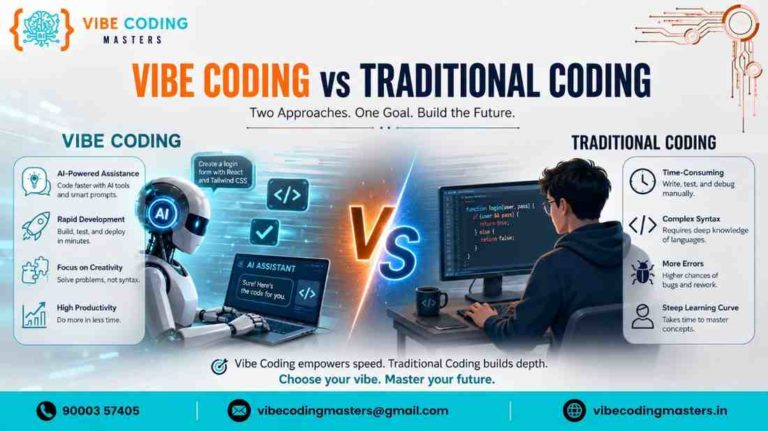
Software development is being rewritten in front of us. A decade ago, becoming a developer meant memorising syntax and slowly building the muscle memory to turn ideas into working programs. Today, a beginner can describe an app in a sentence and watch an AI assistant produce a first version in seconds. This shift is why the vibe coding vs traditional coding debate has become one of the most searched questions among students, career switchers, and working professionals in India.
Vibe coding is the practice of building software by guiding artificial intelligence with natural-language prompts instead of writing every line manually. Traditional coding is the classic discipline of hand-writing code in languages like Python, Java, and JavaScript, with full control over each detail. Both produce working software. They just take very different routes to get there.
Developers are comparing the two because AI has moved from novelty to daily tool. According to GitHub’s 2026 Octoverse report, AI-assisted repositories now account for a majority of new commits on the platform — a sharper signal of real adoption than survey intent. If you are deciding where to start, or wondering whether a structured Vibe Coding Course In Hyderabad fits your goals better than a conventional programming path, this guide breaks down every angle honestly.
Vibe Coding vs Traditional Coding
What is Vibe Coding?
Vibe coding is a modern, AI-first way of building software where you express what you want in plain English and let an AI assistant translate that intent into code. Instead of typing out functions character by character, you prompt, review, refine, and deploy. The term captures a “flow-state” style of development where the human sets direction and the AI handles much of the typing.
It does not mean coding without thinking. It means shifting effort from mechanical typing toward judgement: writing clear prompts, reviewing generated code, and connecting pieces into a working product. A vibe coder still needs to understand what good software looks like, but reaches a working prototype far faster. To go deeper on the concept itself, the detailed explainer on what Vibe Coding is covers how the workflow plays out on real projects.
This approach has made programming dramatically more accessible. People from non-technical backgrounds, commerce, arts, design, are now shipping websites, tools, and small apps that would once have required months of study.
What is Traditional Coding?
Traditional coding is the conventional approach to software development, where developers manually write, test, and maintain code using programming languages and frameworks they have mastered. The developer designs the logic, types the code, tests it, debugs it, and maintains it, relying on their own understanding rather than an AI’s suggestions.
This is how software has been built for decades, and it remains the backbone of large, complex, and mission-critical systems. Banking platforms, operating systems, medical software, and enterprise applications are largely built and maintained through traditional engineering, where predictability and precise control matter more than speed.
Traditional coding demands a steeper investment. You learn data structures, algorithms, language internals, and design patterns. The payoff is deep capability: diagnosing subtle bugs, optimising performance, and architecting systems that scale to millions of users. That depth is why the discipline is not going away, even as AI reshapes the day-to-day.
Vibe Coding vs Traditional Coding: Complete Comparison
The clearest way to understand the two approaches is side by side. The table below compares them across the factors that matter most when you are choosing a path.
Factor | Vibe Coding | Traditional Coding |
|---|---|---|
Learning Curve | Gentle; beginner-friendly start | Steep; months to real fluency |
Development Speed | Very fast for prototypes and MVPs | Slower, more deliberate |
AI Dependency | High; AI is central to the workflow | Low; AI is optional assistance |
Coding Knowledge Needed | Moderate to start, grows over time | Deep from the outset |
Debugging | AI-assisted; still needs human review | Manual; relies on developer skill |
Productivity | High for common tasks | High for complex, custom work |
Flexibility | Excellent for rapid iteration | Excellent for fine-grained control |
Scalability | Good with careful engineering | Proven at massive scale |
Job Opportunities | Fast-growing, AI-aligned roles | Large, stable, well-established |
Best Use Cases | MVPs, startups, automation, tools | Enterprise, systems, high-reliability apps |
Neither column is better in the absolute: vibe coding optimises for speed and accessibility, traditional coding for control and depth. Most careers draw from both.
Vibe Coding vs Traditional Coding: A Detailed Comparison
The single biggest difference is where your effort goes. In traditional coding, most of your time is spent writing and remembering syntax. In vibe coding, most of your time is spent describing intent clearly and reviewing what the AI produces. The mental model shifts from “author” to “director and editor.”
The second difference is the entry point. Traditional coding asks you to build fundamentals before you can create anything meaningful. Vibe coding lets you build something real on day one, then learn the fundamentals as you go. For motivation, that early win matters a lot, especially for beginners who might otherwise quit.
A third difference is accountability. AI writes code quickly, but it cannot be responsible for it. Developer trust in AI output has actually fallen, with only around 29% fully trusting accuracy, and AI-generated code can carry more security vulnerabilities than human-written code. That is why judgement, review, and testing remain human jobs: vibe code fast, then engineer carefully.
Advantages of Vibe Coding
Speed is the headline advantage. You can go from idea to working prototype in hours instead of weeks. For founders testing a concept or students building a portfolio, that velocity is transformative.
Accessibility is the second. Because you start by describing what you want, the barrier to entry drops sharply. Learners without a computer-science degree can create functional apps, which opens tech careers to a far wider group of people. The full picture of these gains is laid out in this guide to the benefits of a Vibe Coding course.
Other advantages: AI handles repetitive boilerplate so you focus on logic; debugging is faster when an assistant helps trace errors; and you stay current with tools companies expect. Independent of self-reported surveys, Google’s 2025 DORA report found AI assistance now touches the majority of PR reviews at surveyed enterprises — a stronger proxy for production use than raw adoption %.
Advantages of Traditional Coding
Control is the core advantage. When you write every line, you know exactly what your program does and why. That precision is essential for performance-critical systems, security-sensitive applications, and anything where a subtle bug is expensive.
Depth of understanding is the second. Traditional coding builds genuine problem-solving ability. You learn how memory works, how algorithms behave, and how to design systems that scale. This knowledge does not become obsolete when tools change, and it is what separates a developer who can only assemble AI output from one who can architect a solution.
Reliability rounds out the list. Hand-crafted, well-tested code is easier to reason about over years of maintenance. Frameworks like React and runtimes like Node.js reward developers who understand them deeply, and enterprise teams prize that mastery.
Limitations of Vibe Coding
The main limitation is over-reliance. If you only ever prompt and accept, you may never build the fundamentals needed to catch what the AI gets wrong. And it does get things wrong, often in ways that look correct at a glance. The most common complaint among developers is code that is “almost right, but not quite.”
Security and quality are real concerns. AI can introduce vulnerabilities into authentication, payments, and data handling if that code ships without careful human review. Vibe-coded prototypes are excellent for learning and validation, but production systems demand the discipline of testing, security checks, and code review before launch.
There is also a ceiling for complex work. For novel algorithms, large-scale architecture, and highly optimised systems, human expertise still leads. AI accelerates the routine; it does not replace deep engineering.
Limitations of Traditional Coding
The biggest limitation is time. Becoming productive takes months of study, and building even a simple app by hand is slow compared with an AI-assisted workflow. For someone who needs to ship quickly, that pace is a real disadvantage.
The learning curve can also discourage beginners. Wrestling with syntax errors before creating anything visible causes many people to give up early. The lack of an immediate, motivating result is a genuine barrier.
Finally, ignoring AI entirely is now its own limitation. A developer who refuses to use modern tools is slower than peers who use them well. Google’s DORA research found that around 90% of software teams now use AI at work daily. Pure traditional coding, with no AI assistance, is increasingly the exception rather than the norm.
When Should You Choose Vibe Coding?
Choose vibe coding when speed and iteration matter most. If you are a founder validating an idea, a student building projects for your portfolio, or a professional automating repetitive work, the AI-first approach gets you results fast.
It is also the right choice when you are starting from zero and want early momentum. Beginners who see a working app on day one tend to stay motivated and learn faster. If that describes you, a structured program such as the best Vibe Coding Course In Hyderabad sequences the workflow properly, pairing AI fluency with the fundamentals you will need to grow.
When is Traditional Coding the Better Choice?
Choose traditional coding when reliability, control, and scale are non-negotiable. Banking systems, healthcare software, operating systems, and large enterprise platforms need the precision that only deep, hand-crafted engineering provides.
It is also the better path when you want to build long-term technical depth. If your goal is to become a systems engineer, an architect, or a specialist in performance or security, there is no shortcut around fundamentals. Traditional coding builds the mental models that these roles require.
Vibe Coding Tools Every Developer Should Know
The vibe coding ecosystem revolves around a handful of tools. ChatGPT and Claude are conversational assistants that generate, explain, and debug code from natural-language prompts. GitHub Copilot lives inside your editor and completes code as you type. Cursor and Windsurf IDE are AI-native editors built around agentic, prompt-driven development. Visual Studio Code remains the popular editor that hosts many of these assistants.
Knowing which tool fits which job is part of the skill. A quick rundown of what software is used for vibe coding helps you pick the right assistant for prototyping, debugging, or full builds rather than defaulting to one for everything.
Underneath the AI layer, you still work with real web technologies. Understanding JavaScript and the browser platform lets you read and correct what these tools generate, which is what separates a capable vibe coder from someone who simply pastes output.
Programming Languages Used in Traditional Coding
Traditional coding is built on languages you learn deeply. Python is the most beginner-friendly and dominates data, automation, and AI work; the official Python documentation is the definitive reference. Java remains the workhorse of enterprise and Android development, and the dev.java learning hub is a strong starting point. JavaScript powers the web, both in the browser and, through Node.js, on the server.
Beyond these three, developers commonly learn frameworks and supporting tools: React for building interfaces, Node.js for backend services, and SQL for databases. If your goal is a strong foundation, the Python with Vibe Coding course and the Java with Vibe Coding course both teach a core language alongside the modern AI-assisted workflow.
Version control ties everything together. Git is how developers track changes and collaborate, and the official Git documentation is essential reading whether you code by hand or with AI. GitHub then hosts your work as a living portfolio that recruiters actually look at.
Career Opportunities in Vibe Coding
Vibe coding opens a fast-growing set of AI-aligned roles. AI-assisted developer, automation specialist, prompt engineer, and AI product builder are all emerging titles that value the ability to ship quickly with intelligent tools. Startups in particular hire for this speed, and freelancing opportunities are abundant for people who can turn ideas into working products.
The demand is real and rising. Gartner projects that by 2028, around 90% of enterprise software engineers will use AI code assistants, up from under 14% in early 2024. That trajectory means AI-fluent developers are moving from “nice to have” toward “expected.” A closer look at the specific career opportunities after Vibe Coding shows how these roles map onto the Indian market.
Full-stack ability multiplies your options. Someone who can vibe-code both frontend and backend can build complete products, which is exactly what the Full Stack with Vibe Coding course is designed to develop.
Career Opportunities in Traditional Software Development
Traditional software development offers a large, stable, and well-mapped career ladder. Roles include software engineer, backend developer, frontend developer, systems engineer, DevOps engineer, and eventually solutions architect or engineering manager. These positions exist across every industry, from IT services giants to product companies and global capability centres.
The demand base here is enormous. India’s technology sector keeps growing, and hundreds of thousands of new engineering roles are expected over the coming years, especially where AI, cloud, and data meet strong fundamentals. A traditionally skilled developer is employable almost everywhere.
Salary Comparison: Vibe Coding vs Traditional Coding
For a full city-by-city and role-by-role salary breakdown, see Salary After Learning Vibe Coding. Cross-reference with Levels.fyi India compensation data for third-party validation.
Experience | Vibe Coding (AI-Assisted) | Traditional Coding |
|---|---|---|
Fresher (0–2 Years) | ₹5–10 LPA | ₹3–7 LPA |
Mid-Level (3–5 Years) | ₹12–22 LPA | ₹8–18 LPA |
Senior (6–10 Years) | ₹25–45 LPA | ₹18–35 LPA |
Architect/Lead (10+ Years) | ₹45–90+ LPA | ₹35–60+ LPA |
A few patterns are worth knowing. Rather than restate the premium figure here, the differentiator is when that premium is earned — i.e., the specific fundamentals traditional coding builds that make AI-assisted work commercially trustworthy (see Skills sections below). Hyderabad and Bengaluru pay 20–40% above tier-2 cities, and Hyderabad’s lower cost of living stretches that pay further. For a role-by-role breakdown, see the dedicated guide on salary after learning Vibe Coding. The key caveat: the premium requires genuine fundamentals, not just tool use.
Skills Required for Vibe Coding
Vibe coding is beginner-friendly, but “beginner-friendly” is not “skill-free.” The most important skill is prompt engineering: writing clear, specific instructions that get useful code from an AI. Learning to structure prompts well is a genuine discipline, and this collection of Vibe Coding prompts shows what effective prompting looks like in practice.
Beyond prompting, you need code-reading ability to review AI output and catch errors, plus a working grasp of how frontend, backend, databases, and APIs fit together. You also need debugging judgement: knowing when the AI’s fix is right and when it is confidently wrong.
Finally, version control and deployment matter: managing code with Git and pushing a project live turns a prototype into something you can actually ship.
Skills Required for Traditional Coding
Traditional coding requires deep, durable fundamentals. You need strong command of at least one language, solid knowledge of data structures and algorithms, and an understanding of how programs execute. These are the skills that let you solve problems no tutorial has covered.
You also need software-design ability: writing clean, maintainable code, applying design patterns, and structuring systems that other developers can work with. Debugging here is a manual craft, reading stack traces, reasoning about state, and isolating faults without a tool doing it for you.
System-level knowledge completes the picture. Databases, networking basics, security principles, and testing discipline separate a hobbyist from a professional engineer, and this foundation never goes out of date.
Career Roadmap: From Beginner to Expert
Whichever path you lean toward, growth follows recognizable stages. The roadmap below blends both worlds, which is how most successful 2026 developers actually progress. For a mentor-guided version of this sequence, the Vibe Coding roadmap walks through each stage with real feedback.
Stage | Skills | Tools | Projects | Career Goal |
|---|---|---|---|---|
Beginner | HTML, CSS, basic JS, prompting | ChatGPT, VS Code | Landing page, simple site | First working app |
Intermediate | JS logic, APIs, one framework | Copilot, Cursor, Git | To-do app, portfolio | Junior developer role |
Advanced | Backend, databases, auth, testing | Node.js, SQL, GitHub | Full-stack app, deployment | Full-stack developer |
Expert | Architecture, security, scaling | Cloud, CI/CD, AI agents | Production systems | Senior engineer / architect |
The throughline is judgement. Tools change; the ability to design, review, and secure software is what compounds over a career.
Future of AI-Assisted Development
AI is becoming a permanent layer of the developer workflow, not a passing trend. Beyond daily usage, Stack Overflow’s 2026 survey shows trust in AI-generated code has become the bigger bottleneck than access — which is why review discipline, not tool adoption, is now the differentiator. For people entering the field now, AI-assisted coding is the default starting posture.
But the future is not “AI replaces developers.” It is “AI raises the value of developers who can direct it well.” As more code becomes AI-authored, careful human review, architecture, and security judgement become more valuable, not less.
That balance, speed plus fundamentals, is exactly what a well-designed program teaches. The top-rated Vibe Coding Course In Hyderabad is built around it, so learners graduate able to use AI productively without becoming dependent on it.
Why Vibe Coding is Becoming Popular in India
India’s adoption of vibe coding is accelerating for practical reasons. The country has a massive population of aspiring developers, and vibe coding lowers the barrier for people from non-technical backgrounds to enter tech quickly. In a competitive job market, the ability to build and ship fast is a real edge.
Startups and small teams, which are abundant in hubs like Hyderabad and Bengaluru, favour speed and lean development, and vibe coding fits that model perfectly. At the same time, large enterprises are pushing their existing teams to adopt AI tools to improve productivity, which drives demand for people who already know the workflow.
Hyderabad in particular has become a strong centre for this shift, combining a booming IT market with a lower cost of living. Local, practical training with placement support, such as the Vibe Coding Course In Hyderabad with placement support, meets exactly this demand by turning beginners into job-ready developers.
Why Vibe Coding is the Future of Software Development
Vibe coding represents a genuine change in how software gets made, and several forces point to it becoming standard practice. The first is AI productivity: research from GitHub found developers completed tasks around 55% faster with an AI assistant, and teams report meaningful weekly time savings. When work gets done faster, the methods that enable it tend to win.
The second is faster MVP development. Startups live or die on how quickly they can test ideas, and vibe coding compresses the path from concept to prototype. Reduced effort on routine tasks frees developers to focus on logic, design, and product decisions.
The third is collaboration with AI as a normal part of the job. The near-future workplace treats AI as a teammate that handles the routine while humans handle judgement, and that is already how a large share of teams operate. Vibe coding is the skill set that makes this collaboration effective, which is why it sits at the centre of modern software careers.
Best Learning Path for Beginners
If you are starting out, the smartest path blends both worlds in the right order. Begin with vibe coding to get early wins and stay motivated, then layer in fundamentals so you can grow beyond copying AI output. This sequence keeps you engaged while building real capability.
A practical first month: learn basic HTML, CSS, and prompting; build one small project with an AI assistant; then learn how the generated code actually works. Because vibe coding is so accessible, even complete beginners can start, and this overview of Vibe Coding for non-programmers shows just how low the entry barrier now is.
Structured guidance shortens the journey; learning the right order and building a portfolio under mentorship beats piecing it together alone. If you are in the city, you can join the Vibe Coding Course In Hyderabad to follow this exact path with placement support built in.
Key Takeaways
- Vibe coding builds software through AI prompts and excels at speed, accessibility, and rapid prototyping; traditional coding builds it by hand and excels at control, depth, and reliability.
- The vibe coding vs traditional coding choice is not either/or; the strongest 2026 developers combine AI fluency with real engineering fundamentals.
- AI adoption is now mainstream, with around 84% of developers using or planning to use AI tools and roughly 46% of new code already AI-assisted.
- AI-aligned developers in India often earn a 25–40% premium over generalists, and Hyderabad offers strong pay with a lower cost of living.
- Beginners should start with vibe coding for early momentum, then add fundamentals; production code always needs human review, testing, and security checks.
Conclusion
The vibe coding vs traditional coding question does not have a single winner, and that is the honest answer. Vibe coding gives you speed, accessibility, and an early sense of momentum. Traditional coding gives you depth, control, and the fundamentals that never go out of date. Framing them as rivals misses the point, because the developers who succeed in 2026 draw on both.
If your goal is to build fast and enter tech without a long runway, start with vibe coding. If your goal is deep systems work, invest in fundamentals. For most people, the ideal path is to begin with AI-assisted development for motivation, then build strong foundations so you can grow without limits. Speed gets you started; fundamentals let you last.
The best time to start was yesterday. The second best time is now. Pick your first project, describe it, build it with AI, and then learn how it works. When you are ready for structured, mentor-led training with placement support, the Vibe Coding Course In Hyderabad is built to take you from your first prompt to a real developer career. Start your coding journey today.
FAQ
- What is the difference between vibe coding and traditional Coding?
Vibe coding trades line-by-line authorship for natural-language direction and AI-driven generation, with the developer shifting into a reviewer and quality-gate role. The real difference shows up in accountability — see the Stack Overflow 2026 Developer Survey for current trust and adoption data. If you want the career-path angle rather than the definitional one, our Vibe Coding Roadmap covers that in depth.
- Is vibe coding better than traditional coding?
Neither is universally better. Vibe coding wins for speed, prototypes, and accessibility. Traditional coding wins for complex, high-reliability systems where precise control matters. The best approach depends on your goal, and the strongest developers combine the two.
- Can I get a job with only vibe coding skills?
You can enter AI-aligned roles like AI-assisted developer or automation specialist, especially at startups. However, employers increasingly expect fundamentals too. Pairing vibe coding with core programming knowledge makes you far more employable and better paid.
- Does vibe coding replace the need to learn programming?
No. Vibe coding lowers the barrier to start, but you still need to read, review, and correct AI-generated code. Without fundamentals, you cannot catch the mistakes AI makes, and it makes them often.
- Is vibe coding good for beginners?
Yes. Vibe coding is one of the most beginner-friendly ways to start, because you can build a working app on day one. That early success keeps beginners motivated while they gradually learn the underlying concepts.
- Which pays more, vibe coding or traditional coding?
Developers with AI-assisted skills often earn a 25–40% premium over generalists at the same experience level, because AI-aligned talent is scarce. But real pay depends on skill, portfolio, and company far more than the label..
- What tools are used in vibe coding?
Rather than re-listing every tool here, see our full breakdown in What Software is Used for Vibe Coding. For an independent, vendor-neutral comparison, see GitHub’s State of the Octoverse report. Each suits different jobs, from quick prototyping to full builds, so knowing which to use when is part of the skill.
- Is traditional coding still worth learning in 2026?
Absolutely. Traditional coding builds the fundamentals that let you understand, review, and secure software. Enterprise and mission- critical systems still rely on it, and it makes you a stronger vibe coder too.
- How long does it take to learn vibe coding?
Beginners can build simple projects within weeks, since the AI handles much of the typing. Reaching job-ready level, with fundamentals included, typically takes a few months of consistent, project-based practice.
- Is AI-generated code safe to use in production?
Not without review. AI code can contain security vulnerabilities, especially in authentication, payments, and data handling. Always test, review, and apply security checks before shipping. The rule is simple: vibe code fast, engineer carefully.