Vibe Coding with GitHub Copilot: The Complete 2026 Career Guide
Vibe Coding with GitHub Copilot means describing what you want in plain English and letting an AI assistant draft the code inside your editor, while you review, test and refine it. It blends prompt engineering, debugging and architecture judgement. In India, developers with these skills earn roughly 6 to 30 LPA, making it one of the fastest-growing software career paths of 2026.
★★★★★
4.9/5 rated by 1329+ students · Google Verified
Table of Contents
Introduction
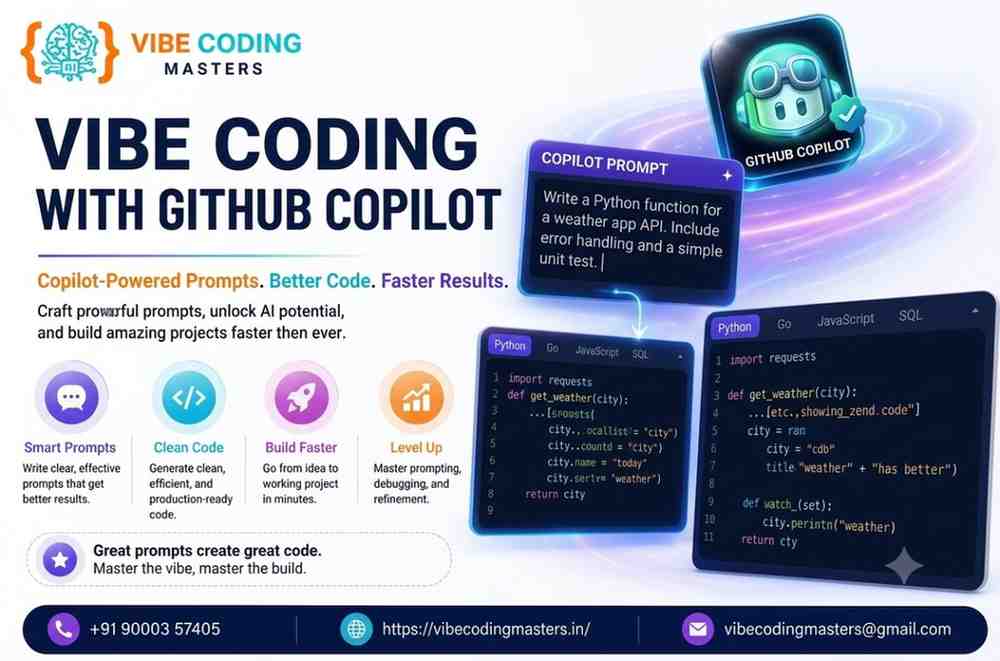
Five years ago a developer typed every line by hand. Today the same developer writes a sentence describing the intent and watches a working function appear. Learning Vibe Coding with GitHub Copilot is one of the most valuable career skills for Indian software professionals in 2026.
Stack Overflow’s 2025 Developer Survey found 84% of respondents use or plan to use AI tools, up from 76%, with 51% of professional developers using them daily. That is the default workflow now.
But here is what beginners miss: adoption rose while trust fell. Only 29% of 2025 respondents said they trust AI output, down 11 points from 2024. Anyone can generate code. The people getting hired can generate it, spot what is wrong with it, and ship something that survives production.
This guide covers what Vibe Coding with GitHub Copilot involves, the skills around it, what roles pay in India, and a realistic path to employability. If you are weighing a structured program, a well-designed Vibe Coding Course In Hyderabad compresses months of trial and error into a guided sequence.
Vibe Coding with GitHub Copilot
What is Vibe Coding with GitHub Copilot?
Vibe Coding is a development style where you express intent in natural language and let an AI assistant produce the implementation. Instead of recalling syntax, you describe the behaviour you want, then read, correct, test and integrate the draft.
GitHub Copilot made this style mainstream. It lives inside your editor, reads the file you are working on, and suggests completions from a single line to a full function. Vibe Coding with GitHub Copilot means this loop: you steer with intent, Copilot drafts, you verify.
Be clear about what it is not. It does not replace understanding programming, and it is not a button that returns a finished app. If you have not read our explainer on what Vibe Coding actually is, start there.
Vibe Coding moves your effort up the stack. Less syntax and boilerplate, far more specification, review, testing and design. The typing gets easier. The thinking gets harder.
How GitHub Copilot Works in Vibe Coding
Copilot is a large language model trained on public code, wired into your editor as an extension. It builds a context window from the current file, open tabs, function signatures and comments, then predicts what should come next. Three interaction modes matter day to day.
Inline completion. A greyed-out suggestion appears ahead of your cursor and you press Tab. Fastest mode, best for predictable code such as loops, data transformations and test scaffolding.
Comment-driven generation. You describe what you want in a comment and the assistant fills in the implementation. “Sort users” produces something vague. “Sort users by last login descending, treating null logins as oldest” produces something usable.
Chat and agent workflows. A conversational panel for explanations, refactors, test generation and debugging, with agent modes making coordinated edits across files.
Output quality is almost entirely a function of the context you supply, which is why our guide to writing effective Vibe Coding prompts is worth working through first. Vague input produces plausible code that does the wrong thing.
The verification loop nobody talks about
Every suggestion you accept is a claim, not a fact. The model predicts likely code; it does not prove correctness. It will handle the happy path perfectly and silently break on empty input or timezone edges.
The professional loop: describe, generate, read line by line, test edge cases, refactor to your conventions, commit. Skipping the middle steps is how teams accumulate technical debt at machine speed.
Benefits of Using GitHub Copilot for Vibe Coding
The advantages are real, if you use the tool with judgement.
- Speed on routine work. Boilerplate, CRUD endpoints, validation and test scaffolding get written in a fraction of the time.
- Lower barrier to unfamiliar territory. A competent draft makes an unknown language or framework far less intimidating.
- Faster onboarding. Asking the assistant to explain an unfamiliar module beats reading it cold.
- Better test coverage. Tedious test writing that developers skip actually gets done when it takes seconds.
- Documentation gets written. Docstrings and README sections stop being postponed forever.
- More time for design. Hours reclaimed from typing go into architecture, security and user experience.
Research supports the productivity claim with caveats. GitHub-funded studies found developers completed a controlled task 55% faster, but with a confidence interval spanning 21% to 89%. The benefit is real and highly variable.
The counterweight matters. In Stack Overflow’s data, 66% of developers struggle with AI output that is close but misses the mark, and 45% say debugging generated code takes longer than writing it. The gain is not automatic. It goes to people who can direct and audit the tool.
Why Vibe Coding is Becoming Popular in India
India has the largest concentration of working developers outside the United States, and its IT model is built on delivering software efficiently at scale. A tool that compresses delivery timelines lands differently here. Several forces are converging.
Enterprise mandates. Global capability centres in Hyderabad, Bengaluru and Pune follow tooling direction from parents that already standardised on AI assistants.
A brutal talent gap. NASSCOM-cited figures put AI talent demand growth near 40% year-on-year against skilled supply growth of only 15 to 20%. That imbalance keeps compensation climbing.
Startup economics. A three-person team shipping what once required eight engineers has a different runway.
Freelance leverage. Developers billing international clients compete on speed, and halving time-to-prototype improves effective rates.
Career defence. AI fluency is becoming a baseline expectation, the way version control once did.
Hyderabad has become a natural hub, with dense product engineering centers and a strong graduate pipeline. Demand for structured Vibe Coding training in Hyderabad has grown sharply among freshers and working professionals.
Career Opportunities in Vibe Coding
Vibe Coding is rarely a job title on its own. It is a capability layered onto established engineering roles, so you can enter through whichever door fits your background.
- AI-Assisted Full Stack Developer. Builds complete web applications across frontend and backend.
- Prompt Engineer for Development Teams. Maintains the prompt patterns, context files and conventions a team relies on.
- AI Integration Engineer. Wires language model capabilities into products via APIs, embeddings and retrieval pipelines.
- Rapid Prototyping Specialist. Turns concepts into working demos in days, usually in innovation labs or agencies.
- Developer Productivity Engineer. Owns tooling and sets safe AI usage standards across an organisation.
- AI Code Reviewer. Audits machine-generated code for security, licensing and maintainability risk.
- Technical Founder. Shipping a product without an initial engineering hire is genuinely viable now.
Each path has different entry requirements and ceilings, mapped out in our career opportunities after Vibe Coding breakdown.
Industries Hiring AI-Assisted Developers
Demand is not confined to technology companies. Any sector shipping software hires for this.
- IT services and consulting. India’s largest employer base, where delivery velocity becomes margin.
- Banking and financial services. Internal tooling, compliance systems and data pipelines, with review discipline mattering most.
- Healthcare technology. Patient platforms and records systems with strict correctness requirements.
- E-commerce and retail. Storefronts, recommendations, logistics dashboards and pricing tools.
- EdTech. Rapid platform iteration with small engineering teams.
- SaaS product companies. Highest-paying segment, most demanding on code quality.
- Manufacturing and logistics. Industrial dashboards, IoT interfaces and supply chain tooling.
- Media and gaming. Content pipelines, internal tools and interactive experiences.
Top Companies Using GitHub Copilot and AI Coding
Enterprise adoption is past the pilot stage. Reporting through 2025 and 2026 indicates around 90% of Fortune 100 companies have deployed the tool and paid subscribers reached about 4.7 million by January 2026. In India, the employers hiring for these skills fall into recognisable groups.
- Global capability centres with engineering operations in Hyderabad, Bengaluru, Pune and Chennai.
- Major Indian IT services firms that now screen for the skill in interviews.
- Funded product startups needing maximum output per engineer.
- Digital agencies competing on turnaround time for client builds.
- Fintech and healthtech firms pairing AI acceleration with rigorous review.
What matters for your job search is that interviews now routinely include a live exercise where you build something with AI help while explaining your reasoning. Our Vibe Coding interview questions reflect what candidates are actually asked in 2026.
Roles and Responsibilities of a Vibe Coding Developer
What teams expect from the role.
- Translate requirements into precise specifications an assistant can act on without ambiguity.
- Generate, review and refine code, treating every suggestion as a draft needing verification.
- Write and maintain tests, because generated code needs stronger coverage, not weaker.
- Debug machine-written code, reading unfamiliar logic quickly and precisely.
- Enforce security and licensing standards, checking injection risks, hardcoded secrets and unsafe dependencies.
- Maintain architectural coherence so the application does not become disconnected generated fragments.
- Manage version control rigorously, with small reviewable commits.
- Document decisions, especially why significant generated components were accepted or rejected.
- Mentor teammates on prompting and safe review practice.
Only one item is about generating code. The other eight are judgement, verification and communication. That is the actual job.
Vibe Coding Salary in India
Compensation for AI-assisted roles sits above general software engineering at equivalent experience, with 2026 analyses putting the premium at 30 to 50%. These are realistic bands, not best-case outliers.
Experience Level | Average Salary Range (INR) | Typical Roles | What Drives the Upper Band |
Fresher (0-2 Years) | 4.5 – 9 LPA | Junior Developer, AI-Assisted Developer, Associate Engineer | Portfolio of shipped projects, internship experience, product company over services |
Mid-Level (3-5 Years) | 10 – 22 LPA | Software Engineer, Full Stack Developer, AI Integration Engineer | Production ownership, API and cloud depth, measurable delivery impact |
Senior (6-10 Years) | 22 – 40 LPA | Senior Engineer, Tech Lead, Developer Productivity Lead | System design, team enablement, GenAI specialisation |
Lead / Architect (10+ Years) | 40 – 80+ LPA | Engineering Manager, Principal Engineer, AI Architect | Org-wide strategy, GCC or top product company, equity component |
Three factors move you within these bands. City matters, with Bengaluru highest and Hyderabad close behind. Company type matters more, as product firms and GCCs pay above services. Specialisation matters most, with GenAI and MLOps adding 25 to 45%.
For city-level breakdowns and negotiation guidance, see our analysis of the salary after learning Vibe Coding.
Skills Required for Vibe Coding with GitHub Copilot
You cannot direct a tool you do not understand. This is what turns AI assistance into capability, layered over the wider stack in our overview of the software used for Vibe Coding.
Core programming foundations
JavaScript is the backbone of web development and the language AI assistants handle best. You need real comfort with async behaviour, closures, array methods and the DOM. Keep the MDN Web Docs JavaScript reference open while reviewing generated code.
TypeScript is disproportionately valuable, because type annotations are context. When code declares what a function expects and returns, suggestions get more accurate and the compiler catches generated mistakes before they run. The official TypeScript documentation covers the type system.
Python is the second pillar, dominant in automation, data work and machine learning, and its readability makes generated code easy to audit. Work through the Python language documentation rather than tutorials alone.
Frameworks and runtimes
React is where most front-end jobs live. Components, hooks and rendering behaviour must be second nature, because generated components often look correct while carrying subtle state bugs.
Node.js covers the server side with one language across the stack. The event loop, streams and module system matter when reviewing generated backend code; keep the Node.js API documentation handy.
APIs connect everything you build. Know REST conventions, status codes, authentication and error handling well enough to notice when a generated integration silently swallows failures.
Version control and collaboration
Git matters more with AI assistance, not less. When code arrives fast, disciplined branching and small commits keep a project reversible. Bisecting back to the commit where a generated change broke something is a real professional skill; the official Git documentation covers the workflows.
The AI-specific layer
Prompt engineering for code is the highest-leverage skill here. Effective prompts specify inputs, outputs, edge cases and conventions. Weak prompts produce code that looks right and behaves wrong.
Debugging AI-generated code needs a different reflex. With your own code you remember your reasoning; with generated code you have none of that context, so you read defensively and assume nothing.
Software testing makes speed sustainable. Unit tests, integration tests and edge case coverage let you accept generated code with confidence rather than hope.
Security awareness rounds it out, since generated code can reproduce insecure patterns, expose credentials or introduce injection flaws.
If that list feels large, that is why most learners benefit from a sequenced program. A structured, hands-on Vibe Coding Course In Hyderabad covers these in dependency order so you are not learning TypeScript generics and prompt design in the same week.
Best AI Tools for Vibe Coding
GitHub Copilot is the most widely deployed assistant, but professionals typically use two or three tools.
Editor-integrated assistants such as GitHub Copilot and Cursor AI excel at in-context completion and refactoring. Conversational assistants such as ChatGPT, Claude AI and Gemini are stronger for architecture discussions and explanations. Full-application generators such as Lovable, Bolt.new and Replit scaffold projects from a description, powerful for prototyping and weaker for maintainability.
Visual Studio Code is where most of this happens. Its extensions, terminal, debugger and Git tooling make it the default environment, and fluency in it pays off daily.
Choosing involves real trade-offs that shift as tools evolve; our comparison of the best AI tools for Vibe Coding in 2026 goes deeper.
GitHub Copilot vs Traditional Coding
How the two approaches differ in practice.
Dimension | Vibe Coding with AI Assistance | Traditional Manual Programming |
Speed to first working version | Very fast, often minutes for standard features | Slower, proportional to typing and lookup time |
Primary developer effort | Specification, review, testing, integration | Syntax recall, implementation, manual lookup |
Entry barrier for beginners | Lower to start, but review skill still required | Higher, steeper initial learning curve |
Boilerplate and repetitive code | Largely automated | Written manually every time |
Risk profile | Subtle bugs and security issues from unreviewed output | Errors are usually visible and traceable to the author |
Long-term maintainability | Depends entirely on review discipline | Consistent when conventions are followed |
Skill development pattern | Broad exposure quickly, depth needs deliberate effort | Depth builds naturally through repetition |
Best suited to | Prototypes, standard features, unfamiliar stacks, scale | Novel algorithms, performance-critical and safety-critical code |
The career answer is not to pick a side. Teams that ship well use AI assistance for well-trodden work and careful manual engineering for the novel or high-risk remainder. Knowing which is which is the judgement you are paid for. Our side-by-side of Vibe Coding vs traditional coding explores this further.
Tool-level comparison
Comparison | Strengths | Limitations | Best Use Case |
GitHub Copilot vs ChatGPT for coding | Copilot has live file context and inline completion; ChatGPT reasons better in long conversation | Copilot is weaker at open-ended architectural discussion; ChatGPT lacks direct editor context | Copilot for writing code in place, conversational tools for planning and explanation |
GitHub Copilot vs Cursor AI | Copilot has the widest enterprise deployment and editor support; Cursor is built around deeper codebase awareness | Copilot is more conservative in multi-file edits; Cursor requires switching editors | Copilot in enterprise environments, Cursor for aggressive multi-file refactoring |
Vibe Coding vs manual software development | Dramatically faster delivery on standard work | Requires disciplined review to avoid accumulating hidden defects | Blend both, matched to task risk |
Market Trends and Statistics
Data worth carrying into an interview.
- Adoption is near-universal. The Stack Overflow Developer Survey findings on AI put usage at 84%, with 51% of professionals using AI tools daily.
- Trust is the bottleneck. Only 29% trust AI output and 46% actively distrust it. The market is short of people who can validate code, not people who can generate it.
- Enterprise deployment is mature. Around 90% of Fortune 100 companies have adopted AI coding assistants, with paid subscriptions near 4.7 million by January 2026.
- Debugging is the friction point. Close to half of developers say fixing generated code takes longer than writing it, which is why review skill is scarce.
- Indian demand outpaces supply. AI talent demand grows roughly 40% year on year against 15 to 20% supply growth, with millions of AI-related roles projected by 2030.
- The premium is durable. AI and ML compensation runs 30 to 50% above general software engineering at equivalent experience.
Together these tell one story. The tools have won; the people who supervise them have not caught up. That gap is your window, and it will not stay open indefinitely, which is a good reason to consider structured weekend Vibe Coding classes in Hyderabad if a full-time program does not fit your schedule.
Vibe Coding Career Roadmap
A staged path from zero to employable, assuming consistent study alongside a job.
Level | Skills to Learn | Typical Duration | Milestone Outcome |
Beginner | Programming fundamentals, JavaScript basics, HTML and CSS, editor fluency, Git essentials, first prompting practice | 4 – 8 weeks | Build and version-control a static multi-page site |
Intermediate | React components and hooks, Node.js, REST API consumption, Python scripting, unit testing, structured prompt patterns | 8 – 14 weeks | Ship a full-stack application with authentication and a database |
Advanced | TypeScript, system design, API design and security, CI pipelines, cloud deployment, code review discipline, LLM API integration | 12 – 20 weeks | Deploy a production-grade project with tests and monitoring |
Expert | Architecture ownership, performance optimisation, team enablement, AI governance and usage standards, mentoring | Ongoing | Lead technical decisions and set AI usage policy for a team |
The most common beginner mistake is skipping fundamentals because the assistant makes them feel unnecessary. You will hit a wall around week six, when generated code breaks and you cannot read it well enough to fix it. Our Vibe Coding roadmap expands each phase with practice projects.
Certifications to Boost Your AI Coding Career
Certifications will not get you hired alone. They get your profile past screening and structure your learning.
Four categories carry weight with Indian employers in 2026: cloud platform credentials validating deployment competence; AI and machine learning certifications; foundational Python or JavaScript credentials for career changers; and institute-issued project-based certificates with a portfolio attached.
That last one matters most. A certificate saying you completed a course is weak; the same certificate alongside four deployed applications is strong. The difference is evidence. Our guide to earning a credible Vibe Coding certification covers which options influence hiring.
Future Scope of Vibe Coding in India
Over the next three to five years, several shifts look predictable.
AI fluency becomes baseline. Job descriptions will stop listing it as a differentiator the way they stopped listing version control.
Role composition shifts upward. Less implementing, more specifying and reviewing. Engineers who enjoy only the typing will find this hard; those who enjoy problem framing will find it a promotion.
Review and governance become formal disciplines. Expect dedicated roles in AI code auditing, licensing compliance and usage standards, especially in regulated industries.
Small teams punch above their weight. The minimum viable engineering team keeps shrinking, favouring India’s startup ecosystem.
Quality becomes the differentiator. When everyone generates code quickly, the edge goes to whoever ships the most reliable software.
The through-line is consistent: demand for people who write code is softening, and demand for people who can judge code is rising sharply.
How to Start Learning Vibe Coding with GitHub Copilot
A sequence that avoids the common failure modes.
Step 1: Set up a real environment. Install a modern editor, configure your assistant extension, install Node.js and Python, and set up Git with a remote repository. Accepting generated changes without version control is how people lose days of work. To start in the browser instead, our guide to Vibe Coding platforms covers setup-free options.
Step 2: Learn fundamentals with the assistant off. Spend two to three weeks writing basic JavaScript by hand. It feels slow and it is the highest-return investment here, because everything downstream depends on reading code critically.
Step 3: Turn the assistant on and start small. Use it for single functions, reading every suggestion before accepting. Build the review habit while stakes are low.
Step 4: Practice specification writing. Write a bad prompt and a good prompt for the same task and compare output. One afternoon of this beats a week of tutorials.
Step 5: Build complete projects. A task manager with a database. A dashboard consuming a public API. A blog with authentication. Deployed and version controlled, not half-finished tutorials.
Step 6: Break things deliberately. Introduce bugs into your own code and fix them without AI help.
Step 7: Learn testing and deployment. Write tests, deploy to a real host, set up a basic CI pipeline. This is the gap between hobby projects and employable work.
Step 8: Build a portfolio. Four deployed projects with clean repositories beat twenty tutorial clones. Be ready to explain your architectural choices and where you overruled the AI.
Self-teaching takes most people six to twelve months. Structured programs compress that to three to six, because ordering is handled and feedback is immediate. If you want that structure with placement support, exploring the best Vibe Coding Course In Hyderabad options is a sensible next step.
Why Vibe Coding with GitHub Copilot is One of the Best IT Careers in India
Industry demand. Every company shipping software needs this, and hiring has not caught up with adoption.
Career growth. The skill compounds. Prompt craft, review discipline and system design improve with every project and transfer across employers.
Remote opportunities. The work is output-measurable, which suits distributed teams, and Indian developers are increasingly hired directly by international employers.
Freelancing potential. Faster delivery means higher effective rates for independents.
Startup ecosystem. India’s startup density means constant demand for engineers who build fast with minimal resources.
Productivity benefits. The skill makes you better at your current job today.
Long-term durability. Tools will keep changing, but specifying clearly, reviewing rigorously and understanding fundamentals do not expire when the next model ships. You are investing in judgement, and judgement holds its value.
Key Takeaways
- Direction, not delegation. You describe intent and verify output. Your value is judgement, not typing speed.
- Fundamentals matter more, not less. You cannot review what you cannot read.
- The trust gap is the opportunity. Adoption sits at 84% while trust sits near 29%.
- Pay is strong and specialisation-driven. Bands run from 4.5 to 9 LPA for freshers to 40 LPA and beyond at architect level.
- Projects beat certificates. Four deployed applications you can explain in depth outperform any credential without evidence.
Conclusion
How software gets built has changed, faster than training pipelines could adapt. That mismatch is why this moment favours anyone willing to learn properly. The tools are mature, enterprise adoption is settled, and the shortage is on the human side.
Learning Vibe Coding with GitHub Copilot is not about outsourcing your thinking. It is about moving it to where it creates most value: understanding the problem, specifying the solution precisely, and holding a rigorous standard for what ships. The developers who thrive will not be the fastest typists, but the ones who ask the sharpest questions and refuse to accept code they do not understand.
Start small and start now. Set up your environment this week, write JavaScript by hand for two weeks, then turn the assistant on and build something real, reviewing every line.
If you would rather not assemble the path yourself, structured Vibe Coding classes in Hyderabad give you the sequence, feedback and portfolio support to get there faster. Either way, begin. The window where this skill is a differentiator rather than an expectation is open now.
FAQ
What is Vibe Coding with GitHub Copilot?
It is a development approach where you describe what you want in natural language and the assistant drafts code inside your editor, while you review, test and refine it. Effort shifts from writing syntax to specifying requirements clearly and verifying that generated code is correct, secure and maintainable.Is GitHub Copilot free for students and beginners?
A limited free tier with monthly caps on completions and chat requests is available to individuals, and verified students, teachers and open source maintainers have historically qualified for free access to paid features. Eligibility and limits change, so check the current official terms.How much does GitHub Copilot cost in 2026?
Individual plans typically start near 10 US dollars per month, with higher tiers around 39 dollars, while business and enterprise seats are priced per user. For Indian learners, the free tier plus a student plan is usually enough to build a full portfolio before paying.Do I need to know programming before learning Vibe Coding?
You can generate working code on day one without experience, but you cannot build a career that way. Reading, debugging and reviewing generated code all require real programming knowledge. Learn fundamentals and AI assistance together, writing basic code manually for the first few weeks.Which programming languages work best with AI coding assistants?
JavaScript, TypeScript and Python produce the strongest results, being heavily represented in training data and widely used in web and automation work. Java, C Sharp, Go and SQL also perform well. For India, JavaScript with TypeScript plus Python is the most employable combination.Can Vibe Coding with GitHub Copilot replace software developers?
No, but it changes what developers do. Assistants generate implementations; they do not decide what to build, judge trade-offs, own architecture or take responsibility for production. Survey data showing roughly 45% of developers find debugging generated code slower than writing it explains why judgement remains essential.What is the salary for Vibe Coding developers in India?
Realistic 2026 bands run 4.5 to 9 LPA for freshers, 10 to 22 LPA at mid level, 22 to 40 LPA for senior engineers, and 40 LPA and above for leads and architects. Product companies and global capability centres pay well above services firms, and GenAI specialisation adds a further premium.How long does it take to learn Vibe Coding with GitHub Copilot?
Basic productivity comes within two to four weeks. Employable competence with a portfolio takes three to six months in a structured program, or six to twelve self-taught. The variable is not the tooling, which is quick to learn, but the fundamentals, testing and debugging skills underneath it.Which certifications help an AI coding career in India?
Cloud platform certifications, AI and machine learning credentials, and foundational Python or JavaScript certificates all help profiles pass screening. Institute-issued project-based certificates carry weight when deployed applications come attached. No certificate substitutes for a portfolio you can explain in depth.What skills should I learn first for Vibe Coding with GitHub Copilot?
Start with JavaScript fundamentals and Git, because everything depends on reading code and managing changes safely. Add HTML and CSS, then React and Node.js, then Python. Layer prompt engineering, testing and debugging across all of it rather than treating them as separate later topics.