Vibe Coding Certification in 2026 | Complete Guide, Fees, Syllabus & Career
A Vibe Coding Certification proves you can build real software using AI tools like GitHub Copilot, ChatGPT, Cursor, and Claude, combined with prompt engineering and core programming. As AI-assisted development becomes the default way to code, this credential helps freshers, working professionals, and career-switchers in India enter high-demand, well-paid roles faster than the traditional route.
★★★★★
4.9/5 rated by 1329+ students · Google Verified
Table of Contents
What is Vibe Coding Certification? Your Complete 2026 Career Guide
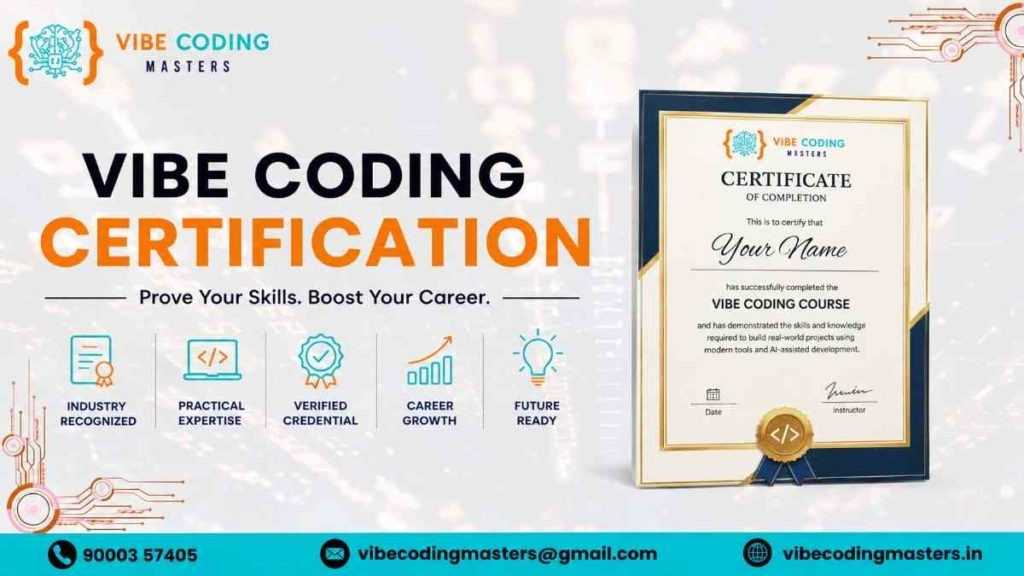
The way software gets built has changed faster in the last two years than in the previous decade. In 2026, writing code is no longer about memorising syntax line by line. It is about describing what you want clearly, guiding an AI assistant, reviewing the output, and shipping working products at speed. This new style of building has a name, and a Vibe Coding Certification in 2026 is quickly becoming one of the smartest ways to prove you can do it.
If you have heard about people building full apps with tools like Cursor, Lovable, or GitHub Copilot and wondered whether it is a real career path, the short answer is yes. AI-assisted coding is now mainstream. By recent industry counts, around 84% of developers already use or plan to use AI tools in their workflow, and roughly half of professional developers use them every single day. That is not a passing trend. It is the new baseline.
For learners in India, and especially in a fast-growing IT hub like Hyderabad, this shift opens a real window of opportunity. Companies want people who can use AI coding tools responsibly and productively, but the supply of trained, certified talent is still small. A structured Vibe Coding Course In Hyderabad helps you close that gap and gives you a credential that signals job-readiness to employers.
In this guide, we will break down exactly what a Vibe Coding Certification is, why it is becoming popular, the skills and tools you will master, the salaries you can realistically expect in India, a step-by-step career roadmap, and how to get started. Whether you are a fresher, a working professional, or switching careers, this article is built to answer the questions you actually care about.
Vibe Coding Certification
What is Vibe Coding Certification?
A Vibe Coding Certification is a credential that confirms you can build software using AI-assisted development methods rather than writing every line of code by hand. It validates a specific, modern skill set: prompting AI tools effectively, generating and refining code, debugging with AI, integrating APIs, and deploying real applications.
The term “vibe coding” describes a workflow where you focus on intent and outcomes. You explain what you want in plain language, an AI assistant produces the code, and you guide, test, and improve it. You still need to understand programming fundamentals, but the day-to-day act of typing boilerplate is handled with AI support.
A good certification program does not just teach you to copy AI output blindly.
It teaches you to think like a developer: to plan an application, write clear prompts, spot mistakes, secure your code, and deliver something that works in the real world. To understand the foundations more deeply, it helps to first learn what vibe coding actually involves before choosing a program.
.
In short, the certification is proof. It tells an employer, “This person can take an idea and turn it into a deployed product using modern AI tooling.” In a job market where everyone claims to “know AI,” a verified credential backed by real projects carries weight.
Why Vibe Coding Certification Is Becoming Popular
The popularity of this certification is tied directly to how quickly AI-assisted development has been adopted. A few clear forces are driving the demand.
First, AI coding tools have gone mainstream. GitHub Copilot alone crossed roughly 20 million users, and tools like Cursor and Claude-based assistants have become daily companions for working developers. New developers increasingly start their journey with AI tools from day one rather than learning the “old way” first.
Second, companies want productivity. Teams using AI coding tools report meaningful time savings each week and dramatically faster delivery cycles. When pull request turnaround can drop from days to hours, businesses notice. They want to hire people who already know how to work this way.
Third, the skill is still scarce. Plenty of developers experiment with AI tools casually, but far fewer can use them with discipline, security awareness, and real project experience. That gap between casual use and professional skill is exactly what a certification fills.
Finally, it is beginner-friendly. You do not need years of computer science theory to start. This makes vibe coding attractive to freshers, non-tech graduates, and career-switchers who want a faster, more practical route into tech. If you are unsure whether you qualify, the eligibility requirements for a vibe coding course are far more open than traditional engineering paths.
Benefits of Earning a Vibe Coding Certification
Earning this credential delivers practical advantages that go well beyond a line on your resume. Here is what you actually gain.
- Faster job-readiness. You learn to build and deploy real applications quickly, which is what employers test for in interviews.
- A portfolio that proves skill. Certification programs are project-based, so you finish with deployable apps you can show, not just theory you can recite.
- Higher confidence with modern tools. You become fluent in the AI assistants that companies already use, removing the learning curve a new employer would otherwise pay for.
- A competitive edge. A verified credential plus real projects helps you stand out in a crowded applicant pool.
- Career flexibility. The skills apply to full-stack roles, automation, freelancing, and product building, giving you multiple paths.
The wider benefits of a vibe coding course extend into freelancing and entrepreneurship too, since the same skills let you build and launch your own digital products.
Career Opportunities After Vibe Coding Certification
A Vibe Coding Certification opens doors to a surprisingly wide set of roles. Because AI-assisted development touches the entire software lifecycle, your options are not limited to a single job title.
Common roles include
- AI-Assisted Developer — builds applications using AI tools as a core part of the workflow.
- AI-Full Stack Developer — handles both AI frontend and AI backend using modern frameworks and AI support.
- AI-Frontend Developer — creates responsive, interactive interfaces with AI-generated components.
- AI-Backend Developer — designs APIs, databases, and server logic with AI acceleration.
- AI-Automation Specialist — builds workflows and integrations that remove repetitive manual work.
- AI-Prompt Engineer — designs effective instructions to get reliable output from AI systems.
- AI-Freelance Product Builder — ships websites, tools, and MVPs for clients independently.
Many learners use this certification as a launchpad into broader career opportunities after vibe coding, then specialise based on what they enjoy most. The beauty of the path is that you can start broad and narrow down as you grow.
Industries Hiring Vibe Coding Professionals
AI-assisted development is not confined to tech companies. Almost every industry that builds or uses software now needs people who can move faster with AI tools.
Sectors actively hiring include
- IT Services and Software Product Companies — the largest employers, building applications for clients and their own platforms.
- Fintech — fast-moving teams that need rapid, secure feature delivery.
- E-commerce — constant demand for new features, integrations, and automation.
- Healthcare and HealthTech — building patient tools, dashboards, and data systems.
- EdTech — learning platforms and interactive applications.
- Startups — small teams that rely on speed and need builders who can do a lot with AI support.
- Digital Marketing and Agencies — automation, landing pages, and custom tools.
In Hyderabad specifically, the dense cluster of IT services firms, global capability centres, and startups means there is steady, year-round demand for developers comfortable with AI-assisted workflows.
Skills You Learn in a Vibe Coding Certification Program
A quality certification program builds both your AI fluency and your core development foundations. You are not just learning to prompt; you are learning to engineer.
AI-Assisted Development. You learn the full workflow of building software with AI: planning, prompting, generating, testing, and refining. This is the heart of vibe coding and the habit that makes you productive on day one of a job.
Prompt Engineering. Good output starts with good instructions. You learn to write clear, specific prompts, provide context, break large tasks into steps, and iterate until the result is correct and secure.
Software Development Fundamentals. You build a working understanding of logic, variables, functions, data structures, and how applications are organised, so you can guide AI rather than depend on it blindly.
Python. A beginner-friendly, versatile language used heavily in automation, AI projects, and backends, with extensive official resources on Python.org. You learn enough to read, modify, and build practical scripts and services.
JavaScript. The language of the web. You learn to build interactive frontends and connect them to backend services, guided by trusted references like the MDN Web Docs for JavaScript.
API Integration. Real applications talk to other services. You learn to connect third-party APIs, handle authentication, and move data safely between systems.
Automation Workflows. You learn to remove repetitive work by building automated pipelines and integrations, a skill that is valuable across every industry.
Low-Code and No-Code Development. You learn to use visual platforms to ship products quickly, which is especially useful for MVPs, prototypes, and freelance projects.
AI Productivity Tools. Beyond coding assistants, you learn to use AI for documentation, testing, debugging, and learning new concepts faster.
To see how these skills map across a full curriculum, the detailed vibe coding course syllabus lays out the exact module-by-module progression.
Vibe Coding Certification Salary in India
Salary is one of the most common questions, and the honest answer is that it depends on your skills, your portfolio, your city, and the type of company you join. That said, AI-assisted development sits in a high-demand band, and the numbers are encouraging.
Tech hubs like Hyderabad and Bengaluru typically pay 20–40% above the national average, and AI or generative AI skills add a further premium on top of generalist software pay. A strong, deployed project portfolio often matters more in negotiation than years of tenure.
Here is a realistic salary range for AI-assisted and vibe coding roles in India in 2026
Experience Level | Average Salary (Per Year) |
|---|---|
Fresher (0–2 Years) | ₹3.5 – ₹7 LPA |
Junior Professional (2–4 Years) | ₹7 – ₹12 LPA |
Mid-Level Professional (4–7 Years) | ₹12 – ₹20 LPA |
Senior Professional (7–10 Years) | ₹20 – ₹35 LPA |
Lead / Architect (10+ Years) | ₹35 – ₹60+ LPA |
These are realistic working ranges, not guarantees. Freshers with strong, deployed projects and good interview performance often land at the higher end of the entry band, while those with specialised generative AI skills can exceed it. For a deeper breakdown, see the dedicated guide on salary after learning vibe coding.
Vibe Coding Career Roadmap
Building a career in vibe coding is a journey of compounding skill. Each stage builds on the last, and consistent project work is what moves you forward.
Stage | Focus Areas |
|---|---|
Beginner | Programming fundamentals, prompt basics, first AI-assisted builds, simple projects |
Intermediate | Frontend and backend basics, API integration, debugging with AI, deployment |
Advanced | Full-stack apps, authentication, automation workflows, security awareness, cloud basics |
Expert | Architecture, complex integrations, mentoring, leading AI-assisted teams, specialisation |
The roadmap is not rigid. Some learners specialise early in frontend or automation, while others go broad into full stack. What stays constant is the loop: build, review, improve, repeat.
Beginner to Expert Journey in Vibe Coding
Let us walk through what the journey actually feels like in practice, because the stages above can sound abstract.
As a beginner, you start by understanding how code is structured and how to prompt an AI tool to generate a simple webpage or script. You build small, satisfying projects like a calculator, a to-do app, or a portfolio site. The goal here is confidence and momentum.
At the intermediate stage, you start connecting things. You build a frontend, wire it to a backend, integrate an API, and deploy your project so others can use it. You begin to debug AI output instead of accepting it blindly, which is a major milestone.
In the advanced stage, you build complete, real-world applications: authentication, databases, payments in demo mode, admin dashboards, and automation. You learn that AI can write code quickly but that a human must review security-sensitive logic carefully. This discipline is what separates professionals from hobbyists.
As an expert, you think in systems. You architect applications, choose the right tools, lead projects, and mentor others. You combine AI speed with engineering judgment, which is the most valuable and best-paid skill in the field.
Certifications That Complement Vibe Coding Certification
A Vibe Coding Certification is powerful on its own, but pairing it with complementary credentials can strengthen your profile and widen your options.
Helpful additions include
- Prompt Engineering Certification — deepens the single most important AI skill.
- Python or JavaScript fundamentals certifications — reinforce your core programming foundation.
- Cloud certifications (entry-level AWS, Azure, or Google Cloud) — since most modern apps deploy to the cloud and cloud-skilled developers earn more.
- Front-end or full-stack specialisation programs — for those who want to go deep on web development.
- API and automation tool certifications — valuable for automation-focused roles.
For learners who want to build a deeper full-stack foundation alongside AI tooling, a structured Full Stack with Vibe Coding Course in Hyderabad pairs naturally with this certification.
Future Scope of Vibe Coding in India
The future scope is strong, and the trend lines all point the same way. AI-assisted development is not slowing down; it is accelerating and becoming the default.
Industry forecasts suggest that the share of AI-assisted code will keep climbing, with a large majority of enterprises adopting generative AI in their development processes. India, with its enormous IT workforce and rapidly digitising economy, is one of the biggest beneficiaries of this shift. Cities like Hyderabad, Bengaluru, and Pune are seeing rising demand for developers who can work productively with AI.
What makes the outlook especially positive for newcomers is that the field rewards practical skill over traditional credentials. A motivated learner with strong projects can compete effectively, and a structured Vibe Coding Course In Hyderabad provides exactly that project-led foundation. As long as you keep building and stay current with tools, the demand for your skills is likely to grow, not shrink.
Why Vibe Coding Is One of the Fastest-Growing Tech Skills
Vibe coding is growing fast for a simple reason: it sits at the intersection of two unstoppable trends, the rise of AI and the constant need for software.
Traditional coding has a steep learning curve that discourages many capable people. Vibe coding lowers that barrier dramatically. It lets beginners build real things early, which keeps them motivated and learning. At the same time, it makes experienced developers far more productive, which keeps demand high at the senior end too.
Add to this the fact that companies are actively pushing their teams to adopt AI workflows, and you have a skill that is being pulled into the mainstream from every direction. New developers are adopting AI tools within their first week on the job. The skill is not a niche specialisation anymore. It is becoming a core expectation. That combination of high demand, broad accessibility, and rapid adoption is exactly what makes a skill grow quickly, and it is why so many learners now choose to enroll in the Vibe Coding Course In Hyderabad to ride that momentum early.
How to Start Your Vibe Coding Career
Starting is more straightforward than you might think. The key is to follow a structured path rather than learning randomly from scattered tutorials.
Here is a simple starting sequence
- Learn the fundamentals. Get comfortable with basic programming logic and how applications are structured.
- Pick up the core tools. Practise with GitHub Copilot, ChatGPT, Cursor, and Claude until prompting feels natural.
- Build small projects. Start with simple apps and deploy them so you have something real to show.
- Take a structured program. A guided course with mentorship shortens the journey by giving you the right order, real feedback, and project reviews.
- Build a portfolio. Create several end-to-end, deployed projects, since these matter more than certificates alone in interviews.
- Apply and keep building. Every project makes you sharper. Consistency is what lands the job.
Working professionals with busy schedules do not need to quit their jobs to begin. Flexible options like weekend and online batches make it practical, as covered in the guide to the vibe coding course for working professionals. If your goal is a focused web track, the Vibe coding with Frontend course in Hyderabad is a strong entry point, while the Vibe coding with backend course in Hyderabad suits those drawn to APIs and server-side logic.
Vibe Coding vs Other Career Paths: A Comparison
It helps to see how vibe coding stacks up against related paths. The table below highlights the practical differences.
Factor | Vibe Coding | Traditional Coding | Full Stack Development | Low-Code Development | Software Testing |
|---|---|---|---|---|---|
Learning Curve | Gentle, beginner-friendly | Steep, syntax-heavy | Moderate to steep | Very gentle | Moderate |
Core Approach | AI-assisted, intent-driven | Manual, line-by-line | Manual + frameworks | Visual, drag-and-drop | Verification and quality |
Speed of Building | Very fast | Slower | Moderate | Fast | N/A |
Flexibility | High, works across stacks | High | High | Limited by platform | Focused |
Best For | Builders who want speed and range | Deep CS specialists | End-to-end web developers | Quick MVPs, non-coders | Quality-focused roles |
AI Skill Demand | Core requirement | Increasingly expected | Increasingly expected | Growing | Growing |
The takeaway is not that one path is universally “best.” It is that vibe coding offers the fastest route from beginner to building real, deployable products, while still teaching the fundamentals you need to grow into senior roles.
Market Demand and Industry Trends
The market signals around AI-assisted development are strong and consistent.
- Adoption is near-universal. Around 84% of developers use or plan to use AI tools, and roughly half of professionals use them daily.
- AI now writes a large share of code. A significant and rising percentage of newly written code is AI-assisted, with projections pointing higher through 2026.
- Delivery is faster. Teams report sharp reductions in pull request turnaround and meaningful weekly time savings.
- New developers start with AI. A large majority of new developers adopt AI coding tools within their first week, making the skill a baseline expectation.
- India is a major beneficiary. With a huge IT workforce and rising digital demand, Indian tech hubs are hiring steadily for AI-capable developers.
One important nuance: as adoption rises, so does the need for careful review. AI-generated code can contain subtle errors and security issues, which is exactly why employers value certified people who know how to verify and secure AI output rather than trust it blindly. That responsibility is built into quality training, and you can sharpen it further by practising with real vibe coding interview questions before you apply.
Why Vibe Coding Certification Is One of the Best Career Investments in India
Few skills offer the combination of accessibility, demand, and earning potential that vibe coding does right now, and that is what makes the certification such a strong investment.
Consider math. The barrier to entry is low, so you can start without a computer science degree or years of preparation. The time to job-readiness is short compared to traditional routes. The demand is high and growing, with companies across industries actively hiring. And the salary band is attractive, with AI skills commanding a premium and tech hubs like Hyderabad paying above the national average.
Now compare that to the cost and time of a full degree or a long, theory-heavy program. A focused certification with real projects and mentorship gets you to a hireable state faster and at a fraction of the cost. You also finish with a portfolio, which is the thing employers actually weigh most heavily in interviews.
There is also a strategic angle. Because AI-assisted development is still early, getting certified now positions you ahead of the curve. You are not chasing a saturated skill; you are building expertise in something that is rapidly becoming essential. Early movers in a fast-growing field tend to capture the best opportunities.
Finally, the skills are durable and flexible. They apply to jobs, freelancing, and building your own products. Even as specific tools evolve, the underlying ability to plan, prompt, review, and ship with AI remains valuable. That is the definition of a future-proof investment. Choosing the best Vibe Coding Course In Hyderabad with strong placement support turns that investment into a clear career outcome.
Key Takeaways
- A Vibe Coding Certification proves real, modern skill. It validates that you can build and deploy software using AI tools, prompt engineering, and core programming fundamentals.
- The demand is real and rising. With around 84% of developers using AI tools and adoption accelerating, certified talent is well-positioned, especially in Indian tech hubs.
- It is beginner-friendly and fast. You do not need a degree or prior experience, and you can become job-ready in months rather than years.
- The earning potential is strong. AI-assisted roles sit in a high-demand band, with generative AI skills and cities like Hyderabad adding a meaningful premium.
- Projects matter most. A portfolio of deployed, real-world applications carries more weight in interviews than certificates alone, so build consistently.
Conclusion
The shift to AI-assisted development is one of the most important changes in the history of software, and it is happening right now. In this environment, a Vibe Coding Certification is more than a credential; it is a practical, future-focused investment in a career that is in demand, well paid, and accessible to motivated learners from almost any background.
You have seen the full picture: what the certification is, why it is growing, the skills and tools you will master, the salaries you can realistically expect in India, a clear roadmap from beginner to expert, and a step-by-step way to start. The opportunity is genuine, the timing is excellent, and the barrier to entry has never been lower.
The developers who thrive in the years ahead will be the ones who combine AI speed with real engineering judgment, and who started building early. There is no better time to begin than today. If you are ready to turn this opportunity into a career, join the Vibe Coding Course In Hyderabad with hands-on projects, expert mentorship, and 100% placement support, and start building your future in AI-assisted development.
FAQ
- What is a Vibe Coding Certification?
It is a credential that proves you can build and deploy real software using AI-assisted development, including tools like GitHub Copilot, ChatGPT, Cursor, and Claude, along with prompt engineering and core programming skills.
- Do I need prior coding experience to get certified?
No. Most vibe coding programs are beginner-friendly and start from fundamentals. A basic comfort with computers and a willingness to learn are enough to begin.
- Is Vibe Coding Certification valuable in India in 2026?
Yes. AI-assisted development is in high demand across Indian tech hubs like Hyderabad and Bengaluru, and certified, project-ready talent is still relatively scarce, which works in your favour.
- How long does it take to complete a Vibe Coding Certification?
Most programs run for around 3 to 6 months depending on the batch type, schedule, and depth, including live training, projects, and assessments.
- What salary can I expect after certification?
Freshers typically start around ₹3.5–7 LPA, with strong portfolios reaching higher. Mid-level professionals often earn ₹12–20 LPA, and senior specialists can earn significantly more, especially with generative AI skills.
- Which AI tools will I learn in the program?
You will work hands-on with GitHub Copilot, ChatGPT, Cursor AI, and Claude AI, plus no-code, low-code, automation, and deployment tools.
- Can working professionals do this certification?
Yes. Flexible weekend and online batches are designed specifically for professionals who want to upskill without leaving their current job.
- Is vibe coding just copying AI output?
No. Quality programs teach you to plan, prompt, review, debug, and secure code. You learn engineering judgment, not blind copying, which is exactly what employers value.
- What jobs can I get after a Vibe Coding Certification?
Roles include AI-assisted developer, full-stack developer, frontend or backend developer, automation specialist, prompt engineer, and freelance product builder.
- Is vibe coding a future-proof skill?
Yes. AI-assisted development is becoming the default way software is built, and demand is projected to keep rising, making the skill increasingly essential rather than optional.