Vibe Coding vs Coding Bootcamp: The Complete 2026 Career Comparison
Vibe Coding vs Coding Bootcamp is one of the biggest career decisions for aspiring developers in 2026. Vibe Coding uses AI tools like ChatGPT, GitHub Copilot, and Cursor AI to build software through natural-language prompts, while Coding Bootcamps teach structured, fundamentals-first programming. Both paths lead to real developer jobs — the right choice depends on your goals, timeline, and learning style.
★★★★★
4.9/5 rated by 1329+ students · Google Verified
Table of Contents
Introduction
Software careers are being reshaped faster than at any point in the last two decades. At the center of this shift sits one question every aspiring developer in India is now asking: Vibe Coding vs Coding Bootcamp — which one should I choose?
Vibe Coding is a new, AI-native way of building software. Instead of writing every line of code manually, developers describe what they want in plain language, and AI tools like ChatGPT, GitHub Copilot, Cursor AI, Claude AI, and Windsurf generate, refine, and debug the code. Coding Bootcamps, on the other hand, are intensive, structured training programs that teach programming fundamentals, data structures, frameworks, and project-building skills over a fixed period — usually three to nine months.
Both approaches are transforming how people enter the tech industry. AI-assisted development has made software creation faster and more accessible than ever, while bootcamps continue to offer a proven, mentor-led route into full-time developer roles. In India, where demand for modern coding skills is accelerating across startups, IT services, and product companies, understanding the real differences between Vibe Coding and Coding Bootcamp training can shape the trajectory of an entire career.
This guide breaks down everything: definitions, skills, tools, salaries, career roadmaps, and how to decide which path — or combination of both — fits you best.
Vibe Coding vs Coding Bootcamp
What is Vibe Coding?
Vibe Coding is a modern software development approach where developers rely heavily on AI coding assistants to generate, edit, and debug code through natural-language prompts rather than typing every function manually. The term reflects the “vibe” of coding by intuition and iteration — describing the outcome you want and letting an AI model handle much of the implementation, while the human developer reviews, tests, and refines the result.
In practice, Vibe Coding blends prompt engineering with traditional programming judgment. A developer might describe a feature — “build a login page with email and password validation” — and tools like ChatGPT or Cursor AI generate working code instantly. The developer’s role shifts toward reviewing logic, catching errors, integrating APIs, and deploying the final application.
For a complete beginner-friendly breakdown of the concept, see our full guide on what Vibe Coding is.
What is a Coding Bootcamp?
A Coding Bootcamp is a short, intensive training program — typically lasting three to nine months — designed to take a beginner from little or no programming knowledge to job-ready developer status. Bootcamps focus on structured, fundamentals-first learning: variables, data structures, algorithms, object-oriented programming, frontend and backend frameworks, databases, and version control with Git and GitHub.
Most bootcamps combine live instruction, mentorship, hands-on projects, and career support such as resume building and interview preparation. They are designed for career switchers, college graduates, and self-taught learners who want a guided, accountability-driven path into tech.
Unlike Vibe Coding, which leans on AI tools from day one, traditional bootcamps historically emphasized writing code from scratch to build deep conceptual understanding — though many top bootcamps in 2026, including our own Vibe Coding Course in Hyderabad, have started integrating AI-assisted development directly into the curriculum.
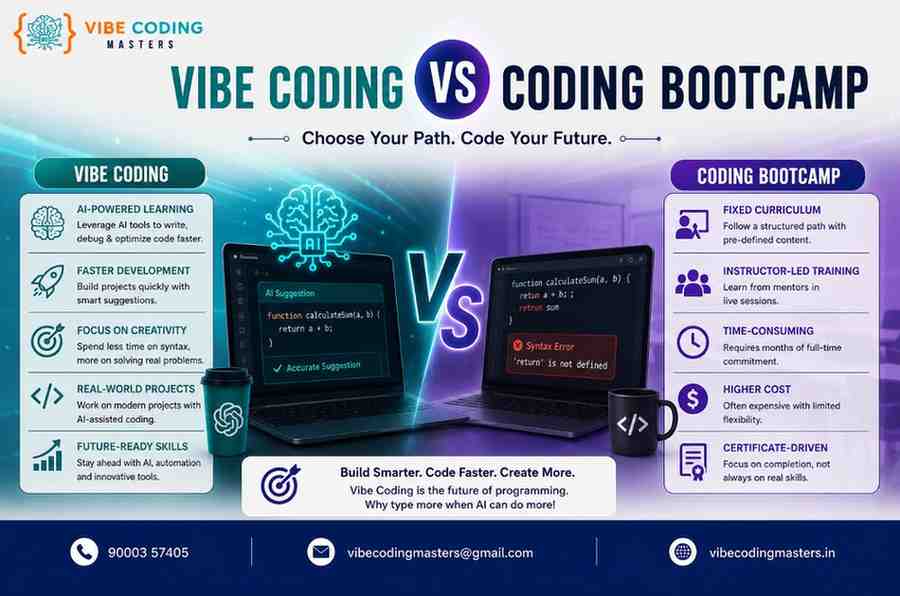
Vibe Coding vs Coding Bootcamp: Key Differences
Aspect | Vibe Coding | Coding Bootcamp |
Learning Style | Self-directed, prompt-based, iterative | Structured, instructor-led, curriculum-based |
Time to First Project | Days to weeks | Months |
Core Skill Focus | AI-assisted development, prompt engineering | Programming fundamentals, algorithms |
Cost | Low to free (tool subscriptions) | Moderate to high (tuition fees) |
Depth of Fundamentals | Variable, depends on self-study | Strong, deliberately built |
Mentorship | Often self-taught or community-driven | Built-in mentors and instructors |
Job Support | Limited unless paired with a course | Often includes placement assistance |
Best For | Fast builders, indie hackers, existing coders upskilling | Complete beginners wanting structured guidance |
Both paths can lead to real, employable skills — the difference lies in how those skills are built and how much structure a learner needs.
Why Vibe Coding is Becoming Popular in India
India’s developer community has embraced Vibe Coding rapidly, driven by a few clear forces. First, AI coding tools have become dramatically more capable and affordable, letting solo developers and students build functional apps without years of prior training. Second, India’s startup ecosystem rewards speed — founders and freelancers who can ship products quickly using AI-assisted development gain a real competitive edge.
Third, the accessibility factor matters enormously in a price-sensitive market: many Vibe Coding tools offer free or low-cost tiers, removing the financial barrier that bootcamp tuition can represent for students in tier-2 and tier-3 cities. Finally, a cultural shift is underway — Indian tech communities, YouTube creators, and LinkedIn influencers are actively promoting Vibe Coding as a fast, modern route into software careers, fueling grassroots adoption among students and early-career professionals. If you’re weighing whether you’re ready to start, our guide on eligibility for a Vibe Coding course breaks down exactly what’s expected of beginners.
Benefits of Learning Through Vibe Coding
- Speed: Build working prototypes and MVPs in hours instead of weeks.
- Low barrier to entry: No need for deep prior programming knowledge to start experimenting.
- Cost-effective: Many AI tools have generous free tiers or low monthly costs.
- Real-world relevance: Mirrors how modern development teams increasingly work.
- Encourages product thinking: Shifts focus from syntax memorization to solving real problems.
Benefits of Joining a Coding Bootcamp
- Strong fundamentals: Deep understanding of logic, algorithms, and system design.
- Structured accountability: Fixed schedules and deadlines drive consistent progress.
- Mentorship and community: Access to instructors, peer learners, and career coaches.
- Placement support: Many bootcamps offer resume reviews, mock interviews, and hiring partnerships.
- Portfolio building: Guided projects that demonstrate skills to employers.
Skills You Learn in Vibe Coding
Vibe Coding develops a hybrid skill set that blends AI fluency with core development ability — prompt engineering, AI-assisted frontend and backend development, API integration, debugging AI output, Git/GitHub, and deployment. Want to build these skills hands-on? Start with a few practical builds from our list of Vibe Coding projects for beginners, then move on to side projects that grow your skills further.
Skills You Learn in a Coding Bootcamp
- Programming Fundamentals — variables, loops, functions, data structures
- Object-Oriented and Functional Programming
- Full Stack Development — frontend frameworks (React, Angular) and backend (Node.js, Django)
- Database Management — SQL and NoSQL systems
- Testing and Debugging — writing unit tests and diagnosing bugs manually
- Git and GitHub — collaborative version control workflows
- System Design Basics — architecture and scalability principles
- Soft Skills — teamwork, technical communication, and interview readiness
For a deeper look at combining both frontend and backend skills in one build, see our guide on Full Stack with Vibe Coding projects.
Career Opportunities After Vibe Coding
Vibe Coding skills open doors to roles like AI-Assisted Developer, Indie App Builder, Freelance Web Developer, and Junior Full Stack Developer on AI-augmented teams. For a complete role-by-role breakdown of where a Vibe Coding skillset can take you, read our dedicated guide on career opportunities after Vibe Coding.
Career Opportunities After a Coding Bootcamp
Bootcamp graduates typically pursue traditional, structured developer roles:
- Frontend Developer
- Backend Developer
- Full Stack Developer
- Software Engineer (Entry-Level)
- QA/Test Engineer
- Junior DevOps Engineer
Salary Expectations for AI-Assisted Developers and Software Engineers in India
Salaries vary based on skills, company size, and location, but here’s a general benchmark for 2026
Experience Level | Traditional Software Engineer (Annual, INR) | AI-Assisted / Vibe Coding Developer (Annual, INR) |
Fresher (0–2 Years) | ₹4–7 LPA | ₹3.5–8 LPA |
Junior Developer (2–4 Years) | ₹7–12 LPA | ₹8–14 LPA |
Mid-Level Developer (4–7 Years) | ₹12–20 LPA | ₹14–22 LPA |
Senior Developer (7–10 Years) | ₹20–35 LPA | ₹15–38 LPA |
Lead/Architect (10+ Years) | ₹35–60+ LPA | ₹25–65+ LPA |
Note: Figures are indicative estimates based on general industry patterns and can vary by city, company, and specialization. For a full city-by-city and role-by-role breakdown, see our detailed guide on salary after learning Vibe Coding.
Developers who combine strong fundamentals with AI tool fluency — essentially bridging both worlds — tend to command the highest compensation, since employers value both reliability and speed.
Industries Hiring Vibe Coders and Developers
- IT Services & Consulting — TCS, Infosys, Wipro-style firms adopting AI-assisted delivery
- Startups & SaaS Companies — fast product iteration using AI tools
- E-commerce Platforms — rapid feature development and A/B testing
- Fintech — building and testing financial products quickly
- EdTech — building learning platforms and interactive tools
- Digital Agencies — client website and app development at speed
- Freelance/Gig Platforms — Upwork, Fiverr-style AI-assisted project delivery
Tools Used in Vibe Coding
- ChatGPT — for code generation, debugging, and explaining logic
- GitHub Copilot — inline AI code suggestions inside IDEs
- Cursor AI — an AI-first code editor built for prompt-driven development
- Claude AI — for reasoning-heavy coding tasks, refactoring, and documentation
- Windsurf — an agentic AI coding environment for end-to-end app building
- Git and GitHub — version control, even in AI-first workflows
- API Testing Tools — Postman and similar tools for backend integration
- Deployment Platforms — Vercel, Netlify, Render for shipping projects live
If you want to see these tools applied to a real, structured build, our guide on the best backend with Vibe Coding projects and best frontend with Vibe Coding projects walks through the tech stack in detail.
Vibe Coding Career Roadmap
Going from beginner to job-ready generally moves through four stages: learning prompt basics and simple pages, building full frontend apps with API connections, shipping complete full-stack projects with authentication and deployment, and finally architecting complex systems and mentoring others. Timelines vary, but most focused learners reach an intermediate, portfolio-ready level within three to six months.
For the full stage-by-stage breakdown with tools, skills, and timelines at each level, see our detailed Vibe Coding Roadmap 2026.
Who Should Choose Vibe Coding?
- Existing developers who want to boost productivity with AI tools
- Freelancers and solo founders who need to ship fast
- Students who want quick, hands-on exposure to building real apps
- Non-technical professionals exploring low-code/no-code product building
- Self-motivated learners comfortable with unstructured, exploratory learning
Non-technical readers specifically should check our guide on Vibe Coding for non-programmers, which covers exactly how someone with zero coding background can get started.
Who Should Choose a Coding Bootcamp?
- Complete beginners with no prior programming background
- Career switchers who need structured guidance and accountability
- Learners who value mentorship, community, and placement support
- Those who want a strong theoretical foundation before relying on AI tools
- People who thrive with deadlines, cohorts, and instructor feedback
Already working full-time and wondering how to fit this in? Our guide on the Vibe Coding course for working professionals covers flexible, weekend, and evening formats built for busy schedules.
Why Vibe Coding Could Be One of the Best Tech Skills for the Future
As AI models become more capable, the ability to direct them effectively — through clear prompts, sound architecture decisions, and rigorous review — is becoming a core professional skill, not a shortcut. Vibe Coding is less about avoiding fundamentals and more about applying them at a higher level of abstraction, similar to how compilers freed earlier generations of programmers from writing machine code by hand. Developers who master both AI tool fluency and underlying programming logic will likely be the most resilient hires in the coming decade.
Future Scope of Vibe Coding in India
India’s IT and startup ecosystem is expected to keep integrating AI-assisted workflows into everyday development. Analysts and industry commentators widely expect that AI coding tools will become standard in professional environments, not niche add-ons — similar to how Git and IDEs became universal. For Indian developers, Vibe Coding skills are unlikely to remain optional; they’re likely to become a baseline expectation across IT services, product companies, and startups alike, especially as global clients increasingly demand faster delivery cycles.
Why Vibe Coding is One of the Most Promising Tech Career Paths in India
India produces one of the largest pools of technical talent in the world, but competition for traditional developer roles is intense. Vibe Coding offers a differentiated entry point: it rewards resourcefulness, fast learning, and product thinking over years of rote practice. For students in smaller cities without access to premium bootcamps, AI tools offer a genuinely level playing field — a laptop, an internet connection, and consistent practice can produce a working portfolio within weeks.
Combined with India’s massive freelance and startup economy, Vibe Coding is positioned to create a new category of developer: fast, product-focused, and AI-fluent — one that global and domestic employers are increasingly seeking out.
How to Start Learning Vibe Coding
- Learn the basics of one programming language (JavaScript or Python) to understand what AI-generated code is doing.
- Get comfortable with ChatGPT or Claude AI for explaining and generating code snippets.
- Install an AI-first editor like Cursor AI or enable GitHub Copilot in your existing IDE.
- Practice prompt engineering — write clear, specific instructions and iterate on results.
- Build small projects — a to-do app, a landing page, a simple API-backed tool.
- Learn Git and GitHub to manage and showcase your projects.
- Deploy your projects using platforms like Vercel or Netlify.
- Explore agentic tools like Windsurf for end-to-end app building as you gain confidence.
- Join communities — Discord servers, LinkedIn groups, and forums focused on AI-assisted development.
- Keep building — a public portfolio of small, working projects is often more persuasive to employers than certificates alone.
Preparing for interviews after building your portfolio? Our Vibe Coding interview questions guide covers what recruiters actually ask in 2026.
Vibe Coding vs Traditional Programming
Aspect | Vibe Coding | Traditional Programming |
Code Writing | AI-generated, human-reviewed | Manually written line by line |
Speed | Very fast prototyping | Slower, deliberate build process |
Learning Curve | Lower initial barrier | Steeper, fundamentals-first |
Depth of Understanding | Can be shallow without discipline | Typically deep and thorough |
Best Use Case | Rapid prototyping, MVPs, startups | Complex, mission-critical systems |
Vibe Coding vs Self-Learning
Aspect | Vibe Coding | Traditional Self-Learning |
Pace | Fast, AI-accelerated | Slower, resource-dependent |
Resources Needed | AI tools, minimal manual research | Textbooks, tutorials, documentation |
Feedback Loop | Immediate (AI responses) | Delayed (self-review or community help) |
Risk of Gaps | Possible if fundamentals are skipped | Possible if motivation drops |
Ideal For | Builders who learn by doing | Disciplined, patient learners |
Market Demand and Industry Trends
The shift toward AI-assisted software development is one of the clearest trends in the global tech industry today. Organizations across sectors are investing in tools that boost developer productivity, and India — as one of the world’s largest IT talent markets — is a major beneficiary of this shift. Key trends shaping the space include
- Rising AI adoption across IT services, product companies, and startups for faster development cycles
- Growing demand for AI-assisted software development skills in job postings across India’s major tech hubs
- Improved developer productivity reported by teams integrating tools like GitHub Copilot and Cursor AI into daily workflows
- Expanding Indian IT market opportunities as global clients seek faster, more cost-effective delivery
- Future hiring trends pointing toward hybrid roles that combine traditional engineering skills with AI tool fluency
Key Takeaways
- Vibe Coding uses AI tools like ChatGPT, GitHub Copilot, and Cursor AI to build software through natural-language prompts, offering speed and low cost of entry.
- Coding Bootcamps provide structured, mentor-led training in programming fundamentals, ideal for complete beginners who want guided accountability.
- Developers who combine AI tool fluency with strong fundamentals tend to command the highest salaries and the widest range of job opportunities.
- India’s growing startup ecosystem and IT market are driving strong demand for both AI-assisted developers and traditionally trained software engineers.
- The best path isn’t always either-or — many successful developers blend Vibe Coding speed with bootcamp-level fundamentals for long-term career resilience.
Conclusion
The debate over Vibe Coding vs Coding Bootcamp doesn’t have a single right answer — it comes down to your starting point, learning style, and career goals. Vibe Coding offers speed, low cost, and hands-on exposure to the AI tools reshaping modern software development, making it a compelling option for fast learners, freelancers, and startup builders. Coding Bootcamps, meanwhile, remain a trusted, structured route for beginners who want strong fundamentals, mentorship, and placement support.
For many aspiring developers in India, the smartest strategy is combining both worlds: building solid programming fundamentals while actively learning to work with AI tools like ChatGPT, GitHub Copilot, Cursor AI, and Claude AI. Whichever path you choose, the demand for skilled, AI-fluent developers in India’s tech industry is only growing — so the best time to start learning is now. Explore our Vibe Coding Course in Hyderabad today and take the first step toward a future-ready software career.
FAQ
- What is the main difference between Vibe Coding and a Coding Bootcamp?
Vibe Coding relies on AI tools to generate and assist with code through prompts, while a Coding Bootcamp teaches structured programming fundamentals through instructor-led lessons over several months.
- Is Vibe Coding suitable for complete beginners?
Yes, but beginners get better results if they pair Vibe Coding with basic programming knowledge, since understanding AI-generated code is important for catching errors.
- Do coding bootcamps still matter in the age of AI tools?
Yes. Bootcamps provide structured fundamentals, mentorship, and placement support that many AI-only learners miss, and most modern bootcamps now include AI tools in their curriculum.
- Which pays more: Vibe Coding skills or traditional programming skills?
Developers who combine both — strong fundamentals plus AI tool fluency — tend to earn the most, since they bring speed and reliability together.
- What AI tools are most commonly used in Vibe Coding? .
Popular tools include ChatGPT, GitHub Copilot, Cursor AI, Claude AI, and Windsurf, often used alongside Git and GitHub for version control.
- Can I get a developer job through Vibe Coding alone, without a degree or bootcamp?
It’s possible, especially for freelance or startup roles, but a strong project portfolio and demonstrated understanding of fundamentals significantly improve your chances.
- How long does it take to learn Vibe Coding?
Basic proficiency can take a few weeks, while building advanced, production-ready skills typically takes three to six months of consistent practice.
- Is prompt engineering a real skill worth learning?
Yes. Writing clear, specific prompts significantly improves the quality of AI-generated code and is increasingly listed as a desirable skill in AI-related job postings.
- What industries in India are hiring AI-assisted developers?
IT services, startups, fintech, e-commerce, EdTech, and digital agencies are among the sectors actively seeking developers skilled in AI-assisted development.
- Should I choose Vibe Coding or a Coding Bootcamp for a long-term career?
If you want fast, flexible entry with lower cost, Vibe Coding is a strong starting point. If you prefer structured learning, mentorship, and placement support, a Coding Bootcamp may suit you better — many learners benefit from combining both.