Lovable AI Tutorial, Bolt.new & Cursor AI for Beginners: The 2026 Guide
Lovable AI turns a plain-English idea into a working full-stack app. Bolt.new builds and runs projects right in your browser, then deploys them in minutes. Cursor AI is a full code editor with AI built in, ideal for beginners who want to learn coding properly. This guide compares all three, walks through each tool step by step, and shows the careers they open up.
★★★★★
4.9/5 rated by 1329+ students · Google Verified
Table of Contents
Introduction
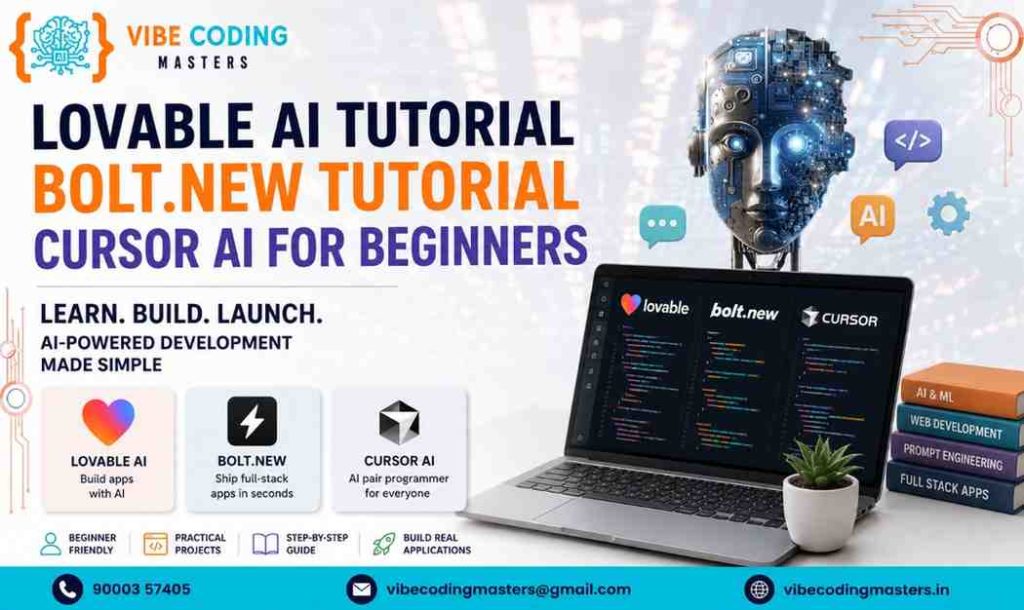
A few years ago, building a web app meant setting up an editor, learning a framework, wiring a database, and fighting deployment before you saw anything on screen. That barrier is mostly gone. This Lovable AI tutorial, Bolt.new tutorial, and Cursor AI for beginners guide walks you through three tools that turn a description into working software, then teaches enough craft to fix and ship it. If you are weighing self-study against a structured Vibe Coding Course in Hyderabad, this gives you the full picture first.
AI-assisted coding is no longer a novelty. Independent 2026 surveys from JetBrains, Stack Overflow, and Google’s DORA program put developer adoption at roughly 85 to 90 percent, and among newcomers it is close to the default. So the real question is not whether to learn AI coding, but which tools to start with and how to use them without shipping broken software.
Lovable AI Tutorial, Bolt.new & Cursor AI for Beginners
What is Lovable AI?
Lovable AI is an AI app builder. You describe the product you want in plain language, and it generates a complete web application: the interface, the logic behind it, and the database connections that store your data. You then refine the result through conversation, the way you might brief a junior developer.
The appeal is speed and completeness. Instead of stitching together separate tools for design, frontend, and backend, Lovable produces a running app you can preview immediately. The output is real code you can inspect and export, not a locked-in template.
What is Bolt.new?
Bolt.new is a browser-based AI development environment. It writes your project, installs packages, runs the app in a live preview, and can deploy it, all in one tab. There is nothing to set up on your machine, which removes one of the most frustrating parts of getting started.
Where Lovable leans toward polished app building, Bolt feels closer to a fast workshop. You prompt it, watch it scaffold the files, then keep talking to adjust features. Because it runs a real development environment in the browser, you see the same file structure a professional would, which makes it a useful bridge toward understanding code.
Key features of Bolt.new
- Zero local setup, since everything runs in the browser.
- Full project generation with live install and preview.
- Quick deployment, so a prototype becomes a shareable link in minutes.
- Visible file tree and editable code for learners who want to look under the hood.
- Support for popular frameworks, giving you real-world stacks rather than toy examples.
Bolt is ideal when you want to test an idea today. Our roundup of beginner project ideas pairs nicely with a browser tool like this one.
What is Cursor AI?
Cursor AI is a code editor with AI built into every part of the workflow. If you have used a professional editor, Cursor feels familiar, because it is based on the same foundation as Visual Studio Code. The difference is you can highlight code and ask for an explanation, request a feature in plain English, or let it edit several files at once while you review.
Cursor asks more of you than an app builder does, and that is the point. You keep working with real files, folders, and version control, so the skills transfer directly to a job. For beginners serious about becoming developers rather than only assembling apps, this is where deeper learning happens. We cover how it pairs with Google’s agent tooling in our guide to using Cursor with Antigravity.
Key features of Cursor AI
- A familiar editor for anyone moving toward professional development.
- Inline chat to explain, refactor, or debug the exact code you select.
- Multi-file edits guided by your instructions, with a review step before you accept.
- Codebase awareness, so suggestions fit the project instead of being generic.
- Direct work with Git, terminals, and packages, like a real developer setup.
Why AI Coding Tools Are Transforming Software Development
The shift is measurable. In the DORA 2025 report, adoption among software professionals jumped 14 percentage points in a single year, and many now use AI for a couple of hours every working day. GitHub’s data shows most new developers reach for an AI assistant within their first week.
Two changes matter most for a beginner. First, the time from idea to running software has collapsed, so you learn by building far more often. Second, developers in 2026 report spending more time reviewing AI-generated code than writing fresh code. Reading, checking, and correcting are becoming the core skills, not typing speed.
That reframes what a good course teaches: less memorising syntax, more understanding structure well enough to judge what the AI hands you. A well-designed vibe coding training program in Hyderabad focuses on exactly that judgment, which separates a fragile demo from a real product.
Key Concepts Every Beginner Should Understand
Before the tutorials, here are the ideas that make AI coding tools click. You do not need all of them on day one, but recognising them turns generated code from a black box into something you can steer.
Prompt engineering and AI-assisted coding
Prompt engineering is describing what you want clearly enough that the AI builds the right thing; good prompts state the goal, the constraints, and the tech to use. AI-assisted coding is the broader habit of working with an AI across writing, explaining, and fixing code. Our guide to writing effective vibe coding prompts goes deep here, and it is the single skill that most improves your results.
Frontend, backend, and full-stack development with AI
Frontend development is everything the user sees and clicks. Backend development is the hidden engine: the logic, the rules, the data handling. Full-stack means both. AI generates all of it from a prompt, so a beginner can produce a complete app, but knowing which layer a bug lives in is what lets you fix it. A frontend with vibe coding project and a matching backend with vibe coding project make the split concrete.
The core web technologies
A few names come up constantly. JavaScript is the language of the web and runs in every browser. TypeScript is JavaScript with type checking that catches mistakes before they run, and it is increasingly expected at product companies. React is the most common library for building interfaces, and Next.js is the framework many teams build on top of it. On the server side, Node.js lets JavaScript run outside the browser, and Python is a favourite for data-heavy work.
Git, APIs, databases, and deployment
Version control with Git tracks every change and is non-negotiable for real work; GitHub is where most people host code. An API is how two programs talk, so fetching weather or processing a payment means calling an API. Database integration is how your app remembers things between visits. Deployment takes your app from your screen to a public web address. Every tool here touches all four, so understanding them matters even when the tool handles the mechanics.
Debugging, refactoring, and code generation
AI code generation is the headline feature: describe a function, get working code. Debugging with AI means pasting an error and asking why it happened, often faster than a search. Code refactoring cleans up working code so it stays readable as your app grows, and AI is good at it. Chat assistants such as ChatGPT, Claude, and Gemini do these tasks in conversation, while editor tools like Cursor and GitHub Copilot bring the same help into your files. Copilot is worth knowing as the autocomplete-style assistant most teams already use.
Lovable AI Tutorial for Beginners
Here is a simple first project with Lovable: a personal expense tracker. The steps generalise to almost anything you build.
- Sign in and start a new project. Create an account and open a blank build. Nothing installed.
- Write a clear first prompt. Describe the whole app in a few sentences: “Build an expense tracker where I can add expenses with a name, amount, and category, see a running total, and delete items from a list.” Specific prompts produce specific apps.
- Review the generated app. Lovable builds the interface and the data handling and shows a live preview. Click around and note what you would change.
- Refine through conversation. Ask for changes one at a time: “Add a monthly filter,” or “Show the total in bold at the top.” Small requests are easier to check than one giant instruction.
- Add accounts if needed. For private per-user data, ask Lovable to add login. This is where understanding authentication pays off.
- Test and publish. Try to break your own app first with odd inputs, empty values, and long text. Then publish and send the link to a friend for feedback.
The habit to build here is reviewing, not just accepting. Read what changed after each prompt, and ask Lovable to explain anything you do not understand. That one behaviour turns app building into real learning.
Bolt.new Tutorial: Step by Step
Bolt shines for quick prototypes. Let’s build a simple landing page with a working contact form.
- Describe the page. Try: “Create a landing page for a coding bootcamp with a hero section, three feature cards, testimonials, and a contact form that validates email.” Bolt scaffolds the files and installs what it needs.
- Watch the live environment. Bolt shows the file tree and runs a real dev server. Open a file or two to see how the project is organised.
- Iterate with follow-up prompts. “Make the hero background a soft gradient,” or “Add a pricing section with three tiers.” Each request updates the running preview.
- Fix issues by talking to Bolt. If the form does not validate, tell Bolt what is wrong. Because it sees the whole project, it usually finds the cause quickly.
- Deploy in a click. Bolt publishes your project to a live URL, so you have a shareable site built entirely in the browser.
Bolt is the tool to reach for when motivation matters, because you see results fast. Once you are comfortable here, the jump to a full editor feels natural. If you want a structured path from prototypes to production, the vibe coding roadmap lays out a sensible order.
Cursor AI for Beginners: A Practical Guide
Cursor is where you stop only generating apps and start understanding them. It looks like a professional editor, so give yourself patience for the first hour.
- Open a project. Start a fresh folder or open code you exported from Bolt or Lovable. Seeing generated code in a real editor is a great way to learn.
- Use inline chat to understand code. Highlight any block and ask, “What does this do?” Cursor explains it in context, which is the fastest way to learn from code that already works.
- Edit with natural language. Select a component and say, “Add a loading spinner while data fetches.” Cursor proposes the change as a diff you accept or reject.
- Let it debug with you. Point Cursor at a failing file. Because it reads the whole codebase, its fixes tend to fit your project rather than being generic snippets.
- Work with Git from the start. Commit as you go. Version control feels like overhead until the day it saves you.
The mindset shift with Cursor is ownership. You are the developer, and the AI is your fastest colleague. Accept its help, but read every change. That balance is exactly what employers value, and what a good course trains.
Lovable AI vs Bolt.new vs Cursor AI
Each tool wins at a different job, so this comparison points you to a starting place rather than a single winner. For a wider view of the field, see our rundown of what software is used for vibe coding.
Feature | Lovable AI | Bolt.new | Cursor AI |
Ease of use | Very high, prompt-driven | High, browser-based | Moderate, editor-based |
Target users | Founders, designers, non-coders | Prototypers, beginners | Aspiring and working developers |
Coding support | Generates and exports code | Full project in the browser | Deep, in-editor AI assistance |
UI generation | Strong, polished output | Strong, fast iteration | You build with AI help |
Backend development | Built-in database and auth | Supported via frameworks | Full control, you wire it |
AI assistance style | Conversational app building | Conversational + live env | Inline chat and multi-file edits |
Deployment | One-click publish | One-click deploy | Your choice of host |
Pricing | Free tier, paid plans scale | Free tokens, paid for more | Free tier, paid pro plan |
Learning curve | Lowest | Low to moderate | Moderate |
Best use case | Idea to working app fast | Quick deployable prototype | Learning to code with AI |
Best Use Cases for Each AI Coding Tool
Choosing the right tool saves hours. Use Lovable AI when you have a clear product idea and want a polished, working version to show investors or users; it is great for a first SaaS prototype or internal tool. Reach for Bolt.new to test many ideas quickly or ship a small site the same day. Choose Cursor AI when the goal is to genuinely learn, work on a real codebase, or add features to something that exists. And yes, you can build a full website with vibe coding, front end and back end included.
In practice, learners combine them: sketch an idea in Bolt, rebuild it in Lovable, then export to Cursor for the features that need real control. The person who knows when to use which is the one who moves fastest.
Skills You Need Before Using AI Coding Tools
You can open any of these tools today with zero background. But a handful of skills separate a demo from something people rely on. Build them as you go.
- Basic web literacy: knowing what frontend, backend, and databases are, so you can locate a problem.
- Reading code: you do not have to write fluently, but you must be able to follow what the AI produced.
- Prompt engineering: clear instructions get clean results, and vague ones get confused apps.
- Git basics: committing, branching, and undoing changes without panic.
- Debugging sense: reading an error message and forming a guess before you paste it into the AI.
This is exactly the gap a structured program fills. Self-teaching works but is slow and full of blind spots. A guided hands-on Vibe Coding Course in Hyderabad compresses months of trial and error into a sequenced path with feedback, which is why many career switchers prefer it.
Common Mistakes Beginners Should Avoid
Most early frustration comes from a short list of avoidable errors. Watch for these
.
- Accepting code without reading it. AI is confident even when wrong; review every change, especially anything touching data or payments.
- Writing one enormous prompt. Break requests into small, testable steps so you can tell what changed.
- Skipping the fundamentals. Without knowing how a web app is structured, every bug becomes a wall.
- Ignoring version control. Without Git, one bad AI edit can undo hours of work. Commit often.
- Not testing edge cases. Empty inputs, huge numbers, and missing data break most apps. Try to break your own build.
- Chasing tools instead of projects. Employers want deployed work. Finish three real projects before the fifth tool.
These habits are what separate a fragile demo from a product you can ship and maintain. Build the discipline early and every later project gets easier.
Learning Roadmap: Beginner to Expert
Use this roadmap as a rough map, not a rigid syllabus.
Level | Learning Focus |
Beginner | Build small apps with Bolt.new and Lovable AI. Learn what frontend, backend, and databases are. Write clear prompts and publish your first live project. |
Intermediate | Move into Cursor AI. Read and edit real code, add user login and databases, and start using Git properly. Learn JavaScript and React basics so you understand the output. |
Advanced | Ship full-stack apps with APIs, payments, and deployment. Add TypeScript and Next.js. Debug and refactor confidently, and review AI code critically before merging. |
Expert | Design architecture, handle security and performance, and lead AI-assisted workflows for a team. Combine prompt engineering with strong fundamentals to ship production software. |
Career Opportunities with AI-Assisted Development
The job market rewards people who pair AI fluency with real skill. Recruiters in India through 2026 report that developers who work well with AI tools such as Cursor, Bolt, and Copilot command noticeable salary premiums over those who do not, which is why job-focused vibe coding classes in Hyderabad train both together. The roles below are realistic targets as you progress.
Role | Required Skills | Recommended Tools | Salary in India (2026) | Career Growth |
AI Frontend Developer | React, TypeScript, UI sense, prompting | Cursor, Bolt.new | ₹4–9 LPA | Senior frontend, product engineer |
AI Full Stack Developer | Frontend + backend, databases, APIs | Cursor, Lovable AI | ₹5–12 LPA (freshers 3.5–6) | Lead engineer, architect |
Prompt Engineer | Clear writing, LLM behaviour, some Python | AI chat assistants, Cursor | ₹6–25 LPA with coding skills | Senior prompt/AI engineer |
AI Software Engineer | Strong fundamentals, system design | Cursor, Copilot | ₹6–15 LPA at mid level | Staff engineer, tech lead |
Product Builder | End-to-end building, design, shipping | Lovable AI, Bolt.new | ₹5–15 LPA or product revenue | Product owner, startup role |
Startup Founder | Building fast, validating ideas | All three tools | Varies; equity upside | Scale your own company |
Freelance AI Developer | Delivery, client work, versatility | Lovable AI, Cursor | ₹40k–1.5L+ per month | Agency, consulting |
To go deeper on which path fits you and how hiring works, read our look at careers after vibe coding. Roles that combine AI tools with real engineering judgment see the fastest salary growth.
Industry Trends and Market Insights for 2026
The numbers make the direction clear. Adoption of AI coding tools sits around 85 to 90 percent of professional developers across the major 2026 surveys. In one open survey, the share of code respondents called AI-generated jumped from about 28 percent in 2025 to 54 percent in 2026, and daily users report saving several hours a week on routine work.
India is at the centre of this. Analysts project the country will host more than a million active AI and machine-learning roles by 2026, with 15 to 20 percent yearly salary growth. Hyderabad has grown as a hub, with major product companies expanding campuses there and a lower cost of living than Bengaluru that stretches a salary further. Startups want builders who can ship with AI, and enterprises are adopting these tools with reviews wrapped around them.
The counter-trend is trust. Confidence in AI output has fallen even as usage rises, and the common complaint is code that is almost right but not quite. Read that as an opportunity: the people who can spot and fix those near-misses are the ones companies pay more to hire.
Why AI Coding Tools Are One of the Best Skills to Learn in 2026
Put the pieces together and the case is strong.
- Faster development. You go from idea to working app in hours, so you learn and ship far more often.
- Higher productivity. Routine tasks that used to eat in the morning now take minutes.
- Better freelancing. One builder with AI can deliver what used to need a small team.
- A startup edge. Founders can build and test products without waiting on a technical hire.
- Higher-paying jobs. Developers who direct AI will earn a premium, and India’s demand is rising.
- Enterprise demand. Large companies are standardising on AI workflows and need people who use them responsibly.
None of this removes the need to understand software. It raises the value of understanding it, because judgment is now the scarce part.
How to Start Learning Lovable AI, Bolt.new, and Cursor AI
Here is a simple sequence you can start this week. First, build one small app in Bolt.new to feel the speed. Second, rebuild a similar idea in Lovable AI and add user accounts, so you meet authentication and databases. Third, export a project into Cursor AI and read and edit the code, using inline chat for anything unfamiliar. Alongside all three, practise prompt engineering deliberately, because it improves every result.
Self-study can work with this sequence. What it lacks is feedback, structure, and someone to flag bad habits. A guided program supplies those, plus real projects and interview prep. Our full-stack vibe coding course in Hyderabad sequences these tools into a path that ends with deployable projects and job-ready fundamentals, and the enrolment page for the flagship Vibe Coding Course in Hyderabad is where you compare batches and syllabi.
Key Takeaways
- Lovable AI turns ideas into full apps, Bolt.new builds and deploys in the browser, and Cursor AI teaches you to code with AI inside a real editor.
- Start with Bolt or Lovable for quick wins, then move to Cursor to understand the code and build lasting skill.
- The scarce skill in 2026 is reviewing and correcting AI output, not typing code, so learn the fundamentals alongside the tools.
- Deployed projects beat certificates for hiring; finish three or four real builds before chasing the next tool.
- India’s demand for AI-fluent developers is rising, with Hyderabad a growing hub and clear salary premiums for those who direct AI well.
Conclusion: Start Your AI Coding Journey Today
The barrier to building software has dropped further than at any point in a decade. With this Lovable AI tutorial, Bolt.new tutorial, and Cursor AI for beginners guide, you have a clear path: build fast with Bolt and Lovable, grow real skill in Cursor, and learn the fundamentals so you can trust what you ship. The tools are remarkable, but the value comes from the person steering them.
So pick one tool and build something small this week. Publish it, break it, fix it, build the next one. If you want structure, feedback, and a route that ends in deployable projects and job-ready fundamentals, explore the Vibe Coding Course in Hyderabad and turn these tutorials into a career. The best time to begin was a year ago. The second best is now.
FAQ
What is Lovable AI?
Lovable AI is an AI app builder that turns plain-English descriptions into working full-stack web applications. You describe the product you want, and it generates the frontend, backend logic, and database wiring, then lets you preview and refine the result through conversation. It suits founders, designers, and beginners who want a functional app without writing every line by hand.
Is Bolt.new free?
Bolt.new offers a free tier with a limited monthly allowance of AI tokens, which is enough to try small projects and learn the workflow. Larger or more frequent builds need a paid plan, since generating and running full applications in the browser consumes more resources. Beginners can complete their first few projects on the free tier.
Is Cursor AI good for beginners?
Cursor AI works well for beginners who want to learn real coding rather than only generating apps. It is a full code editor with AI built in, so you can ask it to write, explain, or fix code while still seeing the files. The learning curve is a little steeper than app builders, but you understand more of what you ship.
Which AI coding tool is best for beginners?
There is no single best tool. Lovable AI is best for turning an idea into a working app fast. Bolt.new is best for quick browser-based prototypes you can deploy in minutes. Cursor AI is best if you want to learn to code properly with AI assistance. Most learners end up using all three for different jobs.
Can beginners build apps using AI without coding knowledge?
Yes, beginners can build simple apps with tools like Lovable AI and Bolt.new without writing code first. But you still need to understand what the app is doing to fix bugs, add features, or deploy safely. Basic knowledge of frontend, backend, databases, and Git makes the difference between a demo and a product people can use.
Do I need programming knowledge to use these AI coding tools?
You can start without programming knowledge, but you will hit a ceiling quickly. AI tools generate code confidently, including code that looks right but is wrong. Knowing how a web app is structured, how data flows, and how to read an error message lets you catch these mistakes. That is why structured training pays off faster than trial and error alone.
Which tool is better than GitHub Copilot for beginners?
GitHub Copilot autocompletes code inside your editor and assumes you already know how to code. For beginners who want to build whole apps, Lovable AI and Bolt.new are friendlier because they generate complete projects from a description. Cursor AI sits in the middle, giving you a full editor with deeper AI help than autocomplete alone. The right pick depends on your goal.
Can AI replace software developers?
No. AI speeds up the routine parts of coding, but it does not replace judgment about architecture, security, product decisions, or debugging tricky production issues. Surveys through 2026 show developer roles growing, not shrinking, with the biggest premium going to developers who direct AI tools well and review their output carefully.
What projects can I build with Lovable AI, Bolt.new, and Cursor AI?
Beginners can build landing pages, portfolio sites, to-do apps, expense trackers, booking forms, simple dashboards, and small SaaS prototypes. As you improve, you can add user login, payments, and database-backed features. Building three or four deployed projects matters more for hiring than any certificate.
Which AI coding tool should I learn first?
Start with Bolt.new or Lovable AI to see a working app quickly and stay motivated, then move to Cursor AI to understand the code underneath. Learning prompt engineering alongside all three helps you get better results. A guided course keeps this order structured so you do not skip the fundamentals that interviews still test.