Vibe Coding vs Agentic Coding: The Complete 2026 Guide
Vibe coding vs agentic coding describes two AI-assisted development styles. Vibe coding means a developer prompts an AI conversationally, reviews each suggestion, and stays in control of every edit. Agentic coding means an autonomous AI agent plans tasks, edits multiple files, runs tests, and reports back. Vibe coding suits learning and prototyping; agentic coding suits repetitive, well-specified engineering work.
★★★★★
4.9/5 rated by 1329+ students · Google Verified
Table of Contents
Introduction
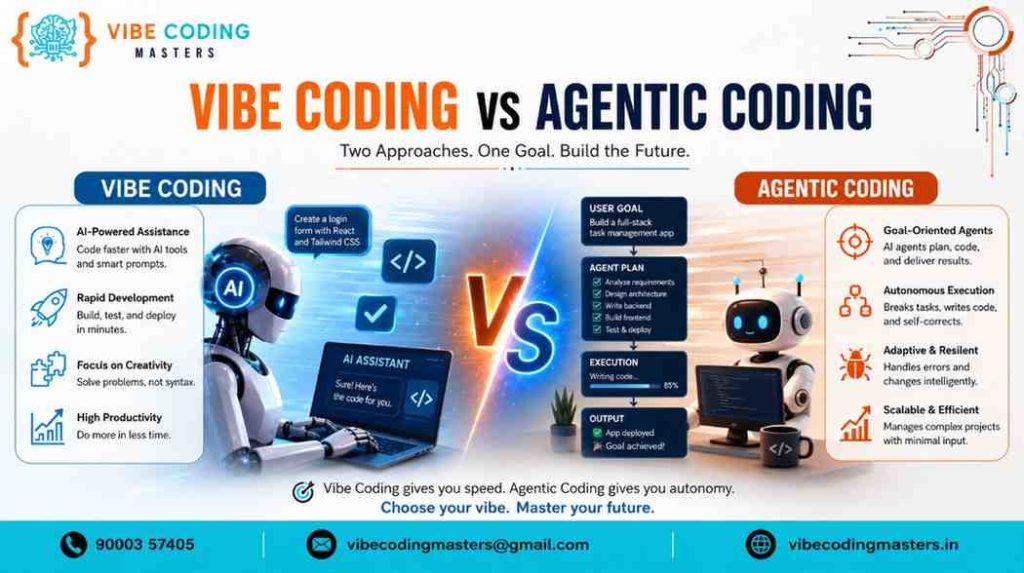
Vibe coding and agentic coding sound similar, share tools, and get used interchangeably. They are not the same. Vibe coding is conversational: you describe what you want, the model proposes code, you read it, correct it, move on. You always press accept. Agentic coding shifts that boundary — you hand over a goal, and an agent breaks it into steps, reads the repository, edits files, runs commands, and retries when something breaks. You review the outcome, not every keystroke.
Developers compare the two because adoption is no longer the story; depth of use is. Surveys through 2025 and early 2026 put AI tool usage among professionals in the mid-eighties to ninety percent range, with roughly half using them daily. What separates an average package from a premium one is not whether you use AI, but whether you can supervise it. Employers now ask for prompt fluency, review discipline and guardrail design — which is why a serious Vibe Coding Course In Hyderabad teaches both workflows rather than treating them as rival camps.
Vibe Coding vs Agentic Coding
What is Vibe Coding?
In this comparison, the key point isn’t what vibe coding means—it’s ensuring that every code change is reviewed and approved before being applied.That one constraint is what separates it from everything else on this page. For the full definition and origin of the term, see what vibe coding actually means. The defining trait is turn-by-turn control — nothing reaches your codebase unread.
A typical session: you ask for a React component showing a paginated order list. The model produces a file. You notice it refetches on every render and ask it to memoise. It rewrites. You notice the error state is missing and ask for it. Four exchanges later you have a working component you understand line by line, because you watched it get built. Done well, this is accelerated pair programming; done badly it produces code nobody understands. Most professional developers say fully hands-off, prompt-only development is not part of their production workflow even though AI-assisted coding is near-universal: the industry adopted the assistant, not the abdication. That is the heart of the vibe coding versus traditional coding debate.
What is Agentic Coding?
Agentic coding is a development style where an AI system receives a goal and the authority to pursue it across multiple steps without asking permission at each one. It plans, acts, observes and adapts, using tools — a file system, a terminal, a test runner — in a loop until the goal is met. The shift is from generation to execution: an assistant answers a question, an agent completes a task. Told to add rate limiting to your API, it reads the routing layer, matches the existing middleware pattern, writes and wires it, adds a test, runs the suite, and installs a missing dependency.
Three capabilities make this work: planning, which decomposes a vague instruction into ordered actions; tool use, which lets the model touch the real world rather than only emit text; and memory, which keeps the loop converging instead of spinning. Autonomy is a dial, not a switch: most production setups keep a human gate before a commit or a deployment. Analysis of AI-authored pull requests repeatedly finds materially higher rates of logic errors and security findings than human equivalents, which is why review capacity, not generation capacity, is now the bottleneck.
Vibe Coding vs Agentic Coding: Key Differences
The two differ across almost every practical dimension. This table is the fastest way to internalise the contrast.
Feature | Vibe Coding | Agentic Coding |
Definition | Conversational, prompt-and-review development where the human accepts each change | Goal-driven development where an AI agent plans and executes multiple steps autonomously |
Human Involvement | Continuous; human is in the loop on every turn | Periodic; human is on the loop, reviewing outcomes and approving checkpoints |
AI Autonomy | Low — the model suggests, never acts alone | High — the agent reads files, runs commands, and retries on failure |
Speed | Fast per snippet; limited by human reading speed | Fast per task; can run unattended across many files |
Learning Curve | Gentle; anyone who can describe a feature can start today | Steep; requires repo hygiene, testing, sandboxing and permission design |
Code Quality | Depends on reviewer skill; usually consistent because each line is seen | Highly variable; strong with good tests and specs, poor without them |
Debugging | Easy — you were present when the code was written | Harder — you must reconstruct the agent’s reasoning after the fact |
Best Use Cases | Learning, prototypes, UI work, unfamiliar syntax, small features | Refactors, migrations, test generation, dependency upgrades, bug triage |
Collaboration | Individual; feels like pair programming | Team-scale; agents fit into CI, ticketing and review pipelines |
Cost | Predictable flat subscription for most tools | Volatile; token spend scales with task complexity and retries |
Scalability | Limited by one developer’s attention | High, but capped by the team’s review bandwidth |
Career Suitability | Students, freelancers, career switchers, product-minded builders | Platform engineers, senior developers, AI engineers, DevOps teams |
How Vibe Coding Works
Stage one: state the intent
Name the framework, the file, the data shape, the edge cases. Vague prompts produce plausible code for a problem you did not have. Much of the craft is learning to specify, and a library of tested vibe coding prompts shortens that curve considerably.
Stage two: read the output critically
Check imports, error handling, and assumptions about data the model could not have known. The most cited failure mode is not broken code — it is code that is almost right, which is far more expensive to catch.
Stage three: correct through conversation
Tell the model what is wrong and why rather than rewriting from scratch. This keeps context alive and forces you to articulate your reasoning.
Stage four: verify by running
Trust nothing that has not been executed. If the language is unfamiliar, keep the official reference open beside the assistant — the Python documentation or the MDN JavaScript reference settles any disagreement faster than another prompt will.
How Agentic Coding Works
Planning. The agent converts your goal into a task list and most show it before acting. A weak plan guarantees a weak outcome, so reviewing it is the highest-leverage thirty seconds you will spend.
Context gathering. The agent searches the repository to learn existing patterns. Clear structure, a readable README, consistent naming and real tests give it signal; a messy repo produces a confused agent.
Acting through tools. The agent edits files and runs commands — what separates agents from assistants, and what requires guardrails. Version control is the safety net, so knowing Git properly, especially branching and reverting, is non-negotiable before an agent touches a working tree.
Observing and reporting. The agent reads terminal output, test results and type errors, then decides what next. A fast test suite gives it a reliable oracle; a repo without tests gives it nothing but confidence. You review the diff, not the journey — treating agent output like a junior developer’s pull request: welcome, useful, never merged unread. That discipline is what practical vibe coding training in Hyderabad drills in lab hours.
Benefits of Vibe Coding
- Extremely low barrier to entry. A student with a browser and an idea ships working software on day one.
- You learn while you build. Because you read every line, the model becomes a tutor attached to your own project.
- Excellent for unfamiliar territory. New framework, new language, unfamiliar API — the model closes the recall gap so you focus on logic.
- Fast prototyping. Founders validate ideas in an afternoon. For portfolio building this is decisive, which is why a list of vibe coding projects for beginners is the standard on-ramp into the field.
- Low blast radius. The worst case is a bad suggestion you decline. Nothing executed, nothing committed, nothing broke.
Benefits of Agentic Coding
- Parallelism. An agent works while you do something else. Several agents can work several tickets at once.
- It absorbs tedious work. Dependency bumps, test scaffolding and config migrations are boring precisely because they are well-defined — exactly what agents handle best.
- Faster review cycles. Teams using AI across the pipeline report large reductions in pull request turnaround.
- It is where enterprise investment is going. Analyst forecasts through 2028 assume near-universal AI assistant use among enterprise engineers.
Vibe Coding vs Agentic Coding for Beginners
Advice that is correct for a staff engineer can be actively harmful for a second-year student. This table maps the recommendation to the person.
Profile | Start With | Why | Move To Agentic When |
Students | Vibe coding, heavily | You need mental models. Watching code appear line by line and asking why builds understanding an agent would deny you. | You can read a 200-line diff and say confidently what is wrong with it. |
Beginners / career switchers | Vibe coding | Fastest route to a working portfolio and to the confidence that you belong in the field. | You have shipped three projects and written your own tests for them. |
Freelancers | Vibe coding with selective agents | Client work is varied and specs are vague, so the tight loop protects your reputation. Agents help on repetitive parts. | You have a repeatable project template with tests you trust. |
Startup founders | Vibe coding first, then agents | Speed to validation beats architecture at prototype stage. Once there are paying users, unattended changes get expensive. | You have CI, staging and version control discipline in place. |
Enterprise developers | Both, with governance | Compliance, audit trails and code ownership are non-optional. Agents need permission boundaries before capability. | Your organisation has approved model policies and CI policy gates. |
AI engineers | Agentic, deeply | Building the agents is the job. Orchestration, evaluation and tool design are the core competencies. | Already there — the growth edge is evaluation and observability. |
Nobody should start with agents. Autonomy is only valuable to someone who can tell whether the autonomous thing did the right thing. That sequence is captured in this structured vibe coding roadmap, and it is the same order a mentored structured Vibe Coding Course In Hyderabad should take you through.
Which Approach is Better for Professional Developers?
The question is not which to choose but when to switch, and it reduces to one thing: how well specified is the task? Reach for vibe coding when the problem is ambiguous or correctness is expensive to verify. Reach for an agent when the task is mechanical but large, or when success has a clear automated signal — test generation, framework upgrades and consistent renames are agent territory.
One uncomfortable finding deserves attention. A controlled trial found experienced developers on familiar codebases were measurably slower with AI tools despite reporting they felt faster. The perception of speed is unreliable, and AI helps least exactly where your expertise is highest. Multiple 2026 surveys found the typical professional runs two or three AI tools rather than one — the market has settled this argument in favour of “both, deliberately.”
Best AI Tools for Vibe Coding
Not every tool sits cleanly on one side of this comparison. ChatGPT and Claude stay purely conversational — you always press accept. Cursor and Windsurf matter here because their agent mode blurs this article’s own line: running one in chat-only mode is vibe coding, flipping on multi-file agent mode is agentic coding — same tool, same session, different discipline required. Bolt.new, Lovable and Replit lean agentic by default: you describe an app, and it builds most of it without a turn-by-turn review loop. For full descriptions of each tool, see the Vibe Coding roadmap.
Cursor AI is an AI-first editor rather than a plugin. It indexes your codebase so prompts are answered with awareness of your actual files, and it straddles vibe and agentic since it also runs multi-step edits — a workflow covered in this guide to vibe coding with Cursor and Antigravity. Windsurf Editor takes a similar codebase-aware approach with heavier emphasis on flow. Gemini is most often used for research-adjacent coding and long-context reading.
A fuller comparison lives in this overview of what software is used for vibe coding, and tool selection is one of the first things a hands-on Vibe Coding Course In Hyderabad should settle through project work rather than opinion.
Best AI Agents for Agentic Coding
Claude Code is the terminal-native agent that drove much of the mainstream shift toward agentic workflows; its adoption arc from 2025 into early 2026 was among the fastest recorded in developer tooling surveys. OpenAI Codex in its agentic form runs tasks in an isolated environment and returns proposed changes. Devin AI was the first product marketed as an autonomous software engineer rather than an assistant. Cursor AI‘s agent mode performs planned multi-file edits while keeping you in the editor.
Below the products sit the orchestration frameworks, where AI engineers actually work:
- LangGraph models agent behaviour as an explicit state graph of nodes, edges and conditions,Teams reach for it specifically when a workflow needs a mandatory human-approval node before a deployment step, not just after one.
- AutoGen centres on multi-agent conversation — a planner, a coder, a critic —A common setup pairs two agent roles instead of one — the first writes the change, the second is instructed to find fault with it before anything reaches a person. Only after that internal disagreement settles does a reviewer even open the pull request.
- CrewAI uses a role-and-task metaphor that maps onto how human teams divide work, Teams building their first multi-agent pipeline usually prototype here before graduating to LangGraph once the workflow needs stricter control.
- MCP (Model Context Protocol) standardises how models connect to external tools and data, so a capability written once works across compatible clients.
Most run on Node or Python, so working knowledge of the Node.js runtime documentation is close to mandatory if you intend to build agents rather than use them.
Skills Required for Vibe Coding
- Precise technical communication. Stating a requirement unambiguously is the highest-return skill here.
- Code reading. More important now than code writing. You must judge unfamiliar code in under a minute.
- Programming fundamentals. Data structures, control flow, async behaviour, state. Without these you cannot evaluate what you are handed.
- Prompt engineering. Not magic phrases — context supply, constraints, examples, iteration.
Skills Required for Agentic Coding
- Everything above, plus depth. Agentic coding is a superset; there is no shortcut past fundamentals.
- Testing discipline. The test suite is the agent’s feedback signal. Weak tests make your agent blind and confident.
- Security awareness. Agents that consume external content introduce a prompt injection surface that did not exist in the completion era. Familiarity with the OWASP Top Ten is baseline literacy now.
- Evaluation and observability. Answering “is this agent getting better or worse?” with data rather than vibes.
- Governance literacy. Permission boundaries, sandboxing, audit trails. Frameworks such as the NIST AI Risk Management Framework increasingly appear in enterprise procurement, and the vocabulary is a real interview differentiator.
Real-World Use Cases
Where vibe coding wins
A final-year student builds an expense tracker with authentication in a weekend and can explain every design choice in the viva.
Where agentic coding wins
A team migrates two hundred files from one date library to another overnight. Test coverage on a legacy service climbs from eleven to sixty percent because an agent wrote the unmemorable cases. A deprecation cleanup across a monorepo completes correctly because the agent, unlike a human, does not get bored on file ninety.
Where both run together
The realistic 2026 workflow is layered: vibe code the novel part, then hand the surrounding scaffolding to an agent. Full-stack work is the clearest example since the boilerplate ratio is highest, which is why the full stack with vibe coding course in Hyderabad is built around this division of labour rather than around one tool.
Industries Adopting AI-Assisted Software Development
The split by industry tracks risk tolerance more than size. Startups run agents with minimal oversight because a bad autonomous change is cheap to revert. Fintech and enterprise GCCs run agents inside tight permission boundaries with audit trails, because the same mistake there is expensive. IT services in Hyderabad specifically hire for supervised AI use — reading and gating agent output — not for unsupervised speed.
Career Opportunities in AI-Assisted Coding
These are not the beginner titles covered in our general careers after vibe coding guide — this is what those roles evolve into once agentic work becomes part of the job. The number that matters here isn’t the base band — it’s the premium.
The premium isn’t paid for prompting fluency alone — it’s paid to whoever a team trusts to approve an agent’s pull request without quietly redoing the agent’s work themselves. That trust is what the pay gap is actually pricing in. For the full city-wise and experience-wise breakdown, see salary after learning vibe coding. Bengaluru and Hyderabad lead the country on pay, and Hyderabad’s lower cost of living means real purchasing power here is often better than the headline gap suggests.
Every salary study reaches the same conclusion: portfolio beats credential — three well-documented, deployed projects move interview conversion more than any certificate. That is the case for choosing Vibe Coding classes in Hyderabad structured around shipping real projects rather than watching recorded lectures — and it is worth reading what employers actually probe for in these vibe coding interview questions before your first round.
AI-assisted coding career roadmap
Stage | Skills | Recommended AI Tools | Projects |
Beginner (0–3 months) | Programming fundamentals, one language properly, Git basics, prompt structure, reading code critically | A general conversational assistant for explanation; an inline completion assistant in the editor | To-do app with auth; a landing page; a small REST API; a CLI utility you actually use |
Intermediate (3–9 months) | Framework depth, databases, REST and auth, unit testing, debugging, deployment, code review | Codebase-aware AI editor; prompt-to-app tools for rapid experiments | Full-stack CRUD app with tests and CI; a third-party API integration; a deployed portfolio site |
Advanced (9–18 months) | System design, agent orchestration, tool calling, RAG basics, security review, CI/CD, sandboxing | Terminal or CI-attached coding agent; an orchestration framework; MCP-based tool integrations | A working agent that automates a real task in your own repo; an evaluated RAG application |
Expert (18 months+) | Evaluation harnesses, observability, cost and token engineering, governance, multi-agent design, mentoring | Custom agent stacks; internal platform tooling; policy-gated pipelines | An internal AI developer platform; a published evaluation framework; open-source contributions |
AI-Assisted Development Market Insights
Adoption is effectively saturated. Adoption has moved past the early-majority phase, but the more telling number is the split within that adoption: teams increasingly run a conversational assistant for exploration and a separate agent for execution, rather than one universal tool. That two-tool pattern is a stronger sign of maturity than any single usage percentage.
Productivity gains are real and uneven. Around nine in ten AI users save at least an hour a week and one in five save eight or more, but gains concentrate among daily users and senior engineers.
Trust has fallen while usage rose. The trust gap isn’t uniform across workflows — reviewers catch issues in agent-authored diffs noticeably more often than in vibe-coded snippets, simply because an agent touches more files per session than a human would ever approve in one sitting. The most cited frustration is output that is almost right — more usage, less trust.
Quality risk is measurable, and review has overtaken writing. AI-authored pull requests carry substantially higher issue rates, and independent testing shows a large share of AI code samples failing security benchmarks. Meanwhile multiple 2026 surveys found developers now spend more hours per week reviewing AI-generated code than writing new code. Review capacity is the bottleneck, so review skill is the scarce good.
Why AI-Assisted Coding is Transforming Software Development
Faster cycles, less repetition. Pull request turnaround has compressed dramatically at teams using AI across the pipeline rather than only at the keyboard. Boilerplate, scaffolding and config files were never where engineering value lived, and handing them to a machine is the least controversial claim in this article.
Quality is now a governance question. AI raises both speed and defect rate. Teams that treat AI output as draft material, tag AI-authored changes and run automated security gates keep the speed without the incidents. Teams that skip that step ship the incidents.
The role itself is being redefined. Engineering is shifting from producing code to specifying, supervising and validating it. That is not a smaller job — it is a more senior one, arriving earlier in careers than it used to. What that means for titles and progression is explored in this look at careers after vibe coding.
Future of Vibe Coding and Agentic Coding
Three predictions are safe. First, the distinction will blur at the tool level — every assistant is growing an agent mode and every agent a conversational mode. Second, it will sharpen at the skill level: knowing when to delegate and when to supervise is judgement, and judgement does not ship in a product update. Third, standardisation wins, as MCP-style protocols shift competition from integration coverage to reliability, cost and safety. What will not change is accountability: every serious forecast assumes a human owns the outcome. Treat agents as capable, tireless colleagues with poor judgement about consequences — exactly how you would treat a brilliant intern with committed access.
Common Mistakes Developers Should Avoid
- Accepting code you cannot explain. If you cannot explain it, you cannot maintain it or defend it in an interview.
- Staying in vibe mode after a task turns mechanical — repetitive renames belong to an agent; doing them by hand in chat wastes review time you’ll need elsewhere.
- Handing agents an untested repository. Without tests the agent cannot know it broke something. Neither can you.
- Removing all approval gates for speed. The gates are the reason the incident did not happen.
- Ignoring prompt injection. Any agent that reads external content can be instructed by that content.
- Treating this as a tool decision. It is a workflow decision. The tool will change next quarter; the discipline will not.
- Switching to agent mode before the spec is stable — an agent executes a bad plan fast and confidently, which costs more to unwind than a bad vibe-coding suggestion.
Best Practices for AI-Assisted Software Development
- Give context before instructions. The most bad output is a specification failure wearing a model’s clothes.
- Keep changes small and reviewable. Large diffs get rubber-stamped, and rubber-stamped diffs are where incidents live.
- Invest in tests before autonomy. The test suite is the only honest feedback an agent will ever get.
- Run agents on a branch, always. Never on main, never without a way back.
- Automate the security gate. Static analysis and dependency scanning in CI catch entire classes of failure before a human looks.
- Review the plan, not just the diff. Catching a wrong plan takes thirty seconds; catching a wrong diff takes an hour.
- Learn both approaches in order. Fundamentals, then conversational AI, then agents. A training path that enforces that sequence will get you further than any tool subscription, because the sequence is the curriculum.
Key Takeaways
- Vibe coding is human-led, agentic coding is goal-led. One accepts suggestions turn by turn; the other delegates a task and reviews the outcome.
- Start with vibe coding, always. Autonomy is only valuable to someone who can evaluate it.
- Review skill is the scarce resource. Developers now spend more time reviewing AI code than writing it, adoption sits near ninety percent while trust sits near thirty, and defect rates in AI-authored changes are measurably higher.
- The hybrid workflow has already won. Most professionals run two or three tools — an assistant for thinking, an agent for mechanical work.
- The career premium is for supervision, not usage. In India, generative and agentic specialisation carries a twenty to forty percent premium, and a defensible portfolio outperforms any certificate.
Conclusion
The vibe coding vs agentic coding question is not a fork in the road. It is a sequence. Vibe coding teaches you to specify clearly, read critically, and understand what you are shipping. Agentic coding lets you apply that understanding at a scale one person could not otherwise reach.
Choose based on the task, not the tool you enjoy. Ambiguous, expensive-to-verify work belongs in a conversation; mechanical, automatically-checkable work belongs to an agent. Most real days contain both, which is why the developers doing best stopped picking sides and built the judgement to switch. AI has made producing code trivial and owning code harder.
That skill is built by doing. Pick a real problem, build it conversationally until you understand every line, write tests, then hand the boring half to an agent and review what comes back like it came from a stranger. If you want that path structured, project-driven and mentored rather than improvised, explore the Vibe Coding Course In Hyderabad at Vibe Coding Masters and start building something you can defend.
FAQ
What is vibe coding?
Vibe coding is a development approach where you describe what you want in natural language and an AI model generates the code, while you review and refine each suggestion through conversation. The human stays in the loop on every turn and nothing enters the codebase unread.
What is agentic coding?
Agentic coding is a development approach where you give an AI agent a goal rather than an instruction, and the agent plans the work, reads your repository, edits multiple files, runs commands and tests, observes results, and self-corrects until the task is complete.
What is the difference between vibe coding and agentic coding?
The core difference is autonomy and where the human sits. In vibe coding the human is in the loop, approving every change, and the AI only suggests. In agentic coding the human is on the loop while the AI acts, running commands and editing files independently.
Which is better for beginners, vibe coding or agentic coding?
Vibe coding, without exception. Beginners need mental models of how software works, and that happens by reading code line by line and asking why it was written that way. Move toward agents only once you can read a two-hundred-line diff and confidently identify what is wrong with it.
Is agentic coding replacing developers?
No, and the data actively contradicts the claim. Adoption has reached roughly ninety percent while developer trust in AI output has fallen to around twenty-nine percent, and AI-authored pull requests carry measurably higher issue and security-finding rates. What is changing is the shape of the role: less production of code, more specification, supervision and validation.
Can ChatGPT be used for vibe coding?
Yes. ChatGPT is where most developers write their first coding prompt, and it remains strong for explaining concepts, debugging a pasted stack trace, and exploring an approach before committing. Its limitation is context: it cannot see your repository.
Which AI tools support agentic coding?
Terminal and IDE-native agents including Claude Code, OpenAI Codex in its agentic form, Cursor AI’s agent mode and Devin AI operate at the product level. Beneath them sit orchestration frameworks: LangGraph models behaviour as an inspectable state graph, AutoGen coordinates multiple conversing agents, and CrewAI uses a role-and-task metaphor.
Is coding knowledge required for vibe coding and agentic coding?
For anything beyond a throwaway prototype, yes. You can generate a working demo with no programming knowledge, but you cannot evaluate it, debug it, extend it safely, or defend it in an interview.
Which approach is better for startups?
Vibe coding first, then agents once there are paying users. At the validation stage, speed to a working prototype beats architecture, and prompt-to-app tools compress that from weeks to an afternoon. Once real users depend on the product, introduce agents alongside CI and staging.
What is the future of AI-powered software development?
Tools will converge — every assistant is growing an agent mode and every agent a conversational mode — so the product-level distinction will fade. The skill-level distinction will sharpen, because knowing when to delegate and when to supervise is a judgement no product update ships.