Vibe Coding Side Project Ideas: 25+ Builds to Grow Your Skills in 2026
Vibe coding side project ideas are small, self-directed apps you build using AI coding tools and natural-language prompts instead of writing every line by hand. From to-do apps and portfolio sites to AI chatbots and full-stack SaaS tools, these projects help beginners, students, and working developers learn faster, build a real GitHub portfolio, and prepare for higher-paying AI-assisted development jobs in India and worldwide.
★★★★★
4.9/5 rated by 1329+ students · Google Verified
Table of Contents
Introduction
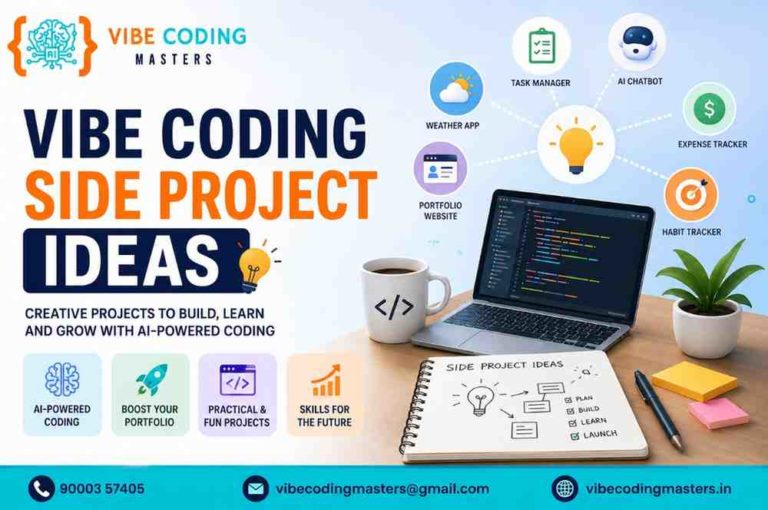
Vibe coding is a new way of building software where you describe what you want in plain English and let an AI coding assistant generate, refine, and debug the code with you. Instead of memorizing every syntax rule before you ship anything, you focus on the idea and the user while the AI handles much of the boilerplate. This shift is opening the door for far more people to build real applications.
The fastest way to get good at this style of development is not another tutorial. It is building things. Side projects give you hands-on practice, force you to solve real problems, and leave you with something you can show. That is exactly why a strong list of vibe coding side project ideas matters so much right now.
Whether you are a beginner, a student trying to stand out, a freelancer building portfolio pieces, or a developer moving into AI-assisted work, side projects are your shortcut. They turn concepts into working apps, build a GitHub profile recruiters notice, and prepare you for interviews and freelance work. For structured guidance alongside your own builds, a hands-on Vibe Coding Course in Hyderabad gives you mentorship and a clear path to a job-ready portfolio.
Vibe Coding Side Project Ideas
Key Takeaways
- Vibe coding side projects teach AI-assisted development faster than tutorials because you learn by building and shipping real apps.
- Start small with beginner builds, then move through intermediate and advanced projects to steadily grow your skills and confidence.
- A GitHub portfolio of two or three deployed projects influences hiring and salary more than certifications alone in 2026.
- AI tools such as ChatGPT, GitHub Copilot, Cursor AI, and Claude speed up building, but you still need to understand and review the code.
- Hyderabad’s growing tech and GCC ecosystem rewards developers who can show practical, deployed vibe coding projects.
What Are Vibe Coding Side Project Ideas?
Vibe coding side project ideas are small application concepts you build on your own time using AI coding assistants and natural-language prompts. A side project is anything you create outside coursework or a paid job: a weekend app, a tool that solves a personal problem, or a demo to learn a new framework.
What makes them vibe coding projects is the workflow. Instead of writing thousands of lines from a blank editor, you describe features to an AI tool, review what it produces, ask for changes, and shape a working product. The AI acts like a fast pair-programmer, and you act like the lead who decides and checks the output.
These projects compress the learning curve. In traditional learning, months can pass before a beginner ships anything useful. With AI assistance, a motivated learner can build and deploy a working app in days, and that early progress turns curious beginners into confident developers. A plain-language explainer on vibe coding projects for beginners shows how these builds are structured.
Why Build Vibe Coding Side Projects?
Side projects are one of the highest-return activities in a developer’s career. Here is what they give you:
- Faster learning. You learn by doing. Every bug you fix teaches more than a lecture.
- Hands-on experience. Projects prove you can take an idea from prompt to deployed product.
- Portfolio building. A set of finished apps is stronger than a resume full of course names.
- GitHub contributions. Regular commits build a public track record recruiters and clients can inspect.
- Interview preparation. Talking through a project you built beats reciting theory.
- Freelancing opportunities. Once you have shipped a few things, you can offer similar work to clients.
The 2025 Stack Overflow Developer Survey found 44% of developers who learned something new last year used AI tools to do it, up from 37%. The guide on careers after vibe coding shows how these skills translate into roles, and vibe coding training in Hyderabad pairs your practice with mentor feedback.
Best Vibe Coding Side Project Ideas for Beginners
Beginner projects should be small enough to finish in a weekend and useful enough to keep you motivated. The goal is to complete something end to end, from idea to deployed link.
- To-do list app. The classic first build: add tasks, mark them done, and store them. Teaches state, storage, and basic UI.
- Personal portfolio website. A single-page site with your bio, projects, and contact form. Your online business card.
- Weather dashboard. Pull data from a free weather API and show a clean forecast. Good practice with external data.
- Expense tracker. Log spending, categorize it, and show a monthly total. Introduces forms and calculations.
- Quiz app. A set of questions with scoring at the end. Fun to build and easy to expand.
- Simple landing page. A marketing page for an imaginary product. Layout, copy, and responsive design.
Each fits AI assistance well: you describe the feature, the tool scaffolds it, and you refine. A good early challenge is turning an idea into a live site, which is why learning whether you can build a website with vibe coding is a useful starting point.
Intermediate Vibe Coding Side Project Ideas
Once you are comfortable shipping small apps, intermediate projects add real logic, user accounts, and connected front and back ends.
- Blog platform with a CMS. Write, edit, and publish posts. Teaches authentication, databases, and content management.
- Recipe or workout app. Save, search, and filter items by category. Good practice with structured data.
- URL shortener. Take a long link, generate a short one, and redirect. A small, satisfying full-stack build.
- Notes app with sync. Notes that save to a database and load across sessions.
- Job board. List openings, filter by role or location, and let users apply. Several features in one product.
- E-commerce storefront demo. Product listings, a cart, and a checkout flow. Teaches a lot even without real payments.
At this stage you wire a front end to a back end and a database. A frontend project with vibe coding gets the interface right, while a matching backend vibe coding project covers the server and data. Doing both gives you a full mental model of how modern apps fit together.
Advanced Vibe Coding Side Project Ideas
Advanced projects are AI-powered, production-minded, and closer to what companies actually ship. These are the builds that impress hiring managers and can even become startups.
- AI chatbot for a niche. A support assistant for fitness, finance, or study help, built on an LLM.
- SaaS dashboard with subscriptions. User tiers, a dashboard, and billing logic. Real product territory.
- AI content generator. Produces summaries, captions, or drafts from a prompt, with editing and export.
- Real-time chat app. Live messaging with rooms and presence. Teaches websockets and scaling.
- Document Q&A tool. Upload a PDF and ask questions about it using retrieval and an LLM.
- Full-stack project manager. Boards, tasks, teams, and permissions, deployed to the cloud.
These are ambitious, and that is the point. Building a complete full-stack vibe coding project that runs live is one of the strongest portfolio pieces you can own. Recruiters in 2026 value candidates who can take a feature from experiment to a working API that serves real users, not just notebook demos. If you want to build these end to end with guidance, the full stack with vibe coding course in Hyderabad takes you from front end to deployment.
Project Difficulty Table
Project Name | Difficulty | Technologies Used | Estimated Completion Time | Skills Learned |
|---|---|---|---|---|
To-do list app | Beginner | HTML, CSS, JavaScript | 1–2 days | State, storage, basic UI |
Personal portfolio site | Beginner | HTML, Tailwind CSS, React | 2–3 days | Layout, responsive design, deployment |
Weather dashboard | Beginner | JavaScript, REST API | 2–3 days | API calls, data handling |
Blog platform with CMS | Intermediate | React, Node.js, MongoDB | 1–2 weeks | Auth, CRUD, databases |
URL shortener | Intermediate | Node.js, Express, PostgreSQL | 4–6 days | Routing, redirects, data storage |
E-commerce storefront demo | Intermediate | Next.js, Node.js, Firebase | 2 weeks | Cart logic, state, checkout flow |
AI chatbot (niche) | Advanced | Python, FastAPI, LLM API | 2–3 weeks | Prompting, API design, deployment |
SaaS dashboard with billing | Advanced | Next.js, Node.js, PostgreSQL | 3–5 weeks | Auth tiers, billing, dashboards |
Document Q&A tool | Advanced | Python, FastAPI, vector search | 3–4 weeks | Retrieval, embeddings, LLM integration |
AI Tools That Make Vibe Coding Faster
The right tool depends on the task. Here is how the most popular assistants fit into a side-project workflow. Each is described in plain terms so you know when to reach for it.
- ChatGPT. Best for brainstorming features, explaining errors, and generating snippets in conversation. A great thinking partner when stuck.
- GitHub Copilot. Lives in your editor and autocompletes as you type. Ideal for routine functions and boilerplate.
- Claude. Strong at longer files, structure, and clear explanations. Useful for refactoring and reviews.
- Gemini. Handy for research, multimodal inputs, and quick generation in Google’s ecosystem.
- Cursor AI. An AI-first editor that edits across your whole project from prompts. Great for multi-file builds.
- Windsurf. Another AI editor focused on agentic, project-wide changes and automated task completion.
- Bolt.new. Generates and runs full web apps in the browser from a prompt. Great for prototypes.
- Lovable. Builds full-stack apps from natural language, aimed at shipping working products quickly.
- Replit AI. An online IDE with AI help, so you build, run, and deploy in one place, no local setup.
A practical routine: prototype in a browser tool, move to an AI editor for real development, and keep a chat assistant open for debugging. The overview of software used for vibe coding compares the options, and since prompt quality decides output quality, studying effective vibe coding prompts makes every tool more useful.
Programming Languages for Vibe Coding Projects
You still need to understand code, even when AI writes much of it. Knowing the language lets you review output, catch mistakes, and make good decisions.
- Python. Beginner-friendly and dominant in AI and back-end work. The clear first choice for chatbots and data tools. The official Python documentation is the reference to keep open.
- JavaScript. The language of the web. Essential for interactive front ends and full-stack apps. The MDN JavaScript guide is the standard learning resource.
- TypeScript. JavaScript with type safety. It catches errors early and is widely used in larger projects.
- Java. A staple of enterprise software and Android. Reliable and still in heavy demand.
- C#. Strong for Windows apps, Unity games, and .NET business back ends.
- SQL. The language of databases, needed to store and query data properly.
For a beginner, Python plus JavaScript covers most side-project needs. The breakdown of vibe coding vs traditional coding shows where each style shines. If you want structured, project-based practice in one language, the Python with vibe coding course in Hyderabad and Java with vibe coding course in Hyderabad both build real apps from day one.
Frontend Technologies for Vibe Coding
The front end is what users see and touch. AI tools are excellent at generating clean, responsive interfaces from a description.
- HTML. The structure of every web page. Simple to learn and impossible to skip.
- CSS. Controls styling, spacing, and layout. It turns a plain page into a polished one.
- Tailwind CSS. A utility-first framework that pairs well with AI generation: describe a look and get styled markup fast.
- React. The most popular library for building interactive UIs. Component-based and portfolio-friendly. The React documentation is well written and beginner-accessible.
- Next.js. A React framework adding routing, server rendering, and easy deployment. Strong for real products.
A common winning stack for side projects is React with Tailwind CSS, deployed in minutes. It looks professional and reads well in a portfolio. To turn practice builds into job-ready interface skills, the frontend vibe coding course in Hyderabad covers React and Tailwind hands-on.
Backend Technologies for Vibe Coding
The back end handles logic, data, and security. This is where your app becomes more than a static page.
- Node.js. Runs JavaScript on the server, so you can use one language across your whole app. The Node.js documentation covers the essentials.
- Express.js. A lightweight framework for building APIs and servers on Node.
- FastAPI. A modern Python framework that is fast, clean, and popular for AI-powered back ends.
- ASP.NET Core. Microsoft’s cross-platform framework for secure, high-performance C# services.
- Spring Boot. The go-to for large Java back ends in enterprise and banking systems.
For most AI side projects, Node.js with Express or Python with FastAPI will serve you well. Both are quick to prototype and easy for AI tools to work with. For mentor-guided server-side practice, the backend vibe coding course in Hyderabad walks through Node, APIs, and databases end to end.
Databases for AI-Assisted Projects
Every serious app needs to store data, and picking a database early keeps the project organized.
- MySQL. A dependable relational database, widely used and well documented.
- PostgreSQL. A powerful, feature-rich relational database favored for serious applications. The PostgreSQL documentation is thorough and worth bookmarking.
- MongoDB. A flexible document database storing JSON-like records. Great for fast-moving projects.
- Firebase. A hosted platform bundling database, auth, and hosting. Ideal for quick MVPs.
- Supabase. An open-source alternative to Firebase built on PostgreSQL, popular for AI-era apps.
Beginners often start with Firebase or Supabase to skip setup friction. As projects grow, PostgreSQL becomes a reliable workhorse.
Career Benefits of Building Vibe Coding Side Projects
Side projects do more than teach. They move your career forward in measurable ways.
- Better resumes. Real projects give you concrete achievements instead of vague skills.
- Higher interview success. Candidates who demo and explain their own builds do better in technical rounds.
- A strong GitHub portfolio. Recruiters check GitHub, and a clean, active profile signals genuine ability.
- Freelancing opportunities. Portfolio pieces become proof you can deliver, which is exactly what clients want to see.
- Startup ideas. Many side projects grow into products. Building regularly is how founders find what to launch.
- Remote jobs. Global companies hiring from India screen on demonstrated skill, and remote roles reward it.
Industry data backs this up. 2026 hiring analysis found a documented GitHub portfolio of deployed projects affects interview conversion and salary more than certifications alone. Around 11.7% of Indian job postings now ask for AI skills, up from 8.2% a year earlier, and India is projected to host over a million AI and ML roles with 15% to 20% annual salary growth. A structured vibe coding course in Hyderabad helps you choose projects that map to hiring needs.
Best GitHub Portfolio Ideas Using Vibe Coding
Your GitHub profile is public proof of work. Treat it like a product.
- Pin your three best projects. Quality beats quantity. Show your strongest builds first.
- Write clear README files. Explain what it does, how to run it, and add a live link and screenshots.
- Deploy everything you can. A working demo link beats code that only runs locally.
- Commit consistently. Regular activity signals that you are a real, ongoing builder.
- Show variety. A front-end app, a full-stack build, and an AI-powered project prove range.
Good version control habits make this smoother. Learning the basics from the official Git documentation early saves headaches. Aim for a portfolio that tells a story: from a simple beginner app to a deployed, AI-powered product that solves a real problem.
Common Mistakes to Avoid When Building Side Projects
Most people who stall on side projects make the same avoidable errors. Watch for these.
- Starting too big. An over-ambitious first project leads to burnout. Ship something small and finish it.
- Never deploying. Code sitting on your laptop helps no one. Put projects online.
- Blindly trusting AI output. AI code can look right but be wrong, and studies show it often needs correction. Review and test everything.
- Ignoring documentation. A project without a README is hard for recruiters to understand.
- Not finishing. A completed simple app beats an abandoned complex one.
- Skipping the fundamentals. Relying only on AI leaves you unable to debug when things break.
Avoiding these keeps your momentum strong and your portfolio credible. Reviewing common vibe coding interview questions as you build helps you frame each project the way interviewers expect.
Future of Vibe Coding Projects
The direction is clear. AI-assisted development is becoming standard, not optional. The 2025 Stack Overflow survey found that 84% of developers now use or plan to use AI tools, up from 76% the year before, and JetBrains reported 85% already use them regularly. DX’s analysis of a large developer sample estimated an average of around 3.6 hours saved per week per developer, which compounds across a year.
Several trends will shape what you build next. Low-code and no-code platforms keep lowering the barrier to entry, automation is handling more repetitive work, and agentic AI, where systems complete multi-step tasks with little supervision, is moving from experiment to real use. In India, agentic and generative AI skills command the highest salary premiums in 2026.
The lasting takeaway is not that AI replaces developers. Trust in raw AI output is falling, which means human judgment matters more, not less. The people who thrive will direct AI tools well, review the output critically, and ship reliable products. Side projects are how you build that skill set.
How to Start Your First Vibe Coding Side Project
You do not need to plan for months. You need to start. Here is a simple roadmap from idea to deployment.
- Pick one small idea. Choose a beginner project you can finish in a weekend, such as a to-do app or portfolio site.
- Choose your stack. For a first build, React with Tailwind CSS on the front end is a friendly, popular choice.
- Set up your tools. Install an AI-friendly editor and keep a chat assistant open for help.
- Prompt, build, and refine. Describe features one at a time, review the code, and adjust until it works.
- Test everything. Check each feature works and fix bugs before moving on.
- Deploy it live. Put your project online with a free hosting service.
- Push to GitHub. Commit your code, write a clear README, and add the live link.
- Then level up. Once it is shipped, start the next, slightly harder project.
A clear vibe coding roadmap keeps you from feeling lost between projects. If you prefer structure and mentorship, the best vibe coding course in Hyderabad guides you through this path with feedback at each step.
Learning Roadmap Table
|
Level |
Focus |
Sample Projects |
Tools and Skills |
|---|---|---|---|
|
Beginner |
Ship small apps end to end |
To-do app, portfolio site, weather dashboard |
HTML, CSS, JavaScript, basic prompting |
|
Intermediate |
Connect front end, back end, and data |
Blog CMS, URL shortener, e-commerce demo |
React, Node.js, databases, auth |
|
Advanced |
Build AI-powered, deployed products |
AI chatbot, SaaS dashboard, document Q&A |
Python, FastAPI, LLM APIs, cloud deployment |
|
Expert |
Own production and scale |
Multi-tenant SaaS, agentic AI apps, real-time systems |
System design, MLOps, security, DevOps |
Comparison Table
|
Comparison |
Vibe Coding |
The Alternative |
|---|---|---|
|
Vibe Coding vs Traditional Coding |
Describe features in natural language; AI generates and you refine. Faster to prototype. |
Write every line manually. Slower but gives deep low-level control. |
|
Vibe Coding vs Low-Code Development |
Full flexibility with real code you can extend anywhere. |
Faster for standard apps but limited by the platform’s building blocks. |
|
Vibe Coding vs No-Code Platforms |
Produces real, portable code you own and can scale. |
Fastest for simple tools, but you are locked into the platform and cannot customize freely. |
Statistics and Market Trends
The numbers make the opportunity concrete. AI-assisted development is now mainstream, and demand for people who can use it is strong.
- Adoption is the norm. The 2025 Stack Overflow survey found 84% of developers use or plan to use AI tools, and 51% of professionals use them daily. JetBrains put regular use at 85%.
- Productivity gains are real but need judgment. Large-sample analysis showed roughly 3.6 hours saved per developer weekly, while controlled studies show AI output still needs review.
- The tool market is booming. Gartner estimated the AI code-assistant market at 3 to 3.5 billion dollars in 2025, with the broader market larger still.
- Demand is climbing. In India, roughly 11.7% of job postings now require AI skills, and the country is projected to host over a million AI and ML roles with 15% to 20% yearly salary growth.
- India’s tech hubs lead on pay. Bengaluru and Hyderabad pay well above the national average for AI roles, and Hyderabad is often cited for its strong salary-to-cost ratio.
- Portfolios drive hiring. A documented GitHub portfolio of deployed projects affects interview conversion and salary more than certifications alone.
For learners in Hyderabad, this mix of high demand, strong local pay, and portfolio-first hiring is a real advantage. Vibe coding classes in Hyderabad put you close to the GCCs, product companies, and startups hiring AI-capable developers.
Why Vibe Coding Side Projects Are One of the Best Ways to Learn Software Development
If you take one idea from this guide, make it this: building side projects is the most effective way to learn modern, AI-assisted development.
- Faster practical learning. You absorb concepts by using them, which sticks better than passive study.
- Real-world experience. Every project throws real problems at you, and solving them is the job.
- Portfolio creation. You end up with proof of skill, which unlocks interviews and freelance work.
- AI collaboration skills. You learn to prompt, review, and direct AI tools, now a core professional skill.
- Career growth. A visible body of work helps you stand out and negotiate salary.
- Startup opportunities. Some projects reveal problems worth solving at scale, and that is how products begin.
Tutorials teach concepts. Projects teach you to build. In a market that rewards demonstrated ability, the second is what changes your career.
Conclusion
Building side projects is the fastest, most reliable way to become a capable AI-assisted developer. The best vibe coding side project ideas meet you where you are, from a weekend to-do app as a beginner to a deployed, AI-powered SaaS product as you advance. Each one teaches real skills, adds a piece to your portfolio, and moves your career forward.
Start small. Pick one simple idea today and finish it, no matter how basic. Then publish it on GitHub with a clean README and a live link so the world can see what you built. From there, keep leveling up, and keep learning with modern AI coding tools as they evolve, because the developers who direct these tools well are the ones companies are competing to hire.
The demand is real, the opportunity in Hyderabad is strong, and the barrier to entry has never been lower. Choose your first project, open your AI editor, and start building. For expert guidance and a proven path, enroll in a vibe coding course in Hyderabad and turn your side projects into a career.
FAQ
- What are the best vibe coding side project ideas for beginners?
The best beginner projects are small and finishable in a weekend: a to-do list app, a personal portfolio website, a weather dashboard, or a quiz app. Each teaches core skills and leaves you with a deployable result for your portfolio.
- Do I need to know how to code before starting vibe coding projects?
No, but you should learn the basics as you build. AI handles much of the writing, yet you still need to understand code to review output and fix bugs. Beginners can start building immediately and pick up fundamentals as they go.
- Which AI tools are best for vibe coding side projects?
ChatGPT and Claude are great for brainstorming and debugging, GitHub Copilot speeds up in-editor coding, and Cursor AI or Windsurf handle larger multi-file builds. Browser tools like Bolt.new, Lovable, and Replit AI suit fast prototypes. Most builders combine several.
- How many side projects do I need for a strong portfolio?
Quality beats quantity. Two or three well-built, deployed projects with clear README files outperform a long list of unfinished ones. Aim for variety: one front-end app, one full-stack build, and one AI-powered project.
- Can vibe coding side projects help me get a job?
Yes. Recent hiring analysis shows a documented GitHub portfolio of deployed projects influences interview success and salary more than certifications alone. Projects prove you can build real things, which is what employers and clients want.
- What programming language should I use for vibe coding projects?
For most beginners, Python and JavaScript cover nearly everything. Python suits AI and back-end work, while JavaScript powers interactive web apps. Add TypeScript later for type safety on bigger projects.
- Are vibe coding projects good for freelancing?
Yes. Once you have shipped a few polished projects, you can offer similar work to clients. Portfolio pieces prove you can deliver, which helps you win freelance gigs and set fair rates.
- How long does it take to build a vibe coding side project?
Beginner projects take one to three days, intermediate builds one to two weeks, and advanced AI-powered products three to five weeks. Finishing small builds quickly creates the momentum that carries you through harder ones.
- Is vibe coding replacing traditional coding?
Not exactly. Vibe coding changes the workflow and speeds up building, but you still need to understand code. Trust in raw AI output is falling, which makes human review more important, so the strongest developers combine both approaches.
- Where can I learn vibe coding with proper guidance in Hyderabad?
You can learn independently through side projects, but structured training adds mentorship, feedback, and a clear roadmap. A dedicated vibe coding course in Hyderabad takes you from your first project to a job-ready portfolio while connecting you to the local hiring market.