Vibe Coding Roadmap 2026: Skills, Tools & Career Path
A Vibe Coding Roadmap is a step-by-step learning path that takes you from beginner to job-ready AI-assisted developer. It blends programming fundamentals, prompt engineering, and AI tools like ChatGPT, GitHub Copilot, and Cursor with real projects and certifications. In 2026, this skill set powers some of India’s fastest-growing, highest-paying software careers, especially across Hyderabad’s booming IT market.
★★★★★
4.9/5 rated by 1329+ students · Google Verified
Table of Contents
Vibe Coding Roadmap: The Complete 2026 Guide to AI-Assisted Software Careers in India
Software development is being rewritten in real time. A few years ago, writing code meant memorising syntax, fighting compiler errors, and stitching together logic line by line. Today, developers describe what they want in plain English and watch an AI assistant draft working code in seconds. This new way of building software has a name, and a clear learning path: the Vibe Coding Roadmap.
If you are a student, fresher, or working professional trying to break into tech, this roadmap matters more than almost any single skill you could pick. The demand is real, the salaries are climbing, and the entry barrier has never been lower. This guide walks you through every stage, tool, and decision you need to go from complete beginner to a confident, employable AI-assisted developer.
Vibe Coding is not a shortcut that skips learning. It is a smarter way to learn, build, and ship. In cities like Hyderabad, where global capability centres and product companies are hiring aggressively, knowing how to code with AI has quickly become a baseline expectation rather than a bonus. The structured Vibe Coding Course In Hyderabad is built around exactly this roadmap, with real-time projects and placement support to back it up.
AI-assisted development is growing fast for a simple reason: it works. Eighty-four percent of developers say they use or plan to use AI tools in their development process, and 51% of professional developers use them daily. When the whole industry shifts its workflow this quickly, the people who learn the new method early are the ones who get hired first.
Vibe Coding Roadmap
What is Vibe Coding?
Vibe Coding is a modern, AI-first approach to software development where you build applications by guiding artificial intelligence with clear instructions, called prompts, instead of writing every line of code manually. The term was popularised in early 2025 by AI researcher Andrej Karpathy, who described “giving in to the vibes” and letting AI handle the heavy lifting of code generation while the developer focuses on intent, direction, and review.
In practice, Vibe Coding means you describe a feature, the AI drafts the code, and you test, refine, and improve it through an ongoing conversation. You still need to understand how software works, you still review and debug, and you still make the architectural decisions. But the slow, repetitive parts of coding are handled by AI tools, freeing you to think about logic, design, and the user.
This is why Vibe Coding is so beginner-friendly. You learn by building real things from day one, rather than spending months on dry theory before you create anything useful. If you want a deeper definition with examples, the breakdown of what Vibe Coding is covers the concept and its origins in detail.
The key shift to understand: Vibe Coding does not remove the need for skill. It changes what skill means. The valuable developer is no longer the fastest typist, but the clearest thinker, the best prompter, and the most careful reviewer.
Why Vibe Coding is a High-Demand Career in India
India is in the middle of an AI hiring surge, and the numbers tell the story plainly. In 2025, companies posted more than 2.9 lakh AI-linked roles in India, with AI hiring projected to grow 32% year-on-year in 2026 to reach nearly 3.8 lakh positions, while The demand for professionals with Generative AI and Large Language Model (LLM) expertise has increased by approximately 60% compared to the previous year. That demand is not slowing down.
The supply of skilled people, however, is lagging far behind. NASSCOM reports demand growing 40% year-on-year while skilled supply grows only 15 to 20%, and India is projected to host over 1 million active AI and ML roles by the end of 2026 and 4 million by 2030. When demand outpaces supply this sharply, salaries rise and employers compete for anyone who can demonstrate practical AI development skills.
Vibe Coding sits right at the center of this gap. It teaches you to use the exact tools companies are adopting, in the exact way they are adopting them. GitHub Copilot is now deployed at roughly 90% of Fortune 100 companies, which means AI-assisted workflows are no longer experimental, they are the standard. Learning this method through a structured best Vibe Coding Course In Hyderabad puts you on the right side of that shift.
For India specifically, three forces are driving demand
- Global Capability Centres (GCCs): International firms are opening engineering centres in Hyderabad and Bengaluru to hire skilled talent at competitive cost, creating thousands of new roles.
- Digital transformation: Banks, hospitals, logistics firms, and retailers are all building software faster, and AI-assisted developers help them ship sooner.
- Remote work: Indian developers now serve US and EU product teams directly, often at premium pay without relocating.
Vibe Coding Career Opportunities in India
A Vibe Coding skill set does not lock you into a single job title. Because AI-assisted development touches every layer of software, it opens doors across multiple roles. Here are the most accessible career paths
- AI-Assisted Full Stack Developer: Builds complete web applications, frontend to backend, using AI tools to accelerate every layer.
- Frontend Developer: Creates responsive, interactive user interfaces with HTML, CSS, JavaScript, and React, often prompting AI to generate components.
- Backend Developer: Designs APIs, databases, and server logic, using AI to scaffold and then hardening the code by hand.
- Prompt Engineer: Specialises in designing effective inputs that get high-quality, reliable output from AI models.
- Automation Specialist: Connects tools and APIs to automate workflows, a fast-growing niche in operations-heavy companies.
- Freelance AI Developer: Builds websites, apps, and AI-powered tools for clients, often remotely.
Each of these roles rewards a portfolio of real projects far more than a long CV, and each one can progress into senior and lead positions over time.
Industries Hiring Vibe Coding Professionals
AI-assisted development is not confined to tech companies. It has spread across the economy because every industry now runs on software. The sectors hiring most actively in India include
- IT Services and Software: The largest employer by far, holding roughly 37% of AI job postings. These firms need developers who can ship faster.
- Banking and Financial Services (BFSI): A major and fast-growing segment, building AI-driven fraud detection, risk tools, and customer apps.
- Healthcare and Pharma: Hyderabad’s strong pharma base creates steady demand for domain-aware AI developers.
- E-commerce and Retail: Constantly building product pages, recommendation systems, and automation.
- Startups: Often the first to fully adopt Vibe Coding workflows, and a great place for freshers to gain broad experience quickly.
- Education and Media: Building content platforms, learning tools, and creative AI applications.
The breadth here is the point. A Vibe Coding skill set is portable, so you are not betting your career on one industry surviving.
Top Companies Hiring Vibe Coding Developers in India
The companies recruiting AI-assisted developers range from global giants to fast-moving startups. In Hyderabad and across India, the active recruiters include
Company Type | Examples | What They Look For |
|---|---|---|
Global product companies | Microsoft, Amazon, Google | Strong portfolios, real projects, AI tool fluency |
IT services majors | TCS, Infosys, Wipro, Cognizant | Job-ready freshers with full-stack and AI skills |
Consulting and tech | Accenture, Capgemini, PwC | Practical problem-solving and clean coding |
Startups and GCCs | Funded startups, global capability centres | Speed, versatility, and a learn-by-doing mindset |
What unites these employers is a preference for demonstrated ability. A candidate who walks in with three deployed projects often beats one with only certificates and theory. That practical, portfolio-first focus is exactly what a strong Full Stack with Vibe Coding course is designed to build.
Roles and Responsibilities of a Vibe Coding Developer
What does the day-to-day actually look like? A Vibe Coding developer typically
- Translates requirements into prompts: Turning a feature request into clear instructions an AI tool can act on.
- Reviews and refines AI output: Reading generated code critically, catching errors, and improving structure rather than blindly accepting suggestions.
- Builds and connects components: Assembling frontend, backend, databases, and APIs into a working application.
- Debugs with AI assistance: Using AI to diagnose errors faster, while understanding the root cause.
- Secures and tests code: This is critical. Research has found that around 29% of Python code generated by AI assistants can contain potential security weaknesses requiring review, so human verification is non-negotiable.
- Deploys and maintains: Shipping applications to the cloud and keeping them running.
The throughline is judgement. AI accelerates the work, but the developer remains responsible for quality, security, and design. Telemetry shows a meaningful share of merged code can now be AI-authored, which makes careful human review more valuable than ever, not less. Building this discipline under mentorship is exactly what the top-rated Vibe Coding Course In Hyderabad is designed around.
Vibe Coding Salary in India
Salaries for AI-assisted developers in India are strong and rising, driven by the supply-demand gap. Bengaluru and Hyderabad pay 20 to 40% above the national average, and Hyderabad’s lower cost of living makes its real purchasing power especially attractive.
The table below shows realistic salary ranges for AI-assisted and generative-AI-aligned development roles in India in 2026. Actual figures vary with skills, portfolio quality, company type, and city.
Experience | Salary Range (₹ per annum) |
|---|---|
Fresher (0–2 Years) | ₹4.5 – ₹10 LPA |
Mid-Level (3–5 Years) | ₹10 – ₹22 LPA |
Senior (6–10 Years) | ₹22 – ₹45 LPA |
Lead / Architect (10+ Years) | ₹45 – ₹70+ LPA |
A few patterns are worth knowing. Generative AI engineers in India earn 20 to 70 LPA compared to 10 to 40 LPA for traditional ML engineers, because the field is young, skilled talent is scarce, and business impact is immediate. For freshers, generative AI roles in 2026 generally range from ₹4.5 to ₹10 LPA, with top-end packages at premium startups and MNCs reaching ₹12 to ₹15 LPA.
Portfolio strength is the single biggest lever a fresher can pull. These bands are very reachable with the right training: the structured Vibe Coding Course In Hyderabad is built to get freshers job-ready fast. For a detailed, role-by-role breakdown, see the dedicated guide on salary after learning Vibe Coding.
Skills Required to Become a Vibe Coding Professional
Vibe Coding is beginner-friendly, but “beginner-friendly” is not the same as “skill-free.” The strongest developers pair AI fluency with real fundamentals. Here are the core skills, each with a practical use case.
Git & GitHub — Version control is how developers save, track, and collaborate on code. Git records every change so you can roll back mistakes, and GitHub hosts your projects publicly, which doubles as a living portfolio for recruiters. You can learn the fundamentals from the official Git documentation. Use case: managing a team project where multiple people edit the same codebase without overwriting each other.
Python — The most important language for AI-era development, prized for readability and its huge ecosystem of automation and AI libraries. The official Python documentation is the best place to build a solid base. Use case: writing a script that scrapes data, processes it, and feeds it into an AI model.
JavaScript — The language of the web, powering interactivity in every modern site and app. Use case: making a button respond, validating a form, or updating a page without reloading.
HTML — The structural skeleton of every webpage. You will use it constantly. Use case: defining headings, forms, and layout that the browser renders. The MDN Web Docs are the gold-standard reference for HTML, CSS, and JavaScript together.
CSS — The styling layer that controls colour, spacing, layout, and responsiveness. Use case: making a site look polished and work on both phones and desktops.
SQL — The language for talking to databases. Even with AI generating queries, you need to read and verify them. Use case: pulling all customers who ordered in the last 30 days from a database.
APIs — Application Programming Interfaces let your app talk to other services, like payments, maps, or AI models. Use case: connecting your app to a payment gateway or an AI text generator.
Prompt Engineering — The defining skill of Vibe Coding. It is the craft of writing instructions that get accurate, useful output from AI. Use case: turning a vague idea into a precise prompt that generates a working login system.
AI-Assisted Debugging — Using AI to find and explain errors quickly, while understanding why the bug happened. Use case: pasting an error message into an AI tool to get a root-cause explanation, then fixing it properly.
No-Code & Low-Code Platforms — Tools that let you build apps visually with minimal coding. Useful for rapid prototyping and for non-technical builders. Use case: spinning up a working prototype in an afternoon to test an idea before writing custom code.
If you are unsure whether you meet the starting requirements, the guide on eligibility and skills required for a Vibe Coding course clears up exactly what you need on day one (the honest answer: not much).
Best AI Tools to Learn in the Vibe Coding Roadmap
These are the tools that make Vibe Coding possible. You do not need to master all of them at once, but you should become comfortable with a core set.
ChatGPT — The most widely used AI assistant for developers, useful for generating code, explaining concepts, drafting documentation, and debugging. ChatGPT leads AI tool adoption among professional developers, making it a natural starting point. Learn its capabilities through the official OpenAI documentation. Use case: describing a function in plain English and getting a working draft you can refine.
GitHub Copilot — An AI pair programmer that lives inside your code editor and suggests code as you type. It reached roughly 20 million total users by mid-2025 and 4.7 million paid subscribers by January 2026. The official GitHub Copilot documentation is the best onboarding resource. Use case: autocompleting an entire function from a single comment describing what it should do.
Cursor AI — An AI-native code editor built around conversational coding, where you can edit whole files or projects through chat. It has grown rapidly, surpassing 2 billion dollars in annualised recurring revenue by early 2026. Use case: asking the editor to refactor an entire component across multiple files at once.
Claude AI — A powerful AI assistant known for strong reasoning, long-context understanding, and reliable code explanations, widely used for reviewing and refining larger codebases. You can explore its developer capabilities in the official Anthropic documentation. Use case: feeding a long file to the model and asking it to find logic errors and suggest improvements.
Gemini — Google’s family of AI models, integrated across Google’s developer ecosystem and useful for code generation, analysis, and multimodal tasks. Use case: generating code while drawing on Google’s broader tooling and search grounding.
Windsurf IDE — An AI-powered development environment designed for agentic, flow-based coding, where the AI can take multi-step actions across your project. Use case: letting the IDE plan and execute a series of edits to add a new feature end to end.
Visual Studio Code — The most popular code editor in the world and the home base for most AI coding extensions, including Copilot. Use case: your everyday workspace where writing, AI assistance, and debugging all come together.
Learning to combine these tools, rather than relying on any single one, is what separates a capable Vibe Coder from a casual user. The hands-on Vibe Coding course syllabus is structured around exactly this toolchain.
Complete Vibe Coding Roadmap
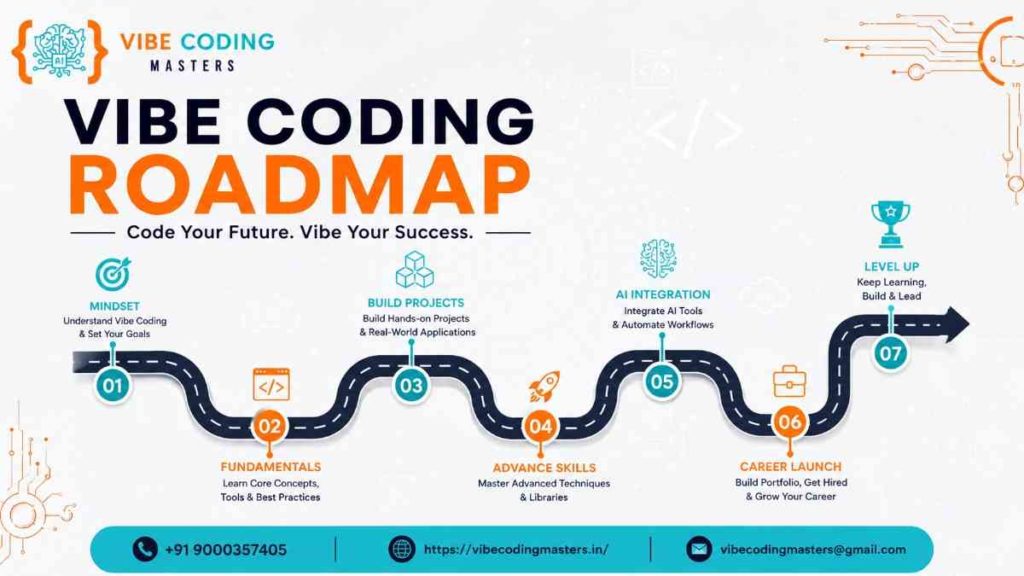
Here is the heart of this guide: a clear, staged Vibe Coding Roadmap that takes you from zero to job-ready. Move through the stages in order, and build a real project at each one.
|
Stage |
Skills to Learn |
AI Tools |
Programming Languages |
Projects |
Expected Outcome |
|---|---|---|---|---|---|
|
Beginner |
Coding logic, prompting basics, version control |
ChatGPT, VS Code |
HTML, CSS |
Personal portfolio site, to-do list app |
Build and deploy a simple static webpage with AI help |
|
Intermediate |
Frontend interactivity, responsive design, APIs |
GitHub Copilot, Cursor |
JavaScript, basic Python |
Weather app, notes app with an API |
Build dynamic, responsive apps that pull live data |
|
Advanced |
Backend logic, databases, authentication |
Claude, Windsurf, Copilot |
Python, SQL, Node.js |
Full-stack CRUD app, login system |
Ship a complete frontend-plus-backend application |
|
Expert |
Architecture, security, automation, deployment |
Full AI toolchain, agentic IDEs |
Python, JavaScript, SQL |
E-commerce store, AI-powered SaaS tool |
Design, secure, and deploy production-grade software |
A few rules make this roadmap work
- Build at every stage. Reading and watching tutorials feels productive, but only shipping projects builds real skill. Studies note that developers often judge AI tools in the first week and experience only a fraction of their potential value, so give yourself time and reps.
- Vibe code fast, engineer carefully. Use AI to prototype at speed, then apply real discipline, review, testing, and security, before anything goes live.
- Master one thing before adding the next. Do not jump to the expert tools while skipping fundamentals.
To go from this roadmap to a guided program with mentorship, you can join the Vibe Coding Course In Hyderabad with 100% placement support, which sequences these exact stages with real feedback. If your focus is the user interface, the frontend Vibe Coding course goes deep on the beginner and intermediate stages, while the backend Vibe Coding course focuses on the advanced server-side work.
Certifications That Strengthen Your Vibe Coding Career
Certifications will not replace a portfolio, but they add credibility, structure your learning, and help you pass the resume-screening stage. The most valuable ones for a Vibe Coding career include
- Course completion certifications from a recognised training institute that validate full-stack and AI-assisted development skills.
- Cloud certifications (AWS, Google Cloud, or Azure fundamentals), since cloud skills meaningfully raise salaries.
- Python and web development certifications that prove your fundamentals.
- AI and prompt engineering credentials from established platforms.
The smart approach is to pair a certification with the projects you built while earning it, so the credential points to real evidence. A recognised Vibe Coding Certification that ties directly to a project portfolio carries far more weight with employers than a standalone certificate.
Future Scope of Vibe Coding in India
The trajectory here is steep and well-documented. India’s AI sector is projected to surpass 2.3 million job openings by 2027, with openings expected to be 1.5 to 2 times the available talent, meaning the shortage of skilled people will persist for years. That is good news for anyone entering the field now.
Several trends point to durable, long-term demand
- AI is becoming the default workflow. Among new developers on GitHub, a large majority adopt AI coding tools within their first week, which means the next generation of the entire profession is being trained on these methods.
- The market is expanding, not contracting. The AI coding assistant market reached 7.37 billion dollars in 2025, up from 4.91 billion in 2024, and is projected to keep growing through 2030.
- Specialisation pays. GenAI, LLM, and AI integration skills carry the highest premiums, and that premium is expected to hold while supply catches up.
There is also an important nuance worth respecting. Adoption is rising while trust in raw AI output is being scrutinised carefully, which is exactly why companies value developers who can review, secure, and verify AI-generated code. That human judgement is the part of the job that is not going away.
How to Start a Career in Vibe Coding
You do not need a computer science degree or prior coding experience to begin. Here is a clear, practical starting sequence
- Set up your tools. Install Visual Studio Code, create a free GitHub account, and get access to an AI assistant like ChatGPT.
- Learn the basics of prompting. Practice describing what you want clearly. This is the core Vibe Coding skill.
- Build your first small project. A personal portfolio page is the classic starting point, simple, useful, and shareable.
- Learn fundamentals alongside building. Pick up HTML, CSS, and basic JavaScript as you need them, not before.
- Add backend and databases. Move into Python, SQL, and APIs once you are comfortable on the frontend.
- Build a portfolio of three to five real projects. This is what gets you interviews.
- Earn a certification and get mentorship. Structured guidance shortens the journey dramatically.
The fastest version of this path is a structured program with real feedback that follows a mentored version of this exact roadmap. Working professionals with limited time can look at the flexible, weekend-friendly Vibe Coding course for working professionals instead.
Why Vibe Coding is One of the Best IT Careers in India
Put the pieces together and the case becomes obvious. Vibe Coding offers a rare combination: a low entry barrier, high and rising salaries, broad industry demand, and a future-proof skill set, all at once.
- Low barrier to entry: No degree or prior coding required to start.
- High demand, short supply: Companies compete for skilled people, which keeps salaries climbing.
- Practical and fast: You build real things from week one, which shortens the path to employability.
- Future-ready: AI-assisted development is the direction the whole industry is moving.
- Location advantage: Hyderabad’s thriving IT and pharma ecosystem, GCC presence, and lower cost of living make it one of the best places in India to launch this career.
Few other career paths in Indian tech offer this much upside with this little friction at the start, and a structured, mentored program is what turns that potential into an actual job.
Comparison Tables
Understanding how Vibe Coding relates to adjacent fields helps you position yourself clearly. Here is how it compares.
Vibe Coding vs Traditional Software Development
Factor | Vibe Coding | Traditional Development |
|---|---|---|
Speed | Very fast, AI generates code | Slower, manual line-by-line |
Entry barrier | Low, beginner-friendly | High, steep learning curve |
Core skill | Prompting and reviewing | Memorising syntax and patterns |
Best for | Rapid building and prototyping | Deep systems and performance-critical work |
Learning curve | Build from day one | Months of theory first |
Vibe Coding vs Full Stack Development
Factor | Vibe Coding | Full Stack Development |
|---|---|---|
Scope | AI-assisted across all layers | Frontend plus backend, manual |
Tools | AI assistants central | Frameworks and libraries central |
Speed to ship | Faster with AI | Standard development pace |
Overlap | Often combined together | Foundation that Vibe Coding builds on |
Vibe Coding and full stack are not rivals, they pair naturally. Many of the strongest developers learn full stack through a Vibe Coding approach, building real projects from the very first week.
Vibe Coding vs AI Engineering
Factor | Vibe Coding | AI Engineering |
|---|---|---|
Focus | Building apps using AI tools | Building and training AI models |
Maths required | Minimal | Heavy (statistics, linear algebra) |
Entry point | Beginner-friendly | Advanced, often needs a degree |
Typical output | Web and software applications | ML models, LLM pipelines |
Vibe Coding vs No-Code Development
Factor | Vibe Coding | No-Code Development |
|---|---|---|
Flexibility | High, real code underneath | Limited to platform features |
Customisation | Full control | Constrained by templates |
Skill ceiling | Grows into full engineering | Caps at platform limits |
Best for | Career developers | Quick internal tools and MVPs |
The takeaway: Vibe Coding gives you the speed of no-code with the unlimited ceiling of real development, which is why it sits in such a strong position.
Key Takeaways
- Vibe Coding is the new default in software development, with the large majority of developers already using AI tools daily and new developers adopting them in their first week on the job.
- India’s demand far outstrips supply, with AI hiring projected to grow 32% in 2026 and a talent shortage expected to persist into 2030, keeping salaries on a steady upward climb.
- The roadmap is staged and beginner-friendly: move from beginner to expert by learning fundamentals, prompt engineering, and AI tools while building a real project at every stage.
- Portfolio beats paper. Three to five deployed projects and a relevant certification will get you further than theory alone, especially in Hyderabad’s portfolio-focused hiring market.
- Human judgement is the irreplaceable skill. AI writes code fast, but reviewing, securing, and verifying that code is what makes you genuinely employable and future-proof.
Conclusion
The Vibe Coding Roadmap is more than a learning plan, it is your entry ticket into one of the most exciting and well-paid corners of Indian tech. The barrier to entry has collapsed, the tools have never been more powerful, and the demand for people who can wield them has never been higher. What used to take years of dense study now takes months of focused, project-driven building.
Start where you are. Set up your tools, write your first prompt, ship your first small project, and keep going. Each project sharpens your judgement, strengthens your portfolio, and moves you closer to a real developer role. Layer in the fundamentals as you build, earn a certification that points to genuine work, and learn to combine AI tools with the engineering discipline employers actually pay for.
In an era where AI writes much of the code, the developers who understand how to direct it, review it, secure it, and ship it are the ones who will lead. Your roadmap is right here in front of you. The best time to start was yesterday, the second best time is right now. Take the first step, build with intent, and turn this roadmap into a career with the Vibe Coding Course In Hyderabad with placement support.
FAQ
- What is a Vibe Coding Roadmap?
A Vibe Coding Roadmap is a structured, stage-by-stage learning path that takes you from beginner to job-ready AI-assisted developer. It covers fundamentals, prompt engineering, AI tools, real projects, and certifications in a logical order, so you build employable skills step by step.
- Do I need prior coding experience to start Vibe Coding?
No. Vibe Coding is designed to be beginner-friendly, and most programs assume no prior experience. Basic computer literacy and a willingness to learn are enough. You pick up fundamentals like HTML, CSS, and Python as you build, not before.
- How long does it take to complete the Vibe Coding Roadmap?
With consistent effort, most learners move from beginner to job-ready in roughly three to six months. The exact time depends on your starting point, weekly hours, and whether you follow a structured program with mentorship, which usually shortens the journey.
- What salary can a Vibe Coding fresher expect in India?
Freshers in AI-assisted and generative-AI-aligned roles typically earn between ₹4.5 and ₹10 LPA in 2026, with strong portfolios pushing the top end to ₹12 to ₹15 LPA at product companies and startups. Hyderabad and Bengaluru pay above the national average.
- Which AI tools should I learn first for Vibe Coding?
Start with ChatGPT for general assistance, Visual Studio Code as your editor, and GitHub Copilot once you are comfortable. As you advance, add Cursor, Claude, Windsurf, and Gemini. Combining tools matters more than mastering any single one.
- Is Vibe Coding a future-proof career in India?
Yes. AI adoption in development is rising, the AI coding market is growing year over year, and India faces a long-term talent shortage projected into 2030. The review and judgement skills Vibe Coding teaches are exactly the parts of the job AI cannot replace.
- Can I get a Vibe Coding job without a degree?
Yes. Employers weigh a strong project portfolio more heavily than formal degrees. Three to five well-built, deployed projects, combined with a relevant certification, can land interviews even without a computer science background.
- What is the difference between Vibe Coding and traditional coding?
Traditional coding means writing every line manually after learning syntax in depth. Vibe Coding means guiding AI with clear prompts to generate code, then reviewing and refining it. The core skill shifts from typing speed to clear thinking, prompting, and verification.
- Is AI-generated code safe to use directly?
Not without review. A notable share of AI-generated code can contain security weaknesses, so you should never ship AI-written authentication, payment, or data-handling logic without careful human review, testing, and validation.
- Where can I learn Vibe Coding in Hyderabad?
You can follow a structured, mentored version of this roadmap through the Vibe Coding Course In Hyderabad, which sequences every stage with real-time projects, certification, and placement support to take beginners to job-ready efficiently.