Vibe Coding vs Software Testing Course: Which to Pick?
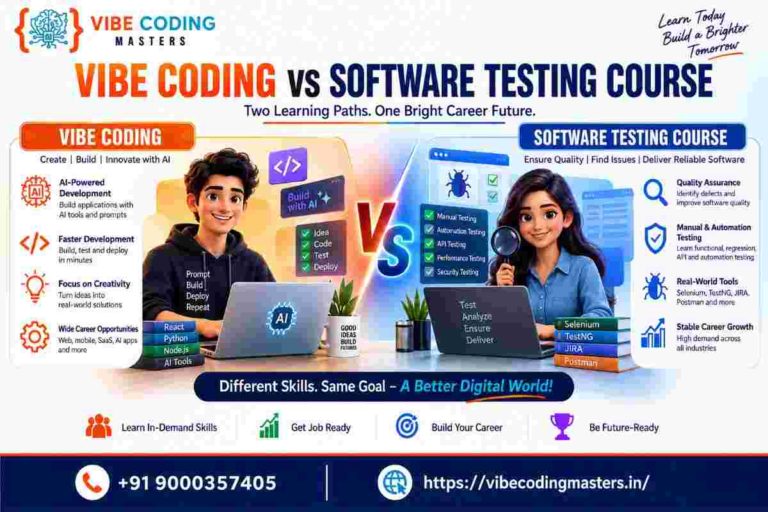
Vibe coding uses AI assistants to generate and refine application code from natural-language prompts, while a software testing course teaches manual and automated methods to validate software quality. The core difference is creation versus verification. Aspiring builders and AI enthusiasts should consider vibe coding; detail-oriented, analytical learners often thrive in software testing and QA roles.
★★★★★
4.9/5 rated by 1329+ students · Google Verified
Table of Contents
Introduction
Software careers in India are being reshaped by two very different but equally relevant forces: the rise of AI-assisted development and the steady, growing demand for software quality assurance. On one side is vibe coding, a style of building applications where developers describe what they want in plain language and let an AI assistant generate, refine, and even debug the underlying code. On the other side is the software testing discipline, a structured field focused on verifying that applications work correctly, securely, and reliably before and after release.
Both paths sit at the center of how modern IT teams ship software, and both are attracting freshers, working professionals, and career switchers who want to future-proof their skills. Someone who searches for a vibe coding vs software testing course is usually trying to answer a very practical question: which skill set is worth investing time and money into right now?
This article breaks down what each path actually involves, the skills and tools required, realistic salary ranges in India, and a decision framework to help you choose the option — or combination of options — that fits your interests and career goals.
Vibe Coding vs Software Testing Course
What is Vibe Coding?
Vibe coding is an approach to software development where a person describes the outcome they want — a feature, a screen, an API, a bug fix — in natural language, and an AI coding assistant generates the corresponding code. Instead of writing every line manually, the developer works more like a director: prompting, reviewing, adjusting, and iterating until the AI-generated output matches the intended “vibe” of the application. It differs from traditional development mainly in speed and workflow — the developer still needs to understand architecture and logic, but delegates the mechanical act of writing code to an AI tool.
For a full breakdown of how it works, how it differs from traditional coding, and real examples, see our detailed guide: What is Vibe Coding?
What is a Software Testing Course?
A modern software testing course prepares learners to verify that software behaves as expected across functionality, performance, security, and usability. Rather than building features, testers are responsible for finding defects before end users do.
A comprehensive software testing course typically covers
- Manual testing fundamentals — understanding requirements, writing test cases, and executing them step by step.
- Functional testing — verifying that each feature works according to specification.
- Regression testing — confirming that new changes haven’t broken existing functionality.
- Integration testing — checking that different modules or services work correctly together.
- API testing — validating request/response behavior of backend services, often using tools like Postman.
- Automation testing — writing scripts that execute test cases automatically instead of manually.
- Selenium or equivalent automation concepts — using Selenium or similar frameworks to automate browser-based testing.
- Bug reporting and defect management — documenting issues clearly so developers can reproduce and fix them.
- Test planning — defining scope, strategy, and schedule for testing activities.
- Quality assurance processes — following structured QA methodologies across the software development lifecycle.
- CI/CD and testing — integrating automated tests into continuous integration and deployment pipelines.
- Introduction to AI-assisted testing — using AI tools to help generate test cases or detect anomalies.
Testing contributes directly to software reliability. A well-tested application is less likely to crash in production, expose security vulnerabilities, or frustrate users with broken features — which is why testing remains a core discipline even as development itself becomes faster with AI.
Vibe Coding vs Software Testing Course: What is the Difference?
The clearest way to understand vibe coding vs software testing is to see them as two different functions in the software lifecycle: one creates, the other verifies.
Factor | Vibe Coding | Software Testing |
Primary Objective | Build applications and features | Validate quality and correctness |
Learning Approach | Prompt-driven, iterative building | Structured, methodical verification |
Technical Skills | Programming, architecture, debugging | Test design, analysis, automation |
Programming Requirement | Important, though AI assists heavily | Basic to advanced, depending on role |
AI Involvement | Very high — core to the workflow | Growing, mainly in automation and analysis |
Tools Used | AI coding assistants, IDEs, Git | Selenium, Postman, JMeter, bug trackers |
Daily Responsibilities | Prompting, reviewing, building, deploying | Designing test cases, executing, reporting bugs |
Career Opportunities | Developer, AI-assisted developer roles | QA tester, automation engineer, SDET |
Difficulty Level | Moderate to high (needs technical grounding) | Moderate (grows with automation depth) |
Time to Learn Basics | A few months for functional prototypes | A few months for manual testing basics |
Entry-Level Opportunities | Growing, especially in startups | Steady, widely available across companies |
Long-Term Growth | Senior developer, architect, AI specialist | Automation lead, SDET, QA manager |
Salary Potential | Generally higher at senior levels | Solid and growing, especially with automation |
Beginner Suitability | Good for those comfortable with logic | Good for detail-oriented, analytical learners |
Neither path is inherently “better” — they solve different problems and appeal to different strengths.
Skills Required for Vibe Coding
To be effective at vibe coding, learners still need a solid technical foundation — AI accelerates coding, but it doesn’t replace understanding. Important skills include
- Prompt engineering — writing clear, specific instructions that produce usable code
- Programming fundamentals — variables, control flow, data structures, functions
- Understanding of application architecture — how frontend, backend, and databases connect
- AI-assisted coding — working efficiently with AI coding assistants
- Debugging — identifying why AI-generated code fails and fixing it
- Git and GitHub — version control and collaboration
- APIs — designing and consuming REST or GraphQL endpoints
- Databases — relational and non-relational data modeling
- Frontend development — building user interfaces
- Backend development — server logic and business rules
- Deployment — shipping applications to production environments
- Testing AI-generated code — verifying correctness before shipping
- Problem-solving — breaking down requirements into buildable pieces
Relevant technologies commonly used in this space include JavaScript/TypeScript, Python, Node.js, React, Next.js, ASP.NET Core, SQL, REST APIs, and Git/GitHub. AI tools can dramatically speed up development, but learners who lack fundamentals often struggle to catch subtle bugs or security issues in AI-generated code.
If you’re mapping out what to actually study and in what order, our Vibe Coding Course Syllabus walks through the full module-by-module breakdown, and Vibe Coding Eligibility covers who can join with no prior coding background.
Skills Required for Software Testing
A strong software testing skill set blends analytical thinking with technical execution. Core skills include
- Testing fundamentals and terminology (SDLC, STLC)
- Test case design and documentation
- Manual testing techniques
- Automation testing frameworks
- Selenium (or Playwright/Cypress) for browser automation
- API testing with tools like Postman
- SQL for database validation
- Programming basics in Java, Python, or JavaScript
- Bug tracking and defect lifecycle management
- Agile and Scrum methodologies
- CI/CD pipeline familiarity
- Test automation framework design
- Analytical and critical thinking
- Clear written and verbal communication for bug reporting
Testers who combine manual testing knowledge with automation and basic programming tend to have the strongest career prospects.
Vibe Coding Tools Every Learner Should Know
Vibe coding leans on a handful of tool categories: AI coding assistants and AI-powered IDEs for generation and debugging, GitHub for version control, and API, database, and deployment tools to ship the finished product. Learners should treat AI output as a draft to review and validate, not a final answer to accept without scrutiny.
For a detailed comparison of specific platforms like Cursor, Lovable, Bolt, and GitHub Copilot, see What Software Is Used for Vibe Coding and Vibe Coding with Cursor and Antigravity.
Software Testing Tools Every Learner Should Know
Common tools in a tester’s toolkit include
- Selenium — browser automation for functional testing
- Postman — API testing and validation
- JMeter — performance and load testing
- Playwright or Cypress — modern end-to-end testing frameworks
- Test management tools — for organizing test cases and runs
- Bug tracking platforms — for logging and following up on defects
- CI/CD tools — for integrating automated tests into build pipelines
- Git/GitHub — for version-controlling test scripts
- SQL database tools — for validating backend data
Manual testing typically comes first — understanding requirements and executing test cases by hand — before moving into automation, where scripts handle repetitive test execution at scale.
Vibe Coding Career Opportunities in India
As AI-assisted development matures, roles like Vibe Coding Developer, AI-Assisted Developer, Full Stack Developer, and Prompt Engineer are emerging or expanding at both startups and established companies. Vibe Coding Jobs in India are growing fastest where teams need to prototype AI-powered products quickly, and these skills tend to complement — rather than replace — conventional programming knowledge.
For the full list of roles, hiring trends, and how to position yourself for them, see Career Opportunities After Vibe Coding.
Software Testing Career Opportunities in India
Software testing offers a well-established and steadily growing set of career paths, including
- Manual Tester
- QA Tester
- Software Test Engineer
- Automation Test Engineer
- QA Automation Engineer
- SDET (Software Development Engineer in Test)
- API Tester
- Performance Tester
- Test Lead
- QA Manager
Demand for quality engineering and test automation continues to grow as companies ship software more frequently and need reliable ways to validate releases quickly. Many testers strengthen their profile with an industry-recognized credential such as ISTQB certification, which is widely respected across QA hiring in India.
Vibe Coding vs Software Testing Salary in India
Experience Level | Vibe Coding / AI-Assisted Development | Software Testing |
Fresher (0–2 Years) | ₹3.5–8 LPA | ₹3–6 LPA |
Mid-Level (3–5 Years) | ₹8–15 LPA | ₹6–12 LPA |
Senior (6–10 Years) | ₹15–25+ LPA | ₹12–20+ LPA |
Lead/Architect (10+ Years) | ₹25–40+ LPA | ₹20–30+ LPA |
These figures are estimates, not guarantees. Actual compensation depends on:
- Location
- Company size and industry
- Technical skills and specialization
- Overall experience
- Project exposure
- Certifications
- Programming ability
- AI expertise
Treat these ranges as a general reference point for planning, not as a fixed outcome.
For a deeper, year-by-year breakdown of vibe coding pay specifically, see What Is the Salary After Learning Vibe Coding and Vibe Coding Developer Salary for Freshers in India.
Vibe Coding vs Software Testing: Which Career is Better?
Neither career is universally superior — the right fit depends on your interests, existing skills, and working style.
- Students exploring IT for the first time may benefit from trying both through short courses before committing.
- Freshers with strong logical thinking but less patience for repetitive verification may enjoy vibe coding more.
- Non-programmers transitioning into tech often find manual testing a more accessible entry point.
- Developers looking to speed up their workflow can add vibe coding skills to their existing programming base.
- Manual testers looking to grow can add automation and API testing skills to increase their market value.
- Automation testers who enjoy scripting may find natural overlap with development work.
- Career switchers from non-technical backgrounds often find testing courses shorter and more approachable initially.
- AI enthusiasts who enjoy experimenting with new tools may be drawn to vibe coding.
- Detail-oriented, quality-focused learners often thrive in QA and testing roles.
A practical decision framework: if you enjoy building things and are comfortable with ambiguity, lean toward vibe coding. If you enjoy finding problems and prefer structured, methodical work, lean toward software testing.
Vibe Coding vs Software Testing Course: Which Course Should You Choose?
This is the core question behind the search for vibe coding vs software testing course, so here’s a direct breakdown.
Choose Vibe Coding if you:
- Enjoy building applications from scratch
- Want to work closely with AI coding tools
- Are interested in full-stack or AI-assisted development
- Want to create websites, APIs, and applications
- Are excited about modern, AI-driven workflows
Choose Software Testing if you:
- Enjoy finding bugs and quality issues
- Prefer structured, detail-oriented work
- Like analytical thinking and methodical processes
- Want a well-established entry point into QA or IT
- Are interested in automation testing as a specialization
It’s also worth noting that learning both development fundamentals and testing principles can create a stronger, more versatile technical profile — many senior engineers and SDETs blend both skill sets.
Still weighing your options within development itself? These related comparisons might help: Vibe Coding vs Coding Bootcamp and Vibe Coding vs Full Stack Developer Course.
Career Roadmap for Vibe Coding
At a glance, learners typically move from programming basics and prompt engineering, through AI-assisted application development with APIs and databases, into full-stack deployment work, and eventually into architecture and production-level AI integration. For the complete stage-by-stage roadmap with timelines and milestones, see our Vibe Coding Roadmap.
Career Roadmap for Software Testing
Level | Learning Focus |
Beginner | Testing fundamentals and manual testing |
Intermediate | SQL, API testing, automation basics |
Advanced | Selenium/Playwright, frameworks, CI/CD |
Expert | SDET, test architecture, performance and quality engineering |
Vibe Coding vs Software Testing Career Comparison
Factor | Vibe Coding | Software Testing |
Main Focus | AI-assisted software development | Software quality and validation |
Programming | Important | Basic to advanced depending on role |
AI Usage | Very high | Increasing |
Entry Path | Development/AI | QA/testing |
Key Tools | AI coding tools, Git, IDEs | Selenium, Postman, testing frameworks |
Career Growth | Developer → Senior → Architect | Tester → Automation → SDET → Lead |
Best For | People who enjoy building | People who enjoy testing and analysis |
How AI is Changing Software Development and Testing
AI is reshaping responsibilities on both sides of the software lifecycle rather than eliminating the need for technical professionals
- AI-generated code speeds up initial development but still requires human review.
- AI-assisted debugging helps identify likely causes of errors faster.
- Automated test generation can suggest test cases based on application behavior.
- AI-powered test case creation helps testers cover more scenarios efficiently.
- Intelligent defect detection flags anomalies that manual review might miss.
- Code review assistants highlight potential issues before merging.
- Test maintenance benefits from AI tools that adapt scripts as applications change.
- Faster development cycles are becoming standard as AI tools mature.
- Human oversight and validation remain essential — AI accelerates work but doesn’t remove responsibility for quality.
In short, AI is changing how developers and testers work, not removing the need for their judgment.
Why Vibe Coding is Becoming an Important IT Skill in India
Several factors are driving growth in vibe coding adoption
- Rapid growth in adoption of AI development tools across Indian tech companies
- Faster application prototyping enabling quicker time-to-market
- Rising demand for AI-enabled applications across industries
- Startups increasingly using AI-assisted workflows to move fast with lean teams
- Enterprise AI transformation initiatives creating new internal tooling needs
- Growing demand for developers who can work effectively alongside AI systems
- The importance of combining AI fluency with solid programming fundamentals
Why Software Testing Remains a Strong IT Career in India
Even as AI accelerates development, testing remains essential because
- Every application still requires quality validation before release
- Security and reliability requirements are becoming stricter, not looser
- Automation testing continues to grow as a specialization
- Continuous integration and deployment pipelines depend on reliable automated tests
- Increasing software complexity creates more surface area for defects
- Human judgment is still needed to interpret ambiguous or edge-case behavior
- Demand for SDETs and quality engineers continues to rise alongside automation adoption
Vibe Coding vs Software Testing: Future Scope
Looking ahead, both fields are likely to evolve rather than disappear
- AI-assisted development may become a standard part of everyday developer workflows, similar to how IDEs and version control became standard.
- Testing will increasingly incorporate AI-generated test cases and automated anomaly detection alongside traditional methods.
- Developers and testers will both need broader technical skills as the line between building and validating software continues to blur.
- Cross-functional engineering skills — professionals comfortable with both development and quality practices — will become increasingly valuable.
- AI literacy across both fields will become a meaningful career advantage, not just a nice-to-have.
How to Start Learning Vibe Coding
The short version: start with programming fundamentals and prompt engineering, build small practice projects while learning Git and APIs, then move into portfolio projects, deployment, and interview prep. If you’re coming from a non-technical background or are already working full-time, the path looks slightly different — see Vibe Coding for Non-Programmers and Vibe Coding Course for Working Professionals for tailored guidance, plus Vibe Coding Certification if you want a credential to show for it.
If you’d rather skip the trial-and-error and learn this with structured mentorship, placement support, and hands-on projects, our Vibe Coding Course in Hyderabad covers this entire path — from fundamentals to a full-stack, job-ready portfolio.
How to Start a Software Testing Career
- Learn software testing fundamentals
- Understand SDLC and STLC
- Practice manual testing
- Learn SQL
- Learn API testing
- Learn an automation framework
- Practice test automation
- Understand Agile and CI/CD
- Build practical testing projects
- Prepare for QA interviews
Statistics, Trends, and Market Demand
India’s IT sector continues to see strong hiring activity in both AI-assisted development and quality engineering roles, driven by rapid cloud adoption and growing enterprise investment in AI tooling. Industry surveys have repeatedly pointed to automation testing and AI-assisted coding as two of the fastest-growing skill areas requested in job postings, though exact figures vary by source and update frequently.
When researching current numbers, it’s worth checking
- Industry reports from NASSCOM on India’s IT workforce trends
- Hiring platform surveys (LinkedIn, Naukri) on in-demand tech skills
- Vendor-published adoption data from AI coding tool providers
- QA industry salary surveys from testing certification bodies
Treat survey findings and market projections as directional guidance rather than fixed facts, since they shift as the industry evolves.
Key Takeaways
- Vibe coding focuses on AI-assisted application building, while software testing focuses on verifying software quality.
- Vibe coding requires programming fundamentals plus prompt engineering; testing requires test design, automation, and analytical skills.
- Both paths offer growing career opportunities in India, from developer roles to QA and SDET positions.
- Salary potential is strong on both sides, though it varies significantly by experience, company, and specialization.
- The right choice depends on whether you enjoy building software or validating its quality — and combining both skill sets can strengthen your overall profile.
Conclusion
Choosing between vibe coding vs software testing course ultimately comes down to what kind of work energizes you. Vibe coding suits learners who want to build applications quickly with the help of AI tools, while software testing suits those who enjoy structured, analytical work focused on quality and reliability. Both paths offer solid career opportunities in India’s fast-evolving IT industry, and neither is inherently superior — they simply serve different roles in the software lifecycle.
If you’re still unsure, consider your natural strengths: are you drawn to creating and building, or to investigating and validating? Whichever path aligns with your interests, the best next step is the same — pick a course, start building practical experience, and let your progress guide your career direction from there.
If building wins out, our Vibe Coding Course in Hyderabad is designed to take you from fundamentals to a job-ready, full-stack portfolio with mentorship and placement support along the way.
FAQ
- What is the difference between Vibe Coding and software testing?
Vibe coding focuses on building applications using AI-assisted, prompt-driven development, while software testing focuses on verifying that applications work correctly, securely, and reliably.
- Is Vibe Coding better than software testing?
Neither is universally better — vibe coding suits those who enjoy building with AI tools, while software testing suits those who enjoy analytical, quality-focused work.
- Is Vibe Coding suitable for beginners?
Yes, but beginners still benefit from learning programming fundamentals alongside prompt engineering to understand and validate AI-generated code effectively.
- Is coding required to learn software testing?
Basic coding helps, especially for automation testing, but manual testing can be learned without deep programming knowledge.
- Which has better career opportunities, Vibe Coding or software testing?
Both offer strong opportunities in India; vibe coding is growing quickly in AI-focused roles, while testing offers steady, well-established demand across industries.
- What salary can a Vibe Coding professional earn in India?
Estimates range from around ₹3.5–8 LPA for freshers to ₹25–40+ LPA for senior architects, though actual pay varies by company, location, and skill level.
- What salary can a software tester earn in India?
Estimates range from around ₹3–6 LPA for freshers to ₹20–30+ LPA for senior QA leads, depending on experience and specialization.
- Can software testers learn Vibe Coding?
Yes — testers with programming basics and analytical skills can transition into or complement their role with vibe coding practices.
- Will AI replace software testing jobs?
AI is automating parts of testing, such as test generation and anomaly detection, but human judgment remains essential for interpreting results and edge cases.
- Which course should I choose: Vibe Coding or Software Testing?
Choose based on interest: pick vibe coding if you enjoy building applications with AI tools, or software testing if you prefer quality-focused, analytical work.