Vibe Coding vs Full Stack Developer Course: The Complete Career Comparison for 2026
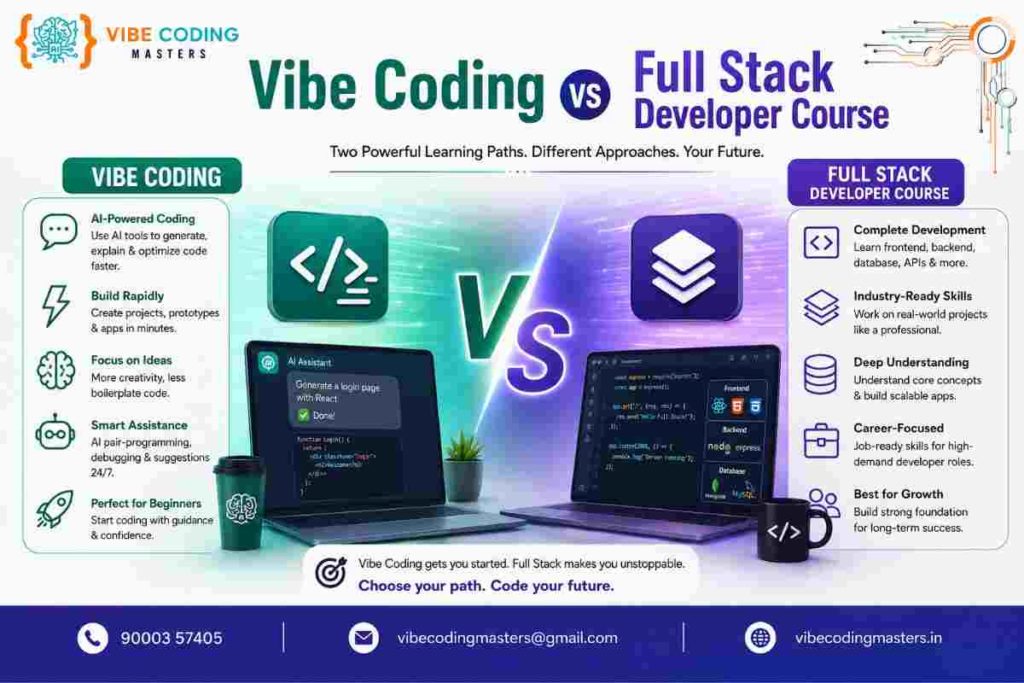
Vibe coding uses AI tools like ChatGPT, Claude, GitHub Copilot, and Cursor to generate and refine code quickly, while a full stack developer course teaches HTML, CSS, JavaScript, backend frameworks, and databases in depth. Vibe coding vs full stack developer course isn’t an either-or choice — most successful developers in India now combine both to build faster, better, and more employable.
★★★★★
4.9/5 rated by 1329+ students · Google Verified
Table of Contents
Introduction
Software development in India is going through a genuine shift. AI coding assistants have moved from novelty to daily-use tools, and at the same time, companies are still hiring full stack developers by the thousands. This has left a lot of learners asking the same question: vibe coding vs full stack developer course — which one actually leads to a job? This is especially relevant if you’re exploring a Vibe Coding Course in Hyderabad, where both AI-assisted and traditional development skills are in growing demand.
The honest answer is that it depends on what you already know, how much time you can invest, and what kind of role you’re aiming for. This guide breaks down both paths in detail — what they are, how they differ, what they pay, and how to decide which one (or which combination) fits your career goals.
What is Vibe Coding?
It’s a way of building software by describing what you want in plain language to an AI coding assistant, which then generates, edits, and debugs the code for you, with the developer guiding, reviewing, and refining the output.
What is a Full Stack Developer Course?
It’s a structured training program that teaches front-end technologies (HTML, CSS, JavaScript, React or Angular), back-end technologies (Node.js, Python, or .NET), databases (SQL, MongoDB, PostgreSQL), and deployment — giving learners the ability to build and maintain complete web applications independently.
The core difference is depth versus speed. Full stack courses build foundational programming ability from the ground up. Vibe coding relies on AI to accelerate output, which works brilliantly for prototypes and MVPs but still benefits enormously from someone who understands what the AI-generated code is actually doing. AI-assisted development is growing in importance because it shortens build cycles, but employers in India continue to value engineers who can debug, scale, and secure applications — skills that come from traditional full stack training. Both paths currently have real career demand in India’s tech hubs, and increasingly, the most hireable candidates are the ones comfortable with both.
Vibe Coding vs Full Stack Developer Course
What is Vibe Coding?
Vibe coding is a style of software development where a developer works
conversationally with AI coding assistants — tools like ChatGPT, Claude, GitHub Copilot, Cursor, and Replit — to generate, modify, and debug code based on natural-language prompts, rather than writing every line manually. If you’re still getting familiar with the concept, this breakdown of what vibe coding actually means goes deeper into the idea before you decide whether it’s right for you.
The term describes a workflow, not a single tool. A vibe coder typically:
- Describes the feature or app they want in plain English (prompt engineering)
- Lets an AI coding assistant generate the first draft of the code
- Reviews, tests, and refines the output rather than typing it from scratch
- Uses AI for debugging suggestions and code optimization
- Still relies on Git and GitHub for version control and deployment
Vibe coding works especially well for rapid prototyping, landing pages, internal tools, and MVPs where speed matters more than deep architectural complexity. It lowers the barrier to entry for people who are new to programming, since AI can explain errors and suggest fixes in real time.
That said, vibe coding is not “no-code.” It still requires understanding of APIs, basic logic, version control, and how to evaluate whether the AI’s output is correct, secure, and efficient. Developers who understand the fundamentals get dramatically better results from AI coding tools than those who don’t.
What is a Full Stack Developer Course?
A full stack developer course is a structured program that teaches both front-end and back-end web development, so a learner can independently design, build, and deploy a complete application.
Typical full stack curricula cover
- Front-end: HTML, CSS, JavaScript, TypeScript, and a framework such as React or Angular
- Back-end: Node.js, Python, or .NET / ASP.NET Core
- Databases: SQL, MongoDB, PostgreSQL
- APIs: Building and consuming REST APIs
- Tools: Git and GitHub for version control
- Deployment: Cloud deployment on platforms like AWS, Azure, or GCP
Full stack courses in India generally run from a few months to a year depending on depth, and are built around hands-on projects, code reviews, and (in many programs) placement support. The goal is to produce developers who understand why code works the way it does, not just how to get an app running.
Vibe Coding vs Full Stack Developer Course: Key Differences
Direct answer: Vibe coding prioritizes speed through AI-generated code and is more accessible to beginners, while a full stack developer course prioritizes depth of programming knowledge, giving learners the ability to build, debug, and scale applications independently.
Aspect | Vibe Coding | Full Stack Developer Course |
Learning curve | Shorter, beginner-friendly | Longer, requires consistent practice |
Programming knowledge required | Basic to moderate | In-depth, fundamentals-focused |
AI dependency | High | Low to moderate (AI used as a helper) |
Development speed | Fast for prototypes and MVPs | Steady, thorough for production-grade apps |
Debugging | AI-assisted, but needs human judgment | Manual, deep debugging skills |
Project development | Best for small to mid-scale apps | Suited for complex, large-scale systems |
Technology depth | Surface to moderate | Deep, across stack |
Job opportunities | Emerging, growing steadily | Well-established, consistently high demand |
Salary potential | Variable, tool- and skill-dependent | Predictable growth with experience |
Long-term career growth | Strong when combined with core skills | Strong on its own |
Best suited for | Founders, indie hackers, quick builders, beginners | Aspiring software engineers, long-term IT careers |
Certification opportunities | Emerging AI-tool certifications | Well-recognized industry certifications |
Portfolio requirements | AI-assisted projects, prompt-to-app case studies | Full-scale projects with clean, original code |
Why Vibe Coding is Becoming Popular in India
Vibe coding is gaining traction across Indian tech hubs because it lets founders, students, and small teams turn ideas into working products without waiting on a large engineering team. Startups in Bengaluru, Hyderabad, and Pune are increasingly using AI-assisted workflows to build MVPs faster and test ideas before committing to full development cycles.
A few reasons behind the rise
- Lower barrier to entry: Beginners can build functional apps while still learning core concepts
- Faster prototyping: Founders can validate ideas without hiring a full dev team upfront
- Cost efficiency for startups: Small teams can ship more with AI assistance
- Growing tool ecosystem: Tools like Cursor, Replit, GitHub Copilot, and Claude have matured rapidly
It’s worth being clear-eyed here: vibe coding accelerates output, but production systems handling real users, payments, or sensitive data still need engineers who understand security, scalability, and clean architecture.
Why Full Stack Development Remains a High-Demand Career
Full stack development remains one of the most consistently in-demand IT skills in India because most companies — from startups to large enterprises — need engineers who can work across the entire application stack, not just isolated pieces.
Job portals and industry reports have repeatedly listed full stack developer roles among India’s most searched-for tech positions, largely because businesses prefer engineers who reduce hand-off friction between front-end and back-end teams. This demand spans product companies, IT services firms, and the growing base of Indian startups building SaaS products for global markets.
Vibe Coding Career Opportunities in India
Vibe coding is opening up newer, less traditional career paths rather than replacing existing developer roles outright. Common opportunities include
In the context of this comparison specifically: vibe-coding-only professionals get hired fastest into roles where a founder or non-technical client just needs a working demo — landing pages, internal dashboards, WhatsApp/CRM automations. The moment the role requires owning uptime, security, or a codebase other engineers will maintain, hiring managers ask for full-stack fundamentals underneath.
— “If freelance/indie-hacker work is your goal specifically, the tool stack and client-pitch approach differs enough that it’s worth its own roadmap — see our guide on vibe coding projects for beginners to build a portfolio that lands that kind of work.
— “For a side-by-side of how this compares against a traditional bootcamp route instead of full stack specifically, see Vibe Coding vs Coding Bootcamp.
These roles are more common at early-stage startups and digital agencies than at large enterprises, which still tend to hire based on traditional programming credentials. For a closer look at how these roles play out day-to-day, see this guide on careers after vibe coding.
Full Stack Developer Career Opportunities in India
Full stack developers have access to a wide and well-established job market across India, including roles such as
- Full Stack Developer (Junior, Mid, Senior)
- Front-End Engineer / Back-End Engineer
- Software Development Engineer (SDE)
- Application Developer
- Technical Lead / Engineering Manager (with experience)
- Solutions Architect (senior career track)
These roles are hired across IT services companies, product startups, e-commerce platforms, fintech firms, and multinational tech companies with India offices.
Industries Hiring Vibe Coding and Full Stack Developers
Both skill sets are in demand across a broad range of industries, including
- IT services and consulting — traditionally strong for full stack roles
- Fintech and banking technology — need robust, secure full stack systems
- E-commerce and D2C startups — use both AI-assisted prototyping and full stack teams
- EdTech — rapid feature development, often AI-assisted
- Healthtech — full stack heavy due to compliance and data needs
- SaaS and B2B software startups — blend vibe coding for MVPs with full stack teams for scale
- Digital agencies — increasingly using AI tools for client prototypes
Top Companies Hiring Vibe Coding and Full Stack Developers in India
Full stack developer roles are advertised regularly by major IT services companies (such as TCS, Infosys, Wipro, and Cognizant), product companies, and a large base of funded startups across Bengaluru, Hyderabad, Pune, Chennai, and Mumbai. Vibe coding and AI-assisted development skills are increasingly listed as a plus point — sometimes a requirement — in job postings from startups and product teams that prioritize fast shipping. Exact hiring numbers vary by quarter and company, so checking current listings on platforms like LinkedIn, Naukri, and AngelList/Wellfound is the most reliable way to gauge live demand.
Vibe Coding vs Full Stack Developer Course: Skills Comparison
Direct answer: Vibe coding relies primarily on prompt engineering and evaluating AI output, while full stack development requires hands-on command of programming languages, frameworks, and databases
Skill Area | Vibe Coding | Full Stack Development |
Prompt engineering | Core skill | Helpful, not essential |
HTML/CSS/JavaScript | Basic understanding helps | Mandatory, in-depth |
Frameworks (React/Angular) | Optional, AI can scaffold | Core requirement |
Backend languages (Node.js/Python/.NET) | Basic exposure | Core requirement |
Databases (SQL/MongoDB/PostgreSQL) | Basic queries via AI help | Strong working knowledge |
Debugging | AI-assisted, human-verified | Manual, systematic |
System design | Rarely required at entry level | Increasingly important with seniority |
Git/GitHub | Required | Required |
Deployment | AI-guided, simplified | Hands-on, cloud-based |
Vibe Coding Tools Every Learner Should Know
Vibe coding revolves around a specific set of AI-powered tools that help generate, refine, and debug code from natural-language prompts. Learners should be familiar with
Rather than listing tools again here, the practical takeaway for someone choosing between the two paths is this: tool fluency is learnable in weeks, but knowing which tool’s output to trust for a database migration versus a landing page is the judgment a full-stack foundation gives you.
— “For the complete tool-by-tool breakdown with use cases, see what vibe coding actually means.
— “If you want tools mapped to a week-by-week learning sequence instead of a flat list, our Vibe Coding roadmap lays that out stage by stage.
If you want to see how these tools are taught in a structured, module-by-module format, this vibe coding course syllabus breaks down the full learning path from fundamentals to real-world projects.
Full Stack Development Technologies Every Student Should Learn
A solid full stack developer curriculum should cover both layers of a web application along with the databases and deployment skills needed to ship it.
Front-end
- HTML, CSS, JavaScript, TypeScript (MDN Web Docs is a reliable free reference for all three)
- React or Angular (at least one in depth)
Back-end
- Node.js (official documentation) or Python
- .NET / ASP.NET Core (common in enterprise environments)
- REST API design and development
Databases
- SQL (relational databases)
- MongoDB (NoSQL)
- PostgreSQL
Tools and deployment
- Git and GitHub
- Cloud deployment basics (AWS, Azure, or GCP)
Vibe Coding Developer Salary in India
Direct answer: Vibe coding is a relatively new career category in India, so salary data is less standardized than for full stack roles. Compensation tends to track closely with a candidate’s underlying programming ability, portfolio, and the type of company hiring, rather than AI-tool usage alone.
Because vibe coding roles are often blended with junior developer, prototyper, or startup generalist positions, pay varies widely by company stage and location. As a general, indicative guide based on current market patterns for AI-assisted development roles
- If you’re weighing this from a pure ROI angle before enrolling, it helps to first check whether you even meet the entry bar for either path — the eligibility for a vibe coding course is intentionally lower than most full stack bootcamps, which is part of why early-career pay looks more variable on the AI side.”
- “Recruiters in Hyderabad and Bengaluru increasingly blend both skill sets into a single job description, so the real premium isn’t ‘vibe coding’ or ‘full stack’ pay — it’s the combination, which we’ve mapped out step-by-step in our Full Stack with Vibe Coding course path.”
- “Portfolio strength moves the number more than the title on your offer letter does — see how project depth translates into pay in our breakdown of Vibe Coding developer salary for freshers.”
- “If you’re a working professional switching lanes rather than starting fresh, your existing experience gets priced differently — the Vibe Coding course for working professionals guide covers how that transition affects offers.
For a more detailed, course-linked breakdown of pay expectations, check this guide on salary after learning vibe coding.
Full Stack Developer Salary in India
Direct answer: Full stack developer salaries in India are relatively well documented across job portals and salary-tracking platforms, and generally scale steadily with experience, technology stack, and company type.
- Service-based IT firms (TCS, Infosys, Wipro-style) generally offer more predictable but slower-growing full stack pay bands, while funded product startups in Hyderabad, Bengaluru, and Pune move faster on hikes but expect broader ownership — see how this plays out for freshers specifically in our full stack developer career opportunities guide.”
- “Stack choice also matters more than most learners expect — React/Node/MERN skills currently command a premium over legacy .NET or PHP stacks in job postings, which is why most structured programs now teach full stack with vibe coding together rather than in isolation.”
- “Before you negotiate an offer, cross-check the band against live data — AmbitionBox, Glassdoor, and Levels.fyi update faster than any blog post can.
Note: All figures above are indicative estimates based on general industry patterns and can vary significantly based on skills, location, company size, portfolio strength, negotiation, and specific job role. Always cross-check current figures on platforms like AmbitionBox, Glassdoor, Naukri, and Levels.fyi before making career decisions.
Vibe Coding vs Full Stack Developer Course: Career Growth
Direct answer: Full stack development currently offers a more predictable, well-mapped career growth path, while vibe coding offers faster entry but benefits significantly from being paired with core programming skills for long-term growth.
Level | Vibe Coding Path | Full Stack Development Path |
Beginner | Learn prompt engineering, build small AI-assisted apps, understand basic HTML/CSS/JS | Learn HTML, CSS, JavaScript fundamentals and Git basics |
Intermediate | Build multi-feature apps with AI tools, learn APIs, start understanding backend basics | Learn a frontend framework (React/Angular), backend language, and REST APIs |
Advanced | Combine AI tools with real programming knowledge, work on production-ready projects | Master databases, system design, cloud deployment, and performance optimization |
Expert | Lead AI-assisted product teams, mentor others on effective AI-driven workflows | Architect large-scale systems, lead engineering teams, specialize (e.g., DevOps, security) |
At every stage, the strongest career outcomes tend to come from combining both: using AI tools to move faster while continuing to build real programming depth underneath.
Certifications and Skills That Boost Career Opportunities
For full stack development, recognized certifications and skill validations include cloud platform certifications (AWS, Azure, GCP), framework-specific certifications (React, Node.js), and comprehensive full stack bootcamp completions with strong project portfolios.
For this comparison, the certification question splits cleanly: full stack certifications (AWS, Azure, React) are checked against a known syllabus, so an HR screener can verify them in seconds. Vibe coding credentials are newer and less standardized, so a live project link plus a short write-up of your prompt-to-code process matters more in interviews.
— “For the full certification landscape, fees, and what a recognized credential should actually cover, see our dedicated Vibe Coding Certification guide.
If you’re evaluating certification options, this page on Vibe Coding Certification explains what a recognized credential typically covers.
Future Scope of Vibe Coding and Full Stack Development in India
Direct answer: Both fields have strong future scope in India — full stack development because it remains foundational to nearly all software products, and vibe coding because AI-assisted workflows are being adopted faster across startups and product teams every year.
Industry commentary from technology analysts and hiring platforms has increasingly pointed to AI-assisted coding becoming a standard part of the developer toolkit rather than a separate discipline. At the same time, full stack fundamentals remain the backbone that AI-generated code still needs to be checked, secured, and scaled against. The likely direction is convergence: full stack developers who also know how to use AI tools effectively, and vibe coders who deepen their programming fundamentals over time, will both be well positioned.
How to Choose Between Vibe Coding and a Full Stack Developer Course
Choosing between the two comes down to your starting point, timeline, and career goal — not an inherent superiority of one over the other.
Consider vibe coding first if you
- Want to build and launch something quickly (MVP, prototype, side project)
- Are a founder or non-technical professional exploring product ideas
- Are completely new to programming and want a gentler on-ramp
- Have limited time and need fast, visible output
Consider a full stack developer course first if you
- Want a stable, long-term software engineering career
- Are targeting product-based companies or engineering-heavy roles
- Want to eventually build, scale, and maintain production systems
- Are willing to invest several months in structured, fundamentals-first learning
For most serious career-builders, the practical answer is: start with full stack fundamentals, then layer vibe coding tools on top to increase your speed and productivity once you understand what’s happening under the hood.
Still unsure if you meet the starting requirements? This page on eligibility for a vibe coding course clarifies what’s actually needed before you enroll.
How to Start a Career with Vibe Coding or Full Stack Development
Direct answer: Start by learning core web development basics, then choose a focused path — either a structured full stack curriculum or hands-on AI-assisted building — and back it up with real, deployed projects on GitHub.
Practical steps
The one step people skip that actually matters most: document your reasoning, not just your code. Keep a short README on every project explaining the decisions you made and why — that’s what tells a recruiter your skill is real, not copy-pasted.
— “For a detailed, stage-by-stage version of this path with timeframes, see our Vibe Coding roadmap.
— “If you’re starting with zero programming background, check eligibility for a vibe coding course first to know exactly where you stand.
If you’re a fresher looking to cover both skill sets together rather than choosing one first, a combined Full Stack with Vibe Coding course in Hyderabad is worth exploring. Working professionals switching careers may prefer a track built specifically for their situation, like this Vibe Coding course for working professionals.
Why Vibe Coding and Full Stack Development Are Strong IT Career Options in India
India’s IT sector continues to produce strong demand for both traditional and AI-assisted development skills, driven by a large domestic tech industry, a growing startup ecosystem, and increasing global outsourcing of software work to Indian talent. Full stack development offers a well-trodden, stable path with clear salary progression. Vibe coding offers a faster, more accessible entry point that’s especially valuable for founders, freelancers, and early-career builders. Together, they represent two complementary ways to build a resilient, future-ready IT career in India. To see the full picture of what a structured program adds on top of self-learning, take a look at these benefits of a vibe coding course.
Vibe Coding Developer vs Full Stack Developer
A vibe coding developer typically works faster on smaller-scope projects using AI assistance, while a full stack developer typically works with deeper technical control across larger, more complex systems. Vibe coding developers are well-suited for MVPs, prototypes, and startup environments where speed matters most; full stack developers are better suited for production systems that require scalability, security, and long-term maintainability. Neither is strictly “better” — they solve different problems.
Vibe Coding vs Software Developer
A traditional software developer writes and understands code at a deep level, including algorithms, data structures, and system architecture, while a vibe coder primarily directs AI tools to produce code and focuses more on evaluating and refining that output. Software developers generally have an advantage in complex, large-scale, or highly regulated projects, while vibe coders have an advantage in speed for simpler builds. Many experienced software developers now use vibe coding techniques as part of their own workflow, blurring the line between the two.
AI-Assisted Developer vs Traditional Developer
AI-assisted developers use tools like Copilot, Claude, and Cursor to speed up coding, debugging, and testing, while traditional developers rely primarily on manual coding skills built through structured learning and experience. The advantage of AI-assisted development is speed and accessibility; its limitation is a continued dependency on human judgment to verify correctness, security, and performance. Traditional development’s advantage is deep, independent problem-solving ability; its limitation is that it can be slower for repetitive or boilerplate-heavy tasks. The ideal developer today increasingly combines both approaches.
Market Demand and Trends: Vibe Coding and Full Stack Development in India
AI adoption in software development has accelerated across Indian tech companies over the past couple of years, with AI-assisted coding tools moving from experimental use to everyday workflows in many engineering teams. Industry bodies like NASSCOM regularly track this shift as part of their reporting on India’s technology sector. At the same time, full stack developer roles remain a consistent fixture on Indian job portals, reflecting sustained demand from IT services firms, product startups, and enterprises.
Startups across Bengaluru, Hyderabad, Pune, Chennai, and Mumbai are increasingly adopting AI coding workflows to move faster with leaner teams, particularly at the MVP and early product stage. At the same time, hiring managers continue to emphasize that candidates who understand both AI tools and core programming fundamentals stand out over those who rely on AI alone. This dual competency — comfortable with AI coding assistants and solid in fundamentals — is emerging as a genuinely valuable and increasingly sought-after profile in India’s technology hubs.
Key Takeaways
- Vibe coding and full stack development are complementary paths, not direct competitors — many successful developers use both.
- Full stack developer courses build deep, foundational programming skills that remain essential for production-grade, scalable software.
- Vibe coding offers a faster, more accessible entry point using AI tools like ChatGPT, Claude, GitHub Copilot, and Cursor, but works best alongside core programming understanding.
- Full stack developer salaries in India are more predictable and well-documented; vibe coding compensation varies more and depends heavily on underlying skills.
- The strongest career outcomes come from combining both — using AI to move faster while building genuine technical depth underneath.
Conclusion
So, vibe coding vs full stack developer course — which should you actually choose? If you’re a complete beginner, a founder testing an idea, or someone who wants to build and ship quickly, vibe coding offers a practical, low-barrier starting point. If you’re aiming for a long-term software engineering career, especially in product companies or roles that demand deep technical ownership, a structured full stack developer course remains the stronger foundation.
What’s important to remember is that AI tools can dramatically speed up how you build software, but they don’t remove the need to actually understand what you’re building. The developers who stand out — and get hired — are the ones who can explain their code, debug it without relying entirely on AI, and back their skills with real, working projects on GitHub.
Whichever path you choose, start building. Ship small projects, document them properly, and keep learning consistently. If you’re in Hyderabad and ready to move forward, explore this Vibe Coding Course in Hyderabad to build the practical, job-ready skills that today’s Indian tech industry is actively hiring for — with hands-on projects, placement support, and mentorship to guide you from fundamentals to a full stack, AI-assisted skill set.
FAQ
- Is Vibe Coding better than Full Stack Development?
Neither is universally “better.” Vibe coding is faster for prototypes and beginners; full stack development offers deeper skills for building and scaling production-grade software. The right choice depends on your goals.
- What is the difference between Vibe Coding and Full Stack Development?
Vibe coding uses AI tools to generate and refine code from natural-language prompts, while full stack development involves manually learning and applying front-end, back-end, and database technologies to build complete applications.
- Can I get a job after learning Vibe Coding?
Yes, particularly at startups and agencies that value fast prototyping, but most employers still expect basic programming understanding alongside AI-tool proficiency, especially for full-time developer roles.
4. Can I switch from a Full Stack course to Vibe Coding mid-way, or vice versa?
Yes, most full stack and vibe coding syllabi share the HTML/CSS/JS/Git foundation, so switching mainly changes how you write later modules (manual vs AI-assisted), not a full restart.
- Does Vibe Coding require coding knowledge?
Basic coding knowledge is not strictly mandatory to get started, but it becomes essential as projects grow more complex, since you need to evaluate, debug, and secure AI-generated code.
- Is Full Stack Development still a good career in India in 2026?
Yes. Full stack developer roles remain consistently in demand across IT services, startups, and product companies in India, making it a stable, well-established career path.
- Which has a better salary, Vibe Coding or Full Stack Development?
Full stack developer salaries are currently more predictable and well-documented across experience levels. Vibe coding compensation varies more, often depending on a candidate’s underlying programming skills.
- Can Vibe Coding replace Full Stack Developers?
No. Vibe coding accelerates certain parts of development, but full stack developers are still needed for complex architecture, scalability, security, and long-term system maintenance.
- Should I learn Vibe Coding after completing a Full Stack Developer course?
Yes, this is a strong combination. Full stack fundamentals help you evaluate and improve AI-generated code, making your vibe coding output far more reliable and production-ready.
- Which is better for a long-term career: Vibe Coding or Full Stack Development?
Full stack development currently offers a more established long-term career path. Vibe coding is a valuable accelerator and entry point, especially when combined with solid programming fundamentals.