Vibe Coding Developer Salary for Freshers in India: Complete 2026 Career Guide
Vibe Coding is an AI-assisted development style where developers describe intent in plain language and AI tools like ChatGPT, GitHub Copilot, and Cursor generate the code. In India, freshers with these skills typically earn between ₹3.5 LPA and ₹8 LPA, depending on portfolio strength, city, and company type, with strong growth potential as AI adoption in software teams accelerates.
★★★★★
4.9/5 rated by 1329+ students · Google Verified
Table of Contents
Introduction
Software development is changing faster than most job descriptions can keep up with. A few years ago, becoming a developer meant memorizing syntax and debugging line by line. Today, a growing number of developers describe what they want in plain English and let an AI model draft the working code. This approach has a name: Vibe Coding.
For freshers in India, this shift is opening a genuinely new entry point into tech. You don’t need a decade of experience to be useful in an AI-assisted workflow — you need curiosity, logical thinking, and comfort working alongside tools like ChatGPT, GitHub Copilot, Cursor AI, and Claude. Naturally, one of the first questions every student and job-seeker asks is: what is the Vibe Coding Developer salary for freshers in India?
This guide breaks down what a Vibe Coding Developer actually does, how much freshers can realistically expect to earn, which companies and industries are hiring, what skills and certifications matter, and how to build a career path in this emerging field — all in one place.
A quick note on framing before we dive in: “Vibe Coding Developer” is not yet a standardized job title the way “Software Engineer” or “Data Analyst” is. It describes a skill set and working style — AI-assisted, prompt-driven development — that shows up inside roles like Full Stack Developer, AI-Assisted Developer, Junior Software Engineer, and Product Engineer. Salary figures in this space are still evolving and vary by source, so we’ve presented realistic ranges rather than a single fixed number.
Vibe Coding Developer Salary for Freshers in India
What is a Vibe Coding Developer?
The term “vibe coding” was coined by AI researcher Andrej Karpathy in early 2025 to describe a workflow where a developer expresses intent in natural language and lets a large language model generate, test, and refine the code, rather than writing every line manually. Karpathy himself described it as a process where you “accept” AI-generated changes, iterate quickly, and focus more on outcomes than on reading every diff.
A Vibe Coding Developer, in practical hiring terms, is someone who:
- Builds applications by prompting AI coding assistants effectively rather than writing everything from scratch
- Still understands programming fundamentals well enough to review, test, and fix AI-generated code
- Uses tools such as ChatGPT, GitHub Copilot, Cursor AI, Claude, and Windsurf as core parts of their daily workflow
- Focuses on shipping working software quickly, while maintaining code quality, security, and structure
It’s important to be clear: vibe coding is not “no-code” and it isn’t about skipping the fundamentals. The developers who succeed with it are the ones who understand code well enough to catch AI mistakes — they’re just faster because AI handles the repetitive parts.
Why Vibe Coding is a High-Demand Career in India
Freshers with AI-assisted development skills aren’t boxed into one narrow job title — the same skill set opens doors across Junior AI-Assisted Developer, Full Stack Developer, Prompt Engineer, Automation Engineer, and Freelance AI App Builder roles. Because it overlaps heavily with full-stack and web development, freshers aren’t limited to companies that explicitly advertise “vibe coding” roles — the same skills are valuable in mainstream software job postings too.
For a deeper look at how these roles differ and which ones fit different strengths, see what career opportunities are available after learning vibe coding.
Industries Hiring Vibe Coding Developers
AI-assisted development skills are being absorbed across sectors, including
- IT services and product companies — building internal tools and client applications faster
- Startups and SaaS companies — MVP development and rapid prototyping
- E-commerce — building and iterating on storefronts, dashboards, and automation scripts
- Fintech — internal tooling, dashboards, and workflow automation (with strict code review for compliance-heavy code)
- EdTech — building learning platforms and interactive tools quickly
- Digital agencies and freelance marketplaces — client project delivery on tight timelines
Top Companies Hiring AI-Assisted Developers in India
Hiring for this skill set spans large IT services firms, product companies, and startups rather than one specific “vibe coding” employer category. In practice, freshers are more likely to find these skills valued at
- Product-based startups building consumer or B2B SaaS apps
- Digital transformation teams within larger IT services companies
- Small and mid-sized product studios that prize shipping speed
- Freelance and contract platforms where clients want fast MVP builds
Rather than searching for “Vibe Coding Developer” as an exact job title on hiring portals, freshers will often find more traction searching for “AI-assisted developer,” “Full Stack Developer + AI tools,” “Junior Software Engineer (AI workflow),” or similar combined listings.
Vibe Coding Developer Roles and Responsibilities
A typical day-to-day for a fresher in this kind of role includes
- Writing clear, structured prompts to generate code with tools like ChatGPT, GitHub Copilot, or Cursor AI
- Reviewing and testing AI-generated code for correctness, security, and performance
- Debugging issues that AI tools introduce or fail to catch
- Integrating APIs and third-party services into applications
- Using Git and GitHub for version control and collaborative development
- Deploying applications to cloud platforms
- Participating in stand-ups, code reviews, and sprint planning like any other developer
- Continuously learning new AI tools and updated best practices
Vibe Coding Developer Salary for Freshers in India
This is the core question most freshers are searching for, so let’s be direct about it.
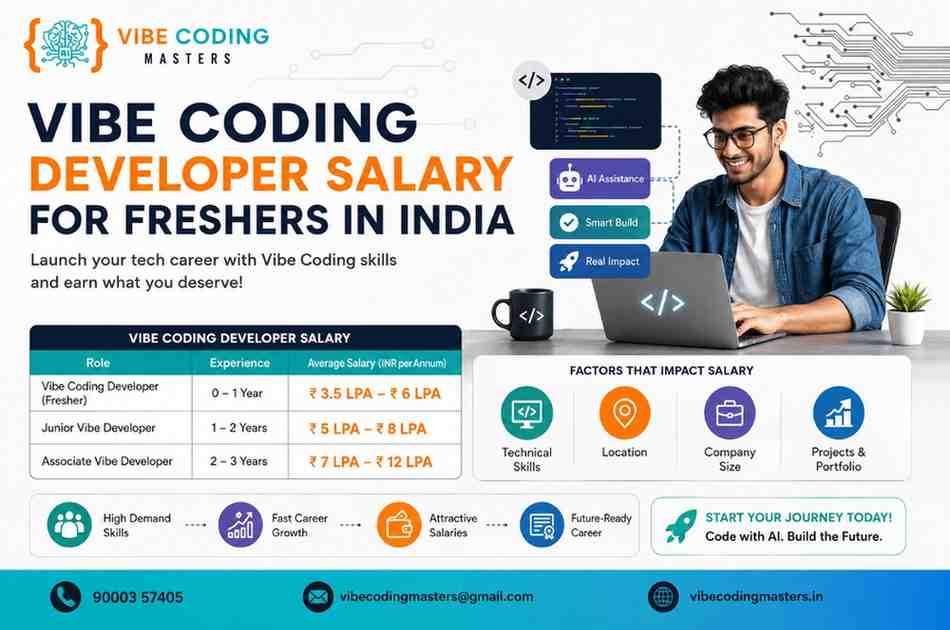
Because “Vibe Coding Developer” is an emerging, informal title rather than a standardized government or NASSCOM job classification, salary data comes primarily from job boards, hiring platforms, and industry blogs rather than a single authoritative source — and figures vary accordingly. Based on current listings and market commentary in 2026, a realistic picture for freshers in India looks like this
Experience Level | Salary Range (Annual, India) |
Fresher (0–2 Years) | ₹3.5 LPA – ₹8 LPA |
Mid-Level (3–5 Years) | ₹8 LPA – ₹15 LPA |
Senior (6–10 Years) | ₹15 LPA – ₹25 LPA |
Lead/Architect (10+ Years) | ₹25 LPA – ₹40+ LPA |
Key factors that move you toward the higher end of the fresher range:
- A portfolio of real, deployed projects (not just tutorials)
- Comfort across the full stack, not just prompting
- Strong debugging and code-review ability, since employers want people who can catch AI mistakes
- Working knowledge of Git, APIs, and basic cloud deployment
- Location — Bengaluru and Hyderabad postings tend to run above the national average, partly offset in real terms by Hyderabad’s lower cost of living
- Company type — early-stage startups may offer lower cash but more responsibility and equity; mid-size product companies often pay more predictably
This article focuses specifically on the fresher band. If you want the full picture across every experience level — from entry-level up to senior and lead roles — see what is the salary after learning vibe coding in 2026.
Featured Snippet: What is the average Vibe Coding Developer Salary for Freshers in India?
The average Vibe Coding Developer salary for freshers in India typically falls between ₹3.5 LPA and ₹8 LPA, depending on skills, portfolio quality, and location. Freshers with strong project experience, full-stack fundamentals, and fluency in AI tools like ChatGPT, Copilot, and Cursor AI tend to land offers toward the higher end of this range.
Skills Required to Become a Vibe Coding Developer
- Programming fundamentals — variables, control flow, data structures, and basic algorithms (you can’t review what you can’t understand)
- Prompt engineering — writing clear, specific, iterative prompts that get AI tools to produce usable code
- Debugging and code review — spotting logic errors, security issues, and inefficiencies in AI-generated output
- Version control — using Git and GitHub confidently
- API integration — connecting applications to external services and data sources
- Basic cloud deployment — getting an app live, not just running locally
- Front-end and back-end basics — enough JavaScript, Python, or similar to work across a typical web stack
- Communication and documentation — explaining what was built and why, especially since AI-assisted code can look “foreign” to teammates
AI Tools Every Vibe Coding Developer Should Learn
- ChatGPT — OpenAI’s general-purpose AI assistant, useful for planning, code generation, and explaining errors
- GitHub Copilot — inline code-completion and chat-based coding assistant integrated into popular editors
- Cursor AI — an AI-native code editor built around agentic, prompt-driven development
- Claude — Anthropic’s AI assistant, useful for reasoning through complex code, refactoring, and multi-file changes
- Gemini — Google’s AI assistant, integrated across Google’s developer and cloud tools
- Windsurf — an AI-powered coding environment focused on agentic workflows
- Visual Studio Code — the most widely used code editor, and the base many AI coding extensions plug into
- Git & GitHub — essential for version control, collaboration, and showcasing your portfolio
- JavaScript — core language for web development, front-end and back-end (via Node.js)
- Python — widely used for scripting, automation, APIs, and AI/ML-adjacent tasks
- React — a leading front-end framework for building interactive user interfaces
- Node.js — JavaScript runtime for building back-end services and APIs
- APIs — the connective layer between applications, services, and data
- Cloud Deployment — platforms like AWS, Vercel, or Render to take a project from local to live
Knowing the tools is only half the job — using them well is what separates a slow learner from a fast shipper. For workflow habits and mistakes to avoid, see Vibe Coding Productivity Tips for Developers: The 2026 Playbook.
Vibe Coding Career Path
Level | Skills Focus |
Beginner | Core programming logic, HTML/CSS/JS basics, simple prompting with ChatGPT or Copilot |
Intermediate | Full-stack development, structured prompt engineering, API integration, debugging AI-generated code |
Advanced | Cursor AI and Claude for multi-file agentic workflows, cloud deployment, code review discipline |
Expert | Architecting AI-augmented pipelines, mentoring teams, balancing speed with security and scalability |
For a stage-by-stage breakdown with tools and timelines at each level, see the full Vibe Coding Roadmap: skills, tools & career path.
Certifications That Boost Vibe Coding Careers
While there’s no single universally recognized “Vibe Coding” certification body yet, freshers can strengthen their profile with full-stack development certifications, cloud fundamentals badges (AWS, GCP, or Azure entry-level tracks), and prompt engineering or generative AI courses — backed by a verifiable project portfolio, which tends to matter more to hiring managers than the certificate itself.
For a complete breakdown of what a Vibe Coding Certification actually covers, typical fees, and how to pick a credible course, see the Vibe Coding Certification guide.
Future Scope of Vibe Coding in India
AI-assisted development is very unlikely to be a passing trend — even Karpathy himself has noted that the underlying practice is maturing into what some call “agentic engineering,” with more oversight and rigor than the earliest, most hands-off version of vibe coding. For India specifically, expect
- Continued growth in AI-tool adoption inside mainstream software teams, not just AI-specific startups
- More job postings blending traditional developer requirements with AI-tool fluency, rather than a fully separate job category
- Rising expectations around code review and quality assurance skills, since “AI wrote it” doesn’t remove responsibility for what ships
- Growing freelance and contract demand for developers who can prototype and deliver quickly
Why Vibe Coding is One of the Best IT Careers in India (For the Right Person)
- Lower entry barrier — you can start building real projects earlier than in traditional coding bootcamps
- Fast skill compounding — AI tools help you learn patterns faster if you actually read and understand the code they generate
- Cross-industry demand — the skill set is relevant well beyond “AI companies”
- Strong upside with fundamentals — those who pair AI fluency with real programming depth tend to out-earn those who rely on AI tools alone
The caveat: this path rewards people who go deep, not people who treat AI tools as a shortcut around learning to code. Employers are increasingly wary of candidates who can prompt but can’t explain or fix the resulting code.
How to Start a Career as a Vibe Coding Developer
- Learn programming fundamentals first — pick one language (JavaScript or Python) and get comfortable with logic, not just syntax.
- Learn Git and GitHub early — every employer expects this, AI-assisted or not.
- Practice prompting deliberately — use ChatGPT, Copilot, or Cursor AI to build small projects, and force yourself to read and understand every generated line.
- Build a portfolio of deployed projects — a to-do app on your laptop is far less persuasive than a live app with a public link and a GitHub repo. If you’re not sure where to start, this list of 25 vibe coding project ideas for beginners is a good starting point.
- Add a full-stack project — combine a front end with a real back end and API integration. See Best Full Stack with Vibe Coding Project and Best Backend with Vibe Coding Project for stack choices and structure.
- Get comfortable with cloud deployment — deploy at least one project so you can speak to the full development lifecycle in interviews.
- Apply broadly — search for “AI-assisted developer,” “full stack developer,” and “junior software engineer” roles, not just “vibe coding” listings, since the title itself is still niche.
- Keep learning tools as they evolve — Cursor, Claude, Copilot, and Gemini are all improving quickly; staying current is part of the job.
Self-teaching works, but it’s slower and easier to get stuck on your own. If you’d rather learn with mentor support, real-time projects, and placement assistance, the Vibe Coding Course in Hyderabad is built to take you from these fundamentals to a job-ready portfolio.
Key Takeaways
- Vibe Coding Developer is an emerging skill set — AI-assisted, prompt-driven development — more than a single standardized job title, so salary and job-search terms vary across sources.
- Freshers in India can realistically expect ₹3.5 LPA to ₹8 LPA, with strong portfolios and full-stack fundamentals pushing offers toward the higher end.
- Programming fundamentals still matter — the developers who succeed are those who can review and fix AI-generated code, not just prompt for it.
- Tools like ChatGPT, GitHub Copilot, Cursor AI, Claude, and Gemini are core to this workflow, alongside traditional skills like Git, APIs, and cloud deployment.
- Building and deploying real projects is the single highest-leverage thing a fresher can do to stand out in this space.
Conclusion
Vibe Coding is reshaping how software gets built, and for freshers in India, it’s opening a genuinely new way into the tech industry — one where curiosity, fundamentals, and comfort with AI tools matter as much as years of experience. While the Vibe Coding Developer salary for freshers in India currently ranges from roughly ₹3.5 LPA to ₹8 LPA, the real opportunity lies in how quickly this space is growing and how much upside exists for developers who pair AI fluency with strong coding fundamentals.
If you’re a student, fresher, or career changer considering this path, the best time to start is now: learn the fundamentals, get hands-on with tools like ChatGPT, GitHub Copilot, and Cursor AI, build real deployed projects, and start applying — not just to “vibe coding” listings, but to the broader wave of full-stack and AI-assisted developer roles opening up across Indian tech.
Want a faster, guided route to get there? The Vibe Coding Course in Hyderabad pairs mentor-led training with real-time projects and placement support, so you can go from fundamentals to a job-ready portfolio without figuring it all out alone.
FAQ
- What is the average Vibe Coding Developer salary for freshers in India?
Freshers can typically expect between ₹3.5 LPA and ₹8 LPA, depending on skills, portfolio, and location, though figures vary across job platforms since this isn’t yet a standardized job title.
- Is Vibe Coding a real, recognized job title in India?
Not formally — it’s a widely used industry term describing AI-assisted development. Related job postings often use titles like “AI-Assisted Developer,” “Full Stack Developer,” or “Junior Software Engineer.”
- Do I need to know how to code to become a Vibe Coding Developer?
Yes. Vibe coding relies on AI to generate code faster, but you still need to understand programming fundamentals to review, debug, and improve what the AI produces.
- Which AI tools should a fresher learn first?
Start with ChatGPT or GitHub Copilot for general-purpose assistance, then move to Cursor AI or Claude for more advanced, multi-file, agentic workflows.
- Can freshers get remote or freelance Vibe Coding work?
Yes, freelance platforms increasingly list short-turnaround projects suited to AI-assisted development, though freshers usually need a visible portfolio to win early contracts.
- How is Vibe Coding different from No-Code development?
No-code tools use visual builders with little or no coding involved. Vibe coding still involves real code — the AI generates it based on your prompts, but you need coding knowledge to guide, review, and fix it.
- Which cities in India pay the most for AI-assisted developer roles?
Bengaluru and Hyderabad tend to post roles above the national average, with Hyderabad’s lower cost of living making the real value of those salaries especially attractive to freshers.
- What certifications help the most for this career?
Full-stack development certifications, cloud fundamentals (AWS/GCP/Azure), and generative AI or prompt engineering courses are most useful — combined with a strong project portfolio.
- Will AI replace the need for developers entirely?
Most current evidence suggests AI is changing how developers work rather than eliminating the role — code still needs review, testing, security checks, and architectural decisions that require human judgment.
- What’s the best way for a fresher to build a portfolio for this field?
Build and fully deploy 2–3 real projects (not tutorials) using a full stack, document your process on GitHub, and be ready to explain every design decision and every AI-suggested change you accepted or rejected.