Best Full Stack with Vibe Coding Project: Ideas, AI Tools, Skills & Career Guide (2026)
The best full stack with vibe coding project combines frontend, backend, and database development with AI coding tools like ChatGPT, GitHub Copilot, Cursor, and Claude. Developers describe what they want in plain language, and AI helps generate, debug, and ship the code. It is one of the fastest, most in-demand ways to build real, deployable web apps in 2026.
★★★★★
4.9/5 rated by 1329+ students · Google Verified
Best Full Stack with Vibe Coding Project: Ideas, Tools, Skills & Career Guide (2026)
Table of Contents
Introduction
A few years ago, building a complete web application meant writing thousands of lines of code by hand — line by line, bug by bug. Today, you can describe what you want in plain English and let an AI assistant draft most of it for you. That shift has a name: vibe coding. And when you pair it with full stack development, you get one of the most powerful, beginner-friendly, and career-relevant skill combinations in tech right now.
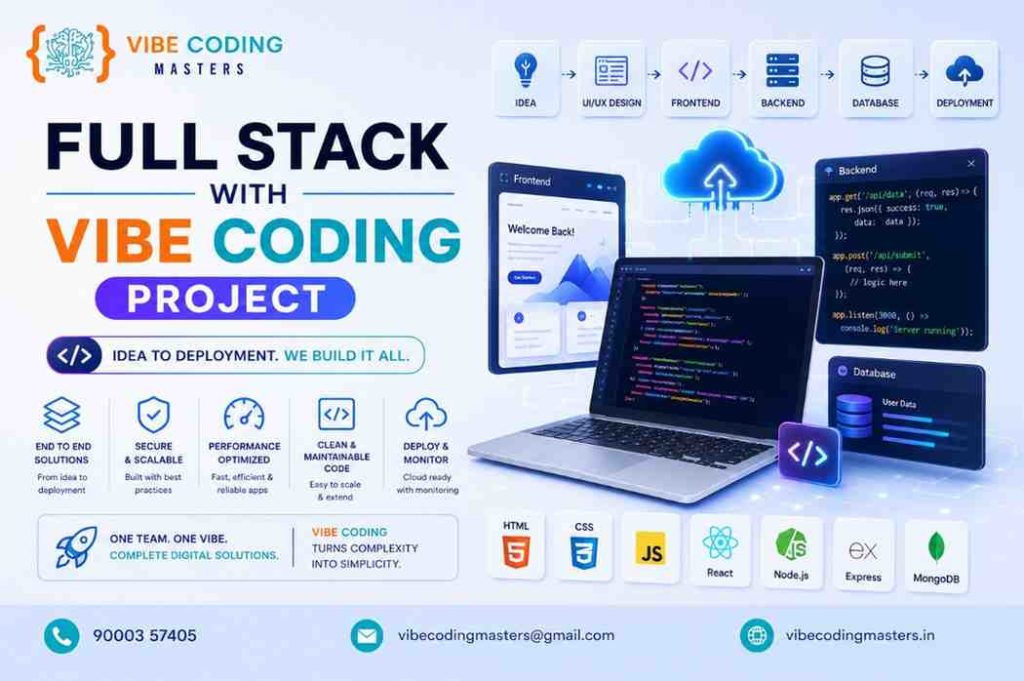
Full stack development simply means you can build both sides of an application — the part users see (the frontend) and the part that runs behind the scenes (the backend and database). A full stack developer connects the buttons, screens, and forms to the servers, logic, and data that make everything actually work.
Vibe coding is the practice of building software by collaborating with AI tools. Instead of memorizing every syntax rule, you guide the AI with clear prompts, review what it produces, fix what it gets wrong, and ship faster. You stay the architect; the AI becomes your tireless pair programmer.
So why is the best full stack with vibe coding project approach becoming so popular? Because it removes the biggest barrier most learners face — the slow, frustrating gap between idea and working product. With AI assistance, a fresher can build a portfolio of real, deployable apps in weeks instead of months.
The demand backs this up. AI skills now appear in a large and rapidly growing share of software job descriptions, and full stack developers are consistently ranked among the most in-demand IT roles in India for 2026, with strong hiring momentum across product companies, fintech, SaaS, startups, and Global Capability Centres (GCCs). According to industry surveys, full stack developers actually lead all roles in AI coding tool adoption — which means learning this combination puts you exactly where the market is heading.
For freshers, vibe coding lowers the entry barrier and helps you build an impressive project portfolio quickly. For experienced professionals, it multiplies productivity and opens doors to higher-paying, AI-integrated roles. And in both India and globally, the future scope is enormous: as software eats more of every industry, the people who can ship full applications with AI — not despite it — will be the ones companies fight to hire.
If you want a structured way to learn this, a dedicated Vibe Coding Course in Hyderabad can take you from zero to a deployable full stack portfolio. Let’s break the whole topic down.
Best Full Stack with Vibe Coding Project: Ideas, Tools, Skills & Career Guide (2026)
What is Full Stack Development?
Full stack development is the ability to build a complete web or mobile application across all its layers — front to back.
A full stack developer works on
- The frontend — everything the user sees and interacts with: pages, layouts, buttons, forms, and animations.
- The backend — the server-side logic, business rules, authentication, and APIs that power the app.
- The database — where all the data (users, orders, messages, content) is stored and retrieved.
Because they understand every layer, full stack developers can take an idea and turn it into a finished, working product on their own. That versatility is exactly why companies value them so highly — one full stack developer can often do the work that would otherwise require two or three specialists.
In 2026, the role has expanded further. Modern full stack engineers are increasingly expected to handle cloud deployment, CI/CD pipelines, and AI integration too — blurring the old lines between developer, DevOps, and AI engineer. If you want to learn all of this in one structured track, the Full Stack with Vibe Coding Course in Hyderabad covers every layer end-to-end.
What is Vibe Coding?
Vibe coding is a modern way of building software where you partner with AI tools to write, test, and improve code through natural-language instructions.
Instead of typing out every function from scratch, you might tell an AI assistant
“Create a login page with email and password fields, validate the inputs, and connect it to a Node.js backend.”
The AI generates a first draft. You review it, refine your prompt, fix the parts it got wrong, and iterate until it works. You’re still in control of the architecture, the logic, and the quality — but the heavy lifting of typing boilerplate code is handled for you.
The term captures the feel of this workflow: you focus on the intent and the “vibe” of what you’re building, while the AI handles much of the mechanical typing. It’s not about blindly accepting whatever the AI produces — good vibe coders read, test, and verify everything. (Surveys consistently show that AI-generated code still needs human review and debugging, so verification is a core skill, not an optional one.)
To understand the fundamentals more deeply, see this guide on what vibe coding actually is.
Why the Best Full Stack with Vibe Coding Project Matters in Modern Development
Building a strong project is the single most effective way to land a developer job — far more than certificates alone. And the best full stack with vibe coding project matters because it proves three things to an employer at once
- You can build end-to-end. You’re not just a frontend stylist or a backend scripter — you can ship a complete, working product.
- You can work with AI tools. This is now a baseline expectation. Teams want developers who use AI to move faster without sacrificing quality.
- You can solve real problems. A live, deployed project shows you can take an idea all the way to production.
In a job market where entry-level postings have tightened and employers increasingly want proof of ability over years of experience, a polished full stack project built with AI assistance is your strongest argument. It’s the difference between a resume that says “I learned React” and a portfolio that says “I built and deployed a real app — here’s the link.”
Benefits of Using Vibe Coding in Full Stack Projects
Pairing vibe coding with full stack work gives you a real, measurable edge
- Speed. AI handles boilerplate, repetitive code, and configuration, so you build working features dramatically faster.
- Faster learning. When AI explains its code, you learn patterns and best practices in context — a live tutor inside your editor.
- Fewer roadblocks. Stuck on an error? AI tools help you debug in seconds instead of hours of forum searching.
- A bigger portfolio. You can complete more projects in less time, giving you more to show recruiters.
- Higher productivity. Industry research shows a majority of developers report meaningful productivity gains from AI assistants — which is why companies are actively hiring for these skills.
- A salary premium. Reports in 2026 indicate full stack developers who can effectively use AI tools (like GitHub Copilot and Cursor) command noticeably higher pay than those who don’t.
The catch — and it’s an important one — is that AI doesn’t replace understanding. The best vibe coders combine AI speed with genuine knowledge of how the code works. (For a fuller picture, see the benefits of a vibe coding course.)
Best Full Stack Technologies for Vibe Coding Projects
A strong vibe coding project is built on a solid, modern tech stack. Below is the toolkit most professionals reach for in 2026, broken into frontend, backend, databases, and AI tools.
Frontend Technologies for Vibe Coding
The frontend is what users see and touch. These are the go-to tools
In a full stack project, the frontend is the layer AI tools handle fastest — React and Next.js remain the default choice because AI models have been trained on millions of examples of them, so prompts like “build a responsive dashboard” produce usable code on the first try far more often than with less common frameworks. TypeScript earns its place here not for style but for safety: in a full stack setup, type mismatches between what the frontend sends and what the backend expects are one of the most common AI-generated bugs, and TypeScript catches many of them before they reach production. Tailwind CSS and Shadcn UI complete the stack by enabling rapid UI refinements through simple prompts like “make this card compact on mobile,” eliminating the need for manual CSS adjustments. matters most in a full stack build, where your attention needs to stay on wiring the frontend to real APIs, not polishing pixels.
To go deeper on this layer, explore the best frontend with vibe coding project guide, or check the dedicated vibe coding with frontend course in Hyderabad.
Backend Technologies for Vibe Coding
The backend powers your app’s logic, security, and data flow:
Picking a backend for a vibe-coded full stack project is really a decision about what the frontend will talk to. Node.js with Express stays the most common pairing simply because it lets you write frontend and backend in the same language, so an AI assistant can reason about both sides of a request in one context window — useful when debugging why data isn’t showing up on a page. FastAPI and Django suit projects where the backend does more than serve data — validating AI-generated inputs, running business logic, or connecting to a database with strict schemas — because their built-in structure catches errors that a looser Node setup might let through. ASP.NET Core and Spring Boot appear mostly in enterprise-style full stack builds, where the backend needs to satisfy compliance and security reviews that AI-generated code can’t skip. Whichever you pick, in a full stack project the backend is where you should slow down and review AI output line by line — a frontend bug shows up visually, but a backend bug can leak data.
For a focused walkthrough, see the best backend with vibe coding project guide. You can also explore the dedicated vibe coding with backend course in Hyderabad for structured backend training.
Databases for Full Stack Projects
Every real app needs a place to store data
The database choice in a full stack project should follow your data shape, not habit: PostgreSQL for anything relational with clear structure (users, orders, transactions), MongoDB when your data is loosely structured or still evolving, and Redis layered on top of either one purely for speed — caching sessions or frequently-read data so the frontend doesn’t wait on the database every time. AI Tools Used in Vibe Coding
These are the AI assistants that make vibe coding possible
On the AI tooling side, the real full stack skill isn’t picking one assistant — it’s knowing which one to reach for at which layer: an editor-native tool like Cursor or Copilot for writing and completing code as you type, and a chat-based assistant like Claude or ChatGPT for planning how the frontend, backend, and database should fit together before you write a single line. Full stack developers who treat these as complementary, not interchangeable, tend to ship cleaner architecture than those who let one tool drive the entire build.A telling 2026 trend: a majority of developers now run three or more AI coding tools in parallel, mixing them to get the best result. Knowing how to combine them is itself a skill.
Best Full Stack with Vibe Coding Project Ideas
The right project depends on your level. Here are practical ideas for every stage — each one designed to be built faster with AI assistance.
For Beginners
- Personal Portfolio Website — showcase your work with React + Tailwind, deployed live.
- To-Do App with Authentication — add login, a database, and CRUD operations (create, read, update, delete).
- Weather Dashboard — fetch live data from a public API and display it cleanly.
- Notes App — a simple full stack app with a Node.js backend and MongoDB.
For Intermediate Developers
- Blog Platform — user accounts, post creation, comments, and an admin panel.
- E-Commerce Store — product listings, cart, checkout, and order history.
- Expense Tracker — charts, categories, and monthly summaries with a real database.
- URL Shortener — practice backend logic, redirects, and Redis caching.
For Advanced Developers
- AI-Powered Chat Application — real-time messaging plus an integrated AI assistant.
- SaaS Dashboard — multi-user app with subscriptions, role-based access, and analytics.
- Job Board Platform — search, filters, applications, and employer dashboards.
- AI Resume Builder — connect an LLM API to generate and format resumes on demand.
The smartest move? Pick a project slightly above your current level and use AI tools to bridge the gap. That’s how you grow fastest. You can browse more real-time vibe coding projects for inspiration, and a structured full stack vibe coding program gives you guided projects exactly like these, with mentorship along the way.
Full Stack Developer Roles and Responsibilities
A full stack developer typically
- Designs and builds responsive user interfaces (frontend).
- Develops server-side logic, APIs, and business rules (backend).
- Designs database schemas and manages data securely.
- Integrates third-party services and AI tools.
- Tests, debugs, and optimizes applications for performance.
- Deploys apps to the cloud and maintains them in production.
- Collaborates with designers, product managers, and other engineers.
In short: they take ownership of the entire product lifecycle, from first screen to live deployment.
Skills Required for Full Stack Vibe Coding Projects
To build the best full stack with vibe coding projects, you’ll want a mix of foundational and modern skills
- HTML — the structure of every web page. (See the MDN Web Docs for the official HTML, CSS, and JavaScript reference.)
- CSS — styling and responsive layouts.
- JavaScript — the core language of the web.
- TypeScript — type-safe JavaScript for reliable, large-scale apps.
- APIs — connecting frontend, backend, and external services (REST and increasingly GraphQL).
- Git — version control and collaboration, essential for every team.
- Cloud Deployment — shipping apps using platforms like Vercel, AWS, or Azure.
- AI-Assisted Development — writing effective prompts, reviewing AI output, and integrating AI tools into your workflow.
Notice the last one. In 2026, prompt skill and AI verification are no longer “nice to have” — they’re core full stack competencies. You can review the full vibe coding course syllabus to see how these build on each other.
Full Stack Developer Salary in India
Full stack developers are among the highest-paid tech professionals in India, and AI fluency pushes earnings even higher. Here’s a realistic 2026 snapshot
Experience Level | Salary Range (Per Annum) |
|---|---|
Fresher (0–2 Years) | ₹3.5 – ₹6 LPA (₹5–7 LPA with strong AI-assisted project portfolios) |
Mid-Level (3–5 Years) | ₹6 – ₹12 LPA |
Senior (6–10 Years) | ₹12 – ₹22 LPA |
Lead / Architect (10+ Years) | ₹22 – ₹50+ LPA |
Figures vary by city, company type, and stack. Bangalore, Hyderabad, and Pune typically pay at the higher end, and product-based companies and GCCs pay more than service firms. AI-integrated and cloud-native full stack roles sit at the top of these ranges.
For a deeper breakdown of earnings by role and experience, see what salary you can expect after learning vibe coding.
Full Stack Career Opportunities in India
India’s tech sector is one of the world’s largest, and full stack developers sit right at its centre. Hyderabad in particular has become one of India’s fastest-growing IT and startup hubs — home to major tech parks, GCCs, and product companies — which makes it an ideal place to launch a full stack career. Opportunities span:
- Product startups building MVPs at speed.
- Established IT services companies and consultancies.
- Global Capability Centres (GCCs) — now owning core product and AI work, not just back-office delivery.
- Fintech, edtech, healthtech, and SaaS companies.
- Freelance and remote roles, including for international clients.
Because full stack developers can do the work of multiple specialists, they remain a hiring priority even when the broader market tightens. For a closer look at the roles you can target, see the guide to careers after vibe coding.
Industries Hiring Full Stack Developers
- Information Technology & Software Services
- Fintech & Banking — secure, scalable apps and embedded finance.
- E-Commerce & Retail
- Healthcare & HealthTech
- EdTech & Online Learning
- SaaS & Cloud Platforms
- AI & Machine Learning Startups
- Media, Entertainment & Gaming
Top Companies Hiring Full Stack Developers
Across India you’ll find full stack roles at large IT firms and fast-growing product companies alike — names regularly hiring include TCS, Infosys, Wipro, Accenture, Capgemini, Persistent Systems, EPAM, Razorpay, Swiggy, Zomato, Flipkart, Amazon, Microsoft, and Atlassian, alongside hundreds of startups and GCCs. Product and platform teams in fintech, SaaS, and AI are where demand is rising fastest.
Full Stack Developer Career Path
Here’s a clear roadmap from beginner to expert, with vibe coding skills woven in at every stage
Stage | Skills Focus |
|---|---|
Beginner | HTML, CSS, JavaScript, Git basics, one frontend framework, fundamentals of prompting AI tools |
Intermediate | React/Next.js, Node.js/Express, REST APIs, one database, daily AI pair-programming (Copilot/Cursor) |
Advanced | TypeScript, system design, authentication & security, cloud deployment, testing, Docker, AI-assisted full builds |
Expert | Architecture, microservices, scalability, DevOps/CI-CD, team leadership, designing AI-driven development workflows |
Treat it as a ladder, not a race. Each stage builds real, demonstrable projects you can show employers.
Full Stack Developer Certifications
Certifications won’t replace a strong portfolio, but they can validate your skills and strengthen your resume. Useful options include
- Cloud certifications (AWS, Microsoft Azure, Google Cloud) — highly valued for deployment skills.
- Framework and language certifications (JavaScript, React, Node.js, Python).
- Meta Front-End / Full-Stack developer professional certificates.
- Industry-recognized full stack and vibe coding course completion certificates from a reputable training institute.
The best approach: combine a recognized vibe coding certification with two or three live, deployed projects. To check whether you qualify for a structured program, review the eligibility for a vibe coding course.
Comparison Tables
Full Stack Developer vs Frontend Developer
Factor | Full Stack Developer | Frontend Developer |
|---|---|---|
Skills | Frontend + backend + database + deployment | HTML, CSS, JavaScript, React/UI frameworks |
Responsibilities | Builds the entire application end-to-end | Builds the user-facing interface only |
Salary Potential | Higher (versatile, end-to-end) | Good, but typically lower than full stack |
Career Growth | Broad — can move into architecture, DevOps, leadership | Strong within UI/UX and frontend specialization |
Demand | Very high across all company types | High, especially in product and design-led teams |
Full Stack Developer vs Backend Developer
Factor | Full Stack Developer | Backend Developer |
|---|---|---|
Skills | Full stack + UI + APIs + databases | Server logic, APIs, databases, system design |
Responsibilities | Both client and server sides | Server-side logic, data, and infrastructure |
Salary Potential | High and flexible | High, especially with system-design depth |
Career Growth | Flexible across the whole stack | Deep specialization toward architecture/platform |
Demand | Very high and versatile | High, particularly in scaling product teams |
Full Stack Developer vs Software Engineer
Factor | Full Stack Developer | Software Engineer |
|---|---|---|
Skills | Web frontend + backend + databases | Broad CS fundamentals, may span web/mobile/systems |
Responsibilities | Build and ship complete web applications | Design and build software across varied domains |
Salary Potential | High | High, often comparable or higher at senior levels |
Career Growth | Toward lead, architect, or tech founder | Toward senior engineer, architect, or management |
Demand | Very high in web/product companies | Very high across the entire industry |
Note: “software engineer” is a broad title — many full stack developers are also called software engineers. The line is increasingly blurred in modern teams.
Market Insights & Industry Trends
The numbers make the opportunity clear. Here’s what’s shaping the field in 2026
- AI adoption is now the norm. Multiple independent surveys put developer adoption of AI coding assistants above 60–80%, with a large share using them daily — and studies report meaningful productivity gains of roughly a third for many teams. This is no longer optional infrastructure.
- Full stack leads AI tool adoption. Among all developer roles, full stack developers report the highest use of AI coding assistants — making this exact combination especially future-proof.
- AI skills are now expected. Industry workforce reports show AI-related skills appearing in a sharply rising share of software job descriptions compared to just a few years ago.
- India is becoming a global product hub. GCCs, fintech, and SaaS companies are expanding product ownership in India — with cities like Hyderabad, Bangalore, and Pune leading the way — accelerating demand for cloud-native, AI-integrated full stack engineers.
- Remote and global opportunities. Full stack development remains one of the most remote-friendly tech roles, opening access to international clients and higher pay.
- A booming market. The global software market reached several hundred billion dollars in size and is projected to more than double over the coming decade, sustaining strong long-term demand.
- A nuance for freshers. Entry-level postings have tightened as AI absorbs simple tasks, which makes a project-rich, AI-fluent profile more important than ever. The freshers who stand out are the ones who can show real, deployed work.
The takeaway: the market increasingly rewards developers who pair end-to-end building ability with genuine AI fluency — exactly the profile the best full stack with vibe coding project builds.
Future Scope of Full Stack Development with Vibe Coding
The future is bright, and here’s why. As AI tools get more capable, the bottleneck in software shifts away from typing code and toward judgment — deciding what to build, designing how it fits together, and verifying that AI output is correct and secure. Full stack developers who vibe code well sit precisely at that high-value intersection.
Over the next several years, expect
- AI to handle more boilerplate, freeing developers for architecture and problem-solving.
- A growing premium on developers who can integrate, orchestrate, and verify AI-generated code.
- More AI-native products, creating demand for engineers who can build with AI at the core.
- Continued strong hiring in India as it cements its place as a global engineering hub.
This is a skill that compounds. The earlier you start, the bigger your advantage.
Why Full Stack Development with Vibe Coding is One of the Best IT Careers
Put it all together and the case is compelling
- High demand across startups, enterprises, and GCCs — especially in a booming IT city like Hyderabad.
- High salaries, with an extra premium for AI fluency.
- Versatility — you can build anything, anywhere, for anyone.
- Remote-friendly, including global opportunities.
- Future-proof, because you work with AI rather than competing against it.
- Fast to portfolio, so you can prove your value quickly.
Few other tech paths combine low barriers to entry, high earning potential, and strong future scope this effectively.
How to Start a Career in Full Stack Development Using Vibe Coding
Here’s a simple, proven path
- Learn the fundamentals — HTML, CSS, and JavaScript. Don’t skip these; AI is far more useful when you understand what it produces.
- Pick one stack — MERN (MongoDB, Express, React, Node) is a great, AI-friendly starting point.
- Add AI tools early — start using ChatGPT, Copilot, or Cursor from day one, but always review and understand their output.
- Build real projects — start small, then climb the difficulty ladder. Aim for three to five deployed apps.
- Deploy everything — use Vercel, Netlify, or a cloud provider so recruiters can click and see live work.
- Learn version control — push everything to GitHub; your repos are part of your resume.
- Get structured guidance — a mentor-led program shortens the path dramatically.
If you’re a busy professional, there are formats designed for you — see the vibe coding course for working professionals. Ready to commit? A hands-on vibe coding training program in Hyderabad will take you from fundamentals to a job-ready full stack portfolio.
Key Takeaways
- The best full stack with vibe coding project combines end-to-end development (frontend, backend, database) with AI tools like ChatGPT, Copilot, Cursor, Claude, and Gemini.
- Full stack developers lead all roles in AI coding tool adoption, making this combination one of the most future-proof skills in 2026.
- Salaries are strong — from ₹3.5–6 LPA for freshers to ₹22–50+ LPA for AI-integrated leads — with a clear premium for AI fluency.
- Real, deployed projects beat certificates. Build three to five live apps and host them on GitHub to stand out.
- The market rewards developers who work with AI, not against it — strong fundamentals plus AI verification skills are the winning formula.
Conclusion
Full stack development has always been one of the most valuable skills in tech — and pairing it with vibe coding makes it more powerful than ever. You get the versatility to build anything, the speed of AI assistance, and a profile that sits exactly where the 2026 job market is heading.
The opportunity is real: high demand across startups, enterprises, and GCCs; strong salaries that rise further with AI fluency; and a future where the developers who can build with AI are the ones companies compete to hire. Whether you’re a fresher looking to break in or an experienced professional aiming to level up, the best full stack with vibe coding project is your fastest route to a standout portfolio.
But reading about it isn’t enough — building is what counts. Pick a project slightly above your current level, fire up your AI tools, and ship something real this week. Then ship another. Your portfolio, your confidence, and your career will grow with every app you deploy.
Ready to start the right way? Join a structured, mentor-led Vibe Coding Course in Hyderabad and go from fundamentals to a job-ready full stack developer — building real, AI-powered projects every step of the way. Start building today.
FAQ
1. What is the best full stack with vibe coding project for beginners?
A to-do app or notes app with user authentication and a database is ideal. It’s small enough to finish, but real enough to teach you the full stack — frontend, backend, database, and deployment — while you learn to use AI tools effectively.
2. What is vibe coding in full stack development?
Vibe coding means building applications by collaborating with AI tools. You describe what you want in plain language, the AI helps generate the code, and you review, refine, and verify it. You stay in control of the architecture and quality while building much faster.
3. Which AI coding tools are best for full stack projects?
The most popular in 2026 are ChatGPT, GitHub Copilot, Cursor AI, Claude, and Gemini. Many developers use several together — autocomplete inside the editor, plus a chat assistant for planning and debugging.
4. Do I need to know how to code to do vibe coding?
Yes — you still need to understand the fundamentals. AI is a powerful assistant, not a replacement for knowledge. The best vibe coders read, test, and verify everything the AI produces, which requires real understanding.
5. What is the salary of a full stack developer in India in 2026?
Freshers typically earn ₹3.5–6 LPA (more with a strong project portfolio), mid-level developers ₹6–12 LPA, and senior developers ₹12–22 LPA. Lead and architect roles, especially AI-integrated ones, can reach ₹22–50+ LPA.
6. Is full stack development with vibe coding a good career in India?
Yes. Full stack developers are among the most in-demand IT professionals in India, and AI fluency adds a salary premium. The role is versatile, remote-friendly, and future-proof.
7. How long does it take to learn full stack vibe coding?
With consistent effort, many learners reach a job-ready level in around 4–8 months. AI tools speed up both learning and building, so a focused, project-based approach can get you there faster.
8. Which tech stack should I learn for full stack vibe coding projects?
MERN (MongoDB, Express, React, Node.js) is the most beginner-friendly and AI-friendly. Add TypeScript and Next.js as you advance, and pick up a Python framework like FastAPI or Django for AI-heavy projects.
9. Do I need certifications to get a full stack job?
Certifications help validate your skills, but a strong portfolio of deployed projects matters far more. The best combination is a recognized certificate plus three to five live projects on GitHub.
10. What is the future scope of full stack development with AI?
Excellent. As AI handles more routine coding, demand grows for developers who can design systems, integrate AI, and verify output. Full stack developers who vibe code well sit at this high-value intersection — a skill that only becomes more valuable over time.