Vibe Coding vs MERN Stack Course: Which Is Better for Your Career?
Vibe Coding is an AI-assisted, prompt-driven approach to building software, where developers describe what they want in natural language and let AI tools generate and refine code. A MERN Stack Course teaches the underlying technologies — MongoDB, Express.js, React, and Node.js — needed to build full applications from scratch. Beginners chasing speed may prefer Vibe Coding; those wanting deep technical fundamentals should choose MERN.
★★★★★
4.9/5 rated by 1329+ students · Google Verified
Table of Contents
Introduction
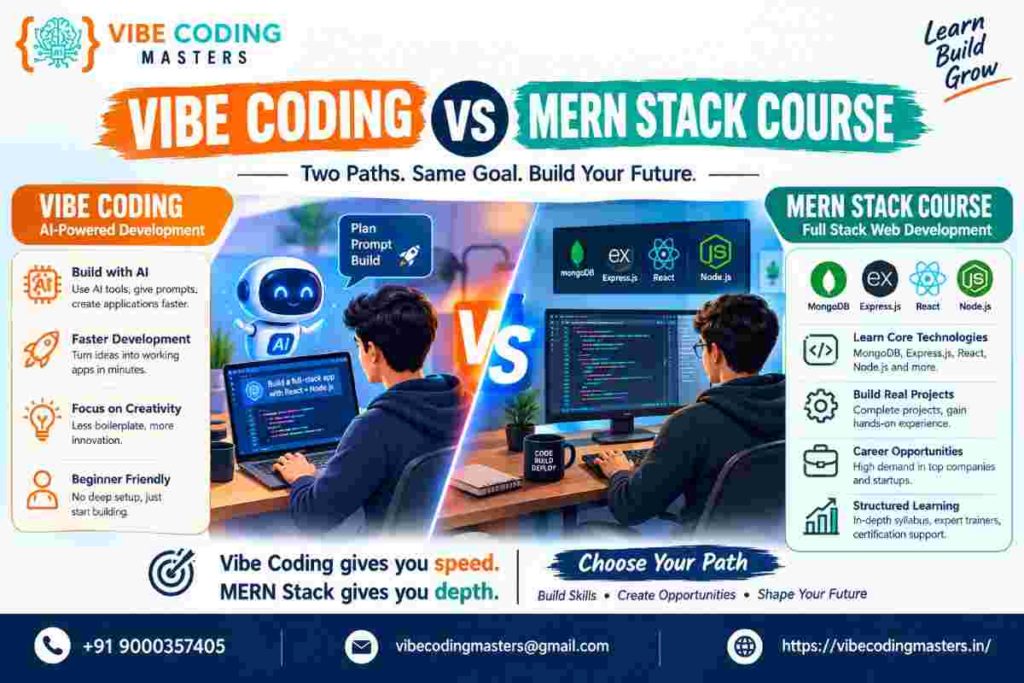
If you’ve spent any time browsing tech forums, LinkedIn, or YouTube lately, you’ve probably run into two very different pieces of advice. One camp says AI has changed everything — just describe what you want and let an AI coding assistant build it for you. The other insists that nothing beats learning a proper stack like MERN, understanding how a request travels from browser to database, and writing real code yourself.
This is exactly why so many learners get stuck comparing Vibe Coding vs MERN Stack Course before deciding where to invest their time.
Vibe Coding refers to a workflow where you build software mainly through natural-language prompts, using AI coding assistants to generate, edit, and debug code. A MERN Stack Course, on the other hand, teaches you MongoDB, Express.js, React.js, and Node.js in depth, so you can build and reason about a full-stack JavaScript application on your own.
Both exist because software development itself is changing. AI tools have made it possible to spin up a working prototype in hours instead of weeks. At the same time, companies still need people who understand APIs, databases, authentication, and system design well enough to fix things when AI-generated code breaks — and it does break.
For beginners, the decision often comes down to a simple question: do you want to move fast and experiment, or do you want to build a solid technical foundation first? The honest answer is that both paths lead to real, paying jobs in India’s tech industry, but they suit different kinds of learners and different career goals. This article breaks down what each path actually teaches, how much you might earn, and how to decide — or combine both — based on where you want to be in two or three years.
This is also one of the most common questions we hear from learners exploring coding careers in Hyderabad, so this guide is written with that decision specifically in mind.
Vibe Coding vs MERN Stack Course
What is Vibe Coding?
Vibe Coding is a software development approach where you build applications primarily by describing your intent in plain language, and an AI coding assistant translates that into working code. Instead of typing out every line of a function, you might prompt an AI tool with something like “create a login form with email and password validation,” review what it generates, and refine it through follow-up instructions.
This workflow generally involves:
- Prompt-driven development — describing features, bug fixes, or UI changes in natural language
- AI coding assistants — tools that generate, complete, or refactor code based on prompts
- Iterative refinement — asking the AI to fix errors, optimize performance, or change design
- AI-assisted debugging — pasting error messages back to the AI to get suggested fixes
- Rapid prototyping — building a working version of an app quickly to test an idea
Importantly, Vibe Coding is a development workflow, not a programming language or a fixed technology stack. You can use it to build a React app, a Python script, or a mobile app — the AI-assisted process is what defines it, not any single tool. For a deeper breakdown of the concept, see our detailed explainer on what Vibe Coding actually means.
The advantage is speed. Someone with limited coding background can produce a working prototype far faster than someone typing every line manually. The limitation is that AI-generated code isn’t always correct, secure, or well-structured. A human developer still has to review the output, understand what it does, catch security issues, and make architectural decisions the AI can’t reliably make on its own. Used without any underlying knowledge, Vibe Coding can produce applications that work in a demo but fail in production.
What is a MERN Stack Course?
A MERN Stack Course teaches you to build full-stack web applications using four core technologies: MongoDB, Express.js, React.js, and Node.js — all built on JavaScript, so you use one language across the entire application.
A typical course covers
- MongoDB — a NoSQL database for storing application data as flexible documents
- Express.js — a lightweight framework for building backend APIs on Node.js
- React.js — a frontend library for building interactive user interfaces
- Node.js — a JavaScript environment designed to execute code on the server.
- JavaScript, HTML, and CSS fundamentals
- REST APIs for communication between frontend and backend
- Authentication using sessions, tokens, or third-party providers
- Database integration — connecting your backend to MongoDB and performing CRUD operations
- Git and GitHub for version control
- Deployment to cloud platforms
- Full-stack project development — combining all of the above into a working application
By the end of a MERN course, you should be able to build an application from the ground up: designing the database, writing backend logic, creating the user interface, and connecting all three layers yourself, without depending on AI to generate the core logic for you.
Vibe Coding vs MERN Stack Course: Key Differences
Factor | Vibe Coding | MERN Stack Course |
Learning approach | Prompt-based, AI-assisted | Structured, technology-by-technology |
Coding knowledge needed | Helpful but not mandatory at the start | Essential from day one |
Core technologies | Varies — AI tools plus any stack | MongoDB, Express, React, Node |
Development workflow | Natural-language prompts, iteration | Manual coding, testing, debugging |
AI involvement | Central to the process | Optional add-on, not core |
Learning curve | Shorter to get a working prototype | Longer to reach the same result manually |
Debugging approach | AI-suggested fixes, human verification | Manual debugging using tools and logic |
Project development speed | Faster initial builds | Slower initially, more thorough understanding |
Job requirements fit | Emerging roles, less standardized | Well-established job descriptions |
Beginner friendliness | Easier to start, harder to master deeply | Steeper start, stronger foundation |
Long-term career value | Growing, but still maturing as a field | Proven, widely recognized skill set |
Neither approach is inherently “better” on every factor — the right choice depends on what you’re optimizing for: speed of building versus depth of understanding.
Vibe Coding vs MERN Stack Course — Which Is Better?
There’s no universal winner here. The better option depends on who you are and what you’re trying to achieve.
- Complete beginners and non-programmers who mainly want to build and validate an idea quickly may find Vibe Coding more approachable at first.
- Students and freshers aiming for conventional developer roles at established companies will benefit more from the structured depth of a MERN Stack Course, since most job descriptions still expect hands-on coding skills.
- Experienced developers can use Vibe Coding as a productivity layer on top of skills they already have — it rarely helps as a starting point without a technical base.
- Freelancers and startup founders often value Vibe Coding for fast MVP creation, since speed to market matters more than architectural perfection in the early stages.
- Career changers moving from non-technical fields may benefit from starting with MERN fundamentals, since it builds the problem-solving skills that make AI tools more useful later. Working professionals switching careers can also look at our Vibe Coding course for working professionals, designed around flexible timings.
- Developers targeting traditional software development jobs — such as backend engineer, frontend developer, or full-stack roles at product companies — will still need solid MERN-level fundamentals, since interviews typically test manual coding and system understanding.
A practical rule of thumb: if your goal is to get hired as a developer, prioritize MERN fundamentals and treat AI tools as an accelerator. If your goal is to launch a product or prototype quickly, Vibe Coding can get you there faster — as long as you eventually validate the code with someone who understands it.
Technologies You Learn in a Vibe Coding Course
Vibe Coding programs vary, but most cover a mix of AI-specific skills and general web development basics
- Prompt Engineering — writing effective instructions for AI coding tools
- AI Coding Assistants — using tools that generate and edit code from prompts
- HTML, CSS, JavaScript/TypeScript — foundational web languages
- React and Next.js — for building modern frontends
- Node.js and Python — common backend choices
- APIs and databases — connecting applications to data sources
- Git/GitHub — version control, even when code is AI-generated
- Debugging and testing — verifying that AI-generated code actually works correctly
- Deployment and cloud platforms — publishing applications
- AI-assisted code optimization — improving performance and readability with AI help
The exact curriculum can vary significantly between programs, since Vibe Coding is still an evolving methodology rather than a standardized syllabus. You can see a full module-by-module breakdown in our Vibe Coding course syllabus.
Technologies Covered in a MERN Stack Course
MongoDB
MongoDB is a NoSQL database that stores data as flexible, JSON-like documents inside collections. You’ll learn how to design schemas, write queries, and connect MongoDB to your backend application. The official MongoDB documentation is a useful reference once you start building.
Express.js
Express is a minimal web framework for Node.js used to build backend APIs. You’ll learn routing, middleware, request handling, and how to structure a server-side application, as detailed in the official Express.js documentation.
React.js
React is a component-based library for building user interfaces. You’ll learn state management, props, hooks, routing, and how to build interactive, reusable UI components — concepts explained in depth in the official React documentation. If you’d rather focus purely on this layer, our Vibe Coding with Frontend course in Hyderabad covers React and modern UI development in depth.
Node.js
Node.js lets you run JavaScript on the server. You’ll learn how to build scalable backend services, handle asynchronous operations, and manage server-side logic, all covered in the official Node.js documentation. Learners who want to specialize here can check our Vibe Coding with Backend course in Hyderabad.
You’ll also cover JavaScript fundamentals, REST API design, authentication (login/signup flows), Git/GitHub for version control, deployment to hosting platforms, and how to bring all four technologies together into a complete, working application. For JavaScript itself, MDN Web Docs remains the most reliable reference for beginners and experienced developers alike.
Vibe Coding vs MERN Stack Course for Beginners
For someone starting from zero, Vibe Coding can feel more approachable because you see results — a working screen, a functioning button — almost immediately. MERN, by contrast, requires understanding programming logic before you can build anything visible, which can feel slower and more frustrating early on.
That said, beginners who rely entirely on AI-generated code without learning fundamentals often hit a wall. When the AI produces incorrect logic, an insecure authentication flow, or code that doesn’t scale, someone without programming knowledge won’t know how to identify or fix the problem. Debugging AI output still requires understanding what the code is supposed to do.
A balanced approach for most beginners is to learn basic programming logic and JavaScript fundamentals first — even briefly — before leaning heavily on AI tools. This way, Vibe Coding becomes a productivity boost rather than a black box you can’t troubleshoot. If you’re unsure whether you meet the starting requirements, our page on eligibility for a Vibe Coding course breaks this down clearly.
Vibe Coding Career Opportunities
Because Vibe Coding is an emerging methodology rather than a formal job category, titles and expectations vary across companies. Roles connected to this space include
- AI-Assisted Developer
- Vibe Coding Developer
- AI Application Developer
- Full Stack Developer (using AI tools)
- AI-Augmented Software Developer
- Automation Developer
- Prototype Developer
- Startup/Indie Developer building MVPs with AI assistance
Job titles in this space will likely keep evolving as companies figure out how to formally define and hire for AI-assisted development skills. For a closer look at where these roles can lead, see our guide on careers after Vibe Coding.
MERN Stack Career Opportunities in India
MERN skills map to well-established, widely recognized job titles
- MERN Stack Developer
- Full Stack Developer
- React Developer
- Node.js Developer
- JavaScript Developer
- Frontend Developer
- Backend Developer
- Web Application Developer
These roles are actively hired across India’s major tech hubs, including Hyderabad, Bengaluru, Pune, Chennai, Mumbai, and Delhi NCR, as well as by fully remote companies serving international clients.
Vibe Coding Developer Salary in India
Because Vibe Coding is a newer, less standardized field, formal salary surveys specifically for “Vibe Coding Developer” roles are limited. In practice, professionals in this space are usually hired under existing titles like Full Stack Developer or AI-Augmented Developer, often with a pay premium for demonstrated AI-tool proficiency.
Experience | Typical Career Stage | Indicative Salary Range |
Fresher / 0–2 Years | Beginner / Junior | ₹3.5–6 LPA |
3–5 Years | Mid-Level | ₹8–16 LPA |
6–10 Years | Senior | ₹16–28 LPA |
10+ Years | Lead / Architect | ₹28+ LPA |
These figures are indicative and can shift meaningfully based on:
- Location and cost of living
- Depth of technical skills beyond AI tool usage
- Company type (startup, product company, or IT services)
- Portfolio quality and past projects
- Interview performance
- Cloud and DevOps knowledge
Do not treat these numbers as guaranteed income — actual offers vary widely between companies and candidates. For a more detailed breakdown, see our dedicated page on salary after learning Vibe Coding.
MERN Stack Developer Salary in India
MERN Stack salaries are better documented, since the role is well-established across the industry.
Level | Indicative Salary Range |
Fresher (0–2 years) | ₹3.5–7 LPA |
Junior Developer (1–3 years) | ₹5–9 LPA |
Mid-Level Developer (2–5 years) | ₹8–16 LPA |
Senior Developer (5+ years) | ₹16–25 LPA |
Lead/Architect (8+ years) | ₹25+ LPA |
Factors influencing MERN salaries include experience level, proficiency in React and Node.js internals, exposure to system design, additional skills like TypeScript or cloud platforms, and whether you’re hired by a service company, a product startup, or an MNC — product companies and startups in metro cities generally pay at the higher end of these ranges.
Skills Required for Vibe Coding
- Prompt Engineering
- Basic programming fundamentals
- Problem-solving ability
- Ability to read and understand AI-generated code
- Debugging skills
- API integration knowledge
- Git/GitHub
- Database fundamentals
- Testing practices
- Security awareness
- Basic software architecture understanding
- Deployment knowledge
- Clear communication (for writing effective prompts)
Skills Required for MERN Stack Development
- JavaScript (core language across the stack)
- HTML and CSS
- React.js
- Node.js
- Express.js
- MongoDB
- REST API design
- Authentication and authorization
- Git/GitHub
- Debugging and testing
- Deployment
- Basic system design principles
Vibe Coding vs MERN Stack Course — Learning Curve
Getting a basic prototype working with Vibe Coding can happen within days, since you’re leaning on AI to generate most of the code. Reaching the same milestone with MERN typically takes weeks, since you’re learning each technology individually before combining them.
However, becoming genuinely job-ready is a longer process either way. With Vibe Coding, the harder part is developing the underlying judgment to evaluate, fix, and secure AI-generated code — that maturity doesn’t come overnight. With MERN, the harder part is simply the volume of concepts to learn before you can build confidently on your own.
Avoid trusting any course or program that promises job-readiness in a fixed number of days — realistic timelines depend heavily on prior experience, consistency of practice, and the complexity of the projects you build.
Vibe Coding vs MERN Stack Course — Project Development
Both approaches can be used to build similar kinds of projects
- Portfolio website
- E-commerce application
- Job portal
- Learning management system
- CRM
- Chat application
- Blog platform
- AI-powered application
- Business dashboard
With Vibe Coding, you can often get a rough version of any of these running quickly by prompting an AI assistant step by step. With MERN, you build the same project by writing and connecting each layer — frontend, backend, and database — yourself, which takes longer but gives you a deeper understanding of exactly how the application works and how to modify it later.
Vibe Coding vs MERN Stack Course — Career Path
Level | Vibe Coding Path | MERN Stack Path |
Beginner | AI tool basics + coding fundamentals | JavaScript fundamentals |
Intermediate | AI-assisted application development | React + Node.js |
Advanced | APIs, databases, testing, deployment | Full-stack applications |
Expert | AI-native development & architecture | Scalable full-stack architecture |
At each stage, the priority should shift from “can I make it work” to “do I understand why it works and can I maintain it.”
Job Market Demand in India
India’s tech job market continues to reflect two parallel trends. On one hand, companies across sectors — from SaaS to fintech to e-commerce — continue hiring full-stack developers with MERN-equivalent skills, since most production web applications still rely on these fundamentals. On the other hand, adoption of AI coding assistants has grown rapidly inside development teams, with many companies now expecting developers to be comfortable using AI tools alongside traditional coding skills, rather than choosing one over the other.
Startups and product companies in hubs like Bengaluru, Hyderabad, and Pune are increasingly looking for developers who can combine both — strong fundamentals plus AI-assisted productivity — rather than treating them as separate skill sets. Hyderabad specifically has seen steady growth in IT parks around HITEC City, Gachibowli, and Madhapur, with a mix of MNCs, GCCs, and startups hiring full-stack and AI-assisted developers.
Why Vibe Coding Is Becoming Important for Developers
- Faster prototyping — ideas can be tested as working demos within hours
- Reduced repetitive coding — boilerplate and common patterns can be generated instantly
- AI-assisted debugging — quick first-pass suggestions for fixing errors
- Faster MVP development — useful for startups validating an idea before heavy investment
- Increased developer productivity — experienced developers can move through routine tasks faster
- Rapid experimentation — testing multiple approaches without writing everything from scratch
Limitations to keep in mind:
- AI hallucinations — confidently wrong code or explanations
- Incorrect logic that looks plausible but fails under real conditions
- Security vulnerabilities in generated code
- Poor architectural decisions for complex systems
- Risk of using code you don’t fully understand
- Ongoing need for testing and human review before deployment
Why MERN Stack Development Is Still Relevant
Despite the rise of AI coding tools, MERN hasn’t lost relevance — if anything, it remains the foundation many AI tools generate code in.
- A massive, active JavaScript ecosystem and community
- Consistently high demand for React developers
- Full-stack capability using a single language across the application
- Continued adoption by startups building web products
- Strong fit for REST API development
- Skills that transfer easily to other frameworks and stacks
Understanding MERN also makes you a better user of AI coding tools, since you can evaluate whether the code they produce is actually correct.
Why Combining Vibe Coding with MERN Can Be a Powerful Career Strategy
A practical, increasingly common path looks like this
MERN fundamentals → AI-assisted development → Prompt Engineering → Git → APIs → Testing → Deployment
Developers who understand core web development principles and know how to use AI tools effectively tend to build faster without sacrificing code quality. They can spot when an AI suggestion is wrong, refine it intelligently, and ship applications that actually hold up in production — a combination that’s increasingly attractive to employers.
Vibe Coding vs MERN Stack Course: Which One Should You Choose?
Choose Vibe Coding if
- You want to build and test applications quickly
- You’re interested in AI-assisted development
- You enjoy experimenting with AI tools
- You want to prototype product ideas
- You want to grow into an AI-augmented developer role
Choose MERN Stack if
- You want strong full-stack development fundamentals
- You prefer learning a clearly defined technology stack
- You’re targeting conventional developer job openings
- You want deep knowledge of both frontend and backend systems
Choose Both if
- You want traditional coding knowledge plus AI-driven productivity
- You want to build modern, AI-powered web applications
- You want the broadest possible career flexibility
If this sounds like you, a combined program such as the Full Stack with Vibe Coding course in Hyderabad is built specifically to cover both fundamentals and AI-assisted workflows in one track.
Top Tools Used in Vibe Coding
Rather than promoting specific products, it helps to understand the categories of tools involved
- AI coding assistants — generate and modify code from natural-language prompts
- AI-enabled IDEs — development environments with built-in AI suggestions
- Code generation tools — produce boilerplate or full components from a description
- Debugging assistants — analyze errors and suggest fixes
- Documentation assistants — generate comments and technical documentation
- API development tools — assist with building and testing endpoints
- Git/GitHub — still essential for version control, regardless of how code is generated
- Deployment platforms — publish applications to the web
Certifications and Projects That Can Improve Career Opportunities
Certifications can help you get noticed, but employers generally weigh practical projects more heavily. Consider building
- An AI-powered chatbot
- A small e-commerce platform
- An employee management system
- A CRM for a small business use case
- A job portal
- An AI content generation tool
- A business analytics dashboard
- A simple SaaS application
Document these projects clearly on GitHub, deploy live versions where possible, and write short explanations of the architecture and decisions you made. A well-documented portfolio often carries more weight in interviews than a certificate alone. You can browse ready Vibe Coding project ideas for inspiration, and see what a recognized Vibe Coding certification actually covers before you enroll anywhere.
Future Scope of Vibe Coding and MERN Development
Software development is likely to keep moving toward a hybrid model rather than one fully replacing the other. Expect continued growth in AI-native development practices, more capable AI coding agents, and increasing automation of repetitive full-stack tasks. At the same time, programming fundamentals, API design, database knowledge, and system architecture are likely to remain essential — someone still needs to guide, verify, and maintain what AI tools produce.
Rather than AI replacing developers outright, the more realistic trend is developers who use AI well outperforming those who don’t, while developers with no technical foundation struggle to move beyond simple prototypes.
How to Start Learning Vibe Coding and MERN Stack
- Learn basic programming concepts
- Understand HTML and CSS
- Learn JavaScript
- Learn React
- Learn Node.js and Express
- Learn MongoDB
- Understand how APIs work
- Learn Git and GitHub (the official Git documentation is a solid starting reference)
- Start using AI coding tools
- Learn prompt engineering
- Build real-world projects
- Practice debugging and testing
- Deploy your applications
- Build a professional portfolio
- Apply for internships and jobs
Career Comparison Overview
Comparison | Key Difference |
Vibe Coding Developer vs MERN Stack Developer | AI-assisted workflow vs manually coded, technology-specific expertise |
AI-Assisted Developer vs Full Stack Developer | Broader tool-driven role vs a defined, well-recognized job title |
Vibe Coding vs Traditional Coding | Prompt-driven generation vs hand-written, line-by-line logic |
AI-Assisted Development vs Conventional Development | Faster iteration vs deeper control over implementation details |
Actual career outcomes in either path depend far more on your skills, project quality, and experience than on which label you choose.
Key Takeaways
- Vibe Coding is an AI-assisted, prompt-driven development workflow, not a fixed technology stack — while MERN is a specific, well-defined full-stack technology combination.
- Vibe Coding offers faster initial results, but MERN builds deeper, more transferable technical fundamentals.
- MERN maps to well-established job titles and salary bands in India; Vibe Coding roles are still forming and vary by company.
- Combining MERN fundamentals with AI-assisted development skills is emerging as a strong, flexible career strategy.
- Neither approach guarantees career success on its own — real projects, consistent practice, and strong fundamentals matter more than the label you choose.
Conclusion
Choosing between Vibe Coding vs MERN Stack Course ultimately comes down to your goals, not which one is objectively superior. If you want to build and test ideas quickly, Vibe Coding offers a fast, approachable entry point. If you’re aiming for a traditional developer role and want to deeply understand how applications are built from the ground up, a MERN Stack Course gives you that foundation.
For most learners, the smartest long-term strategy isn’t choosing one over the other — it’s building solid programming fundamentals through MERN, then layering AI-assisted development skills on top to work faster and more efficiently. Employers increasingly value developers who can do both: write and reason about real code, and use AI tools to move quickly without losing quality.
Whichever path you start with, the most important step is the same: start building. Pick a small project, apply what you’re learning, and keep iterating. Your first line of code — or your first well-crafted prompt — is the real beginning of your Vibe Coding or MERN Stack learning journey.
If you’d rather learn both under expert guidance instead of figuring it out alone, explore the Vibe Coding Course in Hyderabad at Vibe Coding Masters — with hands-on projects, mentorship, and placement support to help you go from fundamentals to a job-ready portfolio.
Note: Before diving into the FAQs, it’s worth practicing with real questions — our Vibe Coding interview questions page is a useful next stop once you’ve built a few projects.
FAQ
- What is the difference between Vibe Coding and MERN Stack?
Vibe Coding is an AI-assisted, prompt-driven approach to building software using natural-language instructions. A MERN Stack Course teaches specific technologies — MongoDB, Express, React, and Node.js — so you can build full applications through manual coding and deep technical understanding.
- Is Vibe Coding better than a MERN Stack Course?
Neither is universally better. Vibe Coding helps you build and prototype faster, while MERN builds stronger technical fundamentals. Your choice should depend on whether you’re prioritizing speed or deep, transferable coding skills.
- Is Vibe Coding suitable for beginners?
Yes, in terms of getting started quickly, since AI tools handle much of the code generation. However, beginners should still learn basic programming logic so they can understand, debug, and trust the code the AI produces.
- Is MERN Stack still in demand in India?
Yes. MERN remains one of the most widely used full-stack combinations for web applications in India, with consistent hiring across startups, product companies, and service providers in major tech hubs.
- Can I learn MERN Stack using AI coding tools?
Yes. Many learners now use AI assistants to speed up MERN learning — generating boilerplate code, explaining concepts, or debugging errors — while still working through the core concepts manually to build real understanding.
- Which has better career opportunities: Vibe Coding or MERN?
MERN currently maps to more established, widely recognized job titles. Vibe Coding opens emerging opportunities, but roles and expectations are still evolving, so job titles and requirements vary between companies.
- What salary can a Vibe Coding developer earn in India?
Since formal roles are still emerging, professionals with strong AI-assisted development skills are typically hired under titles like Full Stack Developer, often earning ₹3.5 — 6 LPA as freshers and rising with experience and additional technical skills.
- What salary can a MERN Stack developer earn in India?
MERN Stack developers in India typically earn ₹3.5–7 LPA as freshers, ₹8–16 LPA at mid-level, and ₹16 LPA or more as senior developers, depending on location, company, and skill depth.
- Should I learn Vibe Coding after MERN Stack?
This is a strong sequence for many learners. Building MERN fundamentals first gives you the judgment to evaluate AI-generated code effectively, making Vibe Coding a genuine productivity boost rather than a black box.
- Can Vibe Coding replace traditional programming skills?
Not entirely. AI tools can generate significant portions of code, but understanding logic, debugging, security, and architecture still requires human expertise — especially for complex or production-grade applications.