Platform-specific skills open doors across multiple career paths — explore the full breakdown on our dedicated Career Opportunities After Vibe Coding page.
Best Vibe Coding Platforms in 2026: A Complete Guide
Vibe coding platforms are AI-powered development environments where you describe an app in plain language and the platform writes, edits, and runs the code for you. They pair large language models with editors, live previews, and one-click deployment, letting beginners, developers, startups, and freelancers build real applications in hours instead of weeks – while you stay in control and review the output.
Facebook
X
LinkedIn
★★★★★
4.9/5 rated by 1329+ students · Google Verified
Table of Contents
Introduction
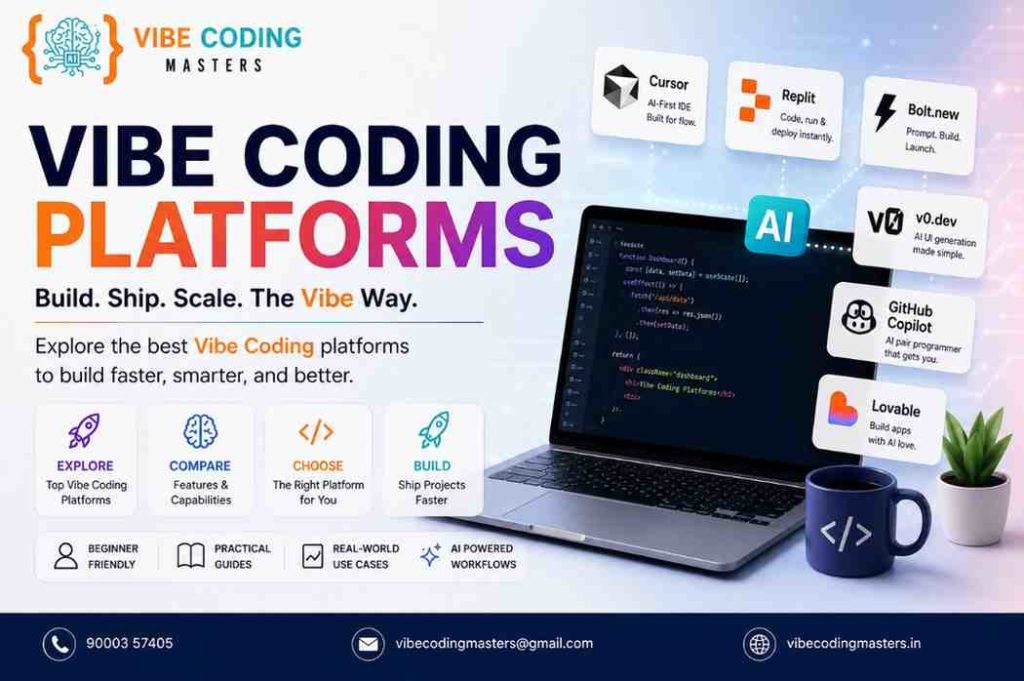
Software is no longer written only by hand. In 2026, a growing number of builders describe what they want in plain English and let AI generate the code. This shift is powered by vibe coding platforms – AI-driven environments that turn natural-language prompts into working applications. Whether you are a beginner, a professional developer, a founder, or a freelancer, these platforms have become one of the fastest ways to ship real software.
The momentum is hard to overstate. Stack Overflow’s Developer Survey found that 84% of developers now use or plan to use AI tools, and stricter industry measures put regular workplace usage closer to 90%. Analysts expect AI-generated code to make up a majority of new code by year’s end. Working fluently with AI coding tools is now a core professional skill, not a novelty.
This guide covers what these platforms are, why they are growing, their benefits, the best options in 2026, and how to get started. If you want structured, mentor-led practice, our Vibe Coding Course in Hyderabad is built around these exact workflows – but you can begin experimenting on your own today.
Vibe coding platforms
What Are Vibe Coding Platforms?
Vibe coding platforms are AI-powered development environments where you build by describing your intent rather than writing every function by hand. You type a prompt such as “create a responsive landing page with a signup form and dark mode,” and the platform generates the files, shows a live preview, and lets you refine through follow-up instructions. The term captures guiding the overall direction – the vibe – while the AI handles the mechanical typing.
Under the hood, these platforms combine a large language model that generates code, an editor where the output lives, a runtime that executes your app, and usually a deployment layer that publishes it. Some run entirely in your browser; others plug into desktop editors you already use. If the concept is new to you, our explainer on what vibe coding actually is covers the fundamentals in more depth.
Importantly, vibe coding is not blindly accepting whatever the AI produces. The best practitioners read the generated code, correct mistakes, and steer the model toward clean results. That balance – speed from AI, control from you – is what makes these tools powerful.
Why Vibe Coding Platforms Are Growing Rapidly
The rise of vibe coding platforms comes down to one economic truth: they compress the time between idea and working product. A prototype that once took a small team a week can now be built by one person in an afternoon. When speed like that arrives, adoption follows – and the data confirms it.
Multiple 2026 surveys report that around 90% of professionals regularly use at least one AI coding tool at work, and roughly half reach for AI every day. Enterprises have moved just as fast. This is no longer an experiment at the edges; it is the mainstream way modern software gets built.
Three forces fuel this: models are far better at understanding context across multiple files; tooling has matured so previewing, debugging, and deploying happen in one experience; and the economics are compelling, with reports of several hours saved per developer each week.
Benefits of Using Vibe Coding Platforms
The advantages go beyond typing speed – they change who can build software and how fast ideas can be tested. The benefits that matter most
- Faster development: Turn prompts into functional features in minutes, shortening the path from concept to demo.
- Lower entry barrier: People without a computer science degree can build real applications, opening the field to designers, analysts, and domain experts.
- Rapid prototyping: Validate an idea with a clickable product before investing weeks of engineering.
- Reduced boilerplate: The AI handles repetitive setup – routing, forms, styling, configuration – so you focus on what is unique.
- Built-in learning: Reading AI-generated code is a fast way to see real patterns and level up.
- Easier debugging: Paste an error and the platform explains the cause and proposes a fix.
These benefits compound: a freelancer delivers more client projects, a startup iterates overnight, and a student builds a portfolio that actually runs. The common thread is leverage.
Best Vibe Coding Platforms in 2026
The 2026 landscape is rich and fast-moving. Below is an overview of the platforms developers reach for most often; most builders combine two or three rather than relying on one.
state that platforms split into AI Coding Assistants, AI-Native IDEs, Prompt-to-App Builders, and Agentic/Backend-Integrated tools, naming 2-3 examples per category without individual tool descriptions, and direct readers to the dedicated software page for full breakdowns
For regularly updated comparisons, see our breakdown of the best AI tools for vibe coding in 2026 and our guide to the software used for vibe coding.
Vibe Coding Platforms Compared
Platform | Best For MVP | Best For Enterprise | Best For Solo Learning | Best For Team Collaboration |
ChatGPT | Medium | Low | High | Low |
GitHub Copilot | Low | High | Medium | High |
Cursor AI | Medium | High | Medium | High |
Replit AI | High | Low | High | Medium |
Bolt.new | High | Low | Medium | Low |
Lovable | High | Medium | Medium | Medium |
Vercel v0 | Medium | Medium | Low | Medium |
Claude AI | Medium | High | High | Medium |
Features to Look for in a Vibe Coding Platform
Not every platform suits every builder, so evaluate them against a consistent checklist rather than chasing whatever is trending
- Prompt quality and context handling: Can the AI understand your whole project, not just the current file? Strong multi-file context separates a toy from a real tool.
- Live preview: Seeing changes rendered instantly tightens the feedback loop.
- Editable source code: You should always be able to open, read, and hand-edit what the AI produces.
- Deployment: One-click hosting removes huge friction, especially for beginners.
- Version control: Git integration protects your work and lets you roll back bad changes.
- Free tier and fair pricing: A generous free plan lets you learn before you pay.
- Debugging and testing support: Built-in error explanation and test generation save hours.
Starting out, prioritize live previews, a free tier, and beginner-friendly guidance; as a professional, weight multi-file context, editor integration, and version control. The right platform fits how you actually work.
How Vibe Coding Platforms Work
A vibe coding platform runs a loop: you write a prompt, the AI interprets your intent and generates or modifies code, the platform runs the result, and you review and refine. Each cycle brings the app closer to what you want.
The intelligence comes from large language models trained on huge amounts of code. When you prompt the model, it predicts the most appropriate code from that training and your project’s context. The platform wraps this with practical tooling – a file system, preview server, terminal, and deployment integrations – so the code can execute.
Output quality depends heavily on input quality. Clear, specific prompts that describe the goal, constraints, and expected behavior produce far better code than vague one-liners. Our guide to effective vibe coding prompts walks through patterns that consistently get better results.
Who Should Use Vibe Coding Platforms?
The honest answer: almost anyone who wants to build software faster.
Beginners build real projects without first mastering an entire stack. Professional developers offload boilerplate and move through tickets faster. Startups and founders validate ideas with a working MVP before hiring a team. Freelancers take on more clients by shipping faster, and students build portfolios that demonstrate deployable skills.
Even non-technical professionals – product managers, marketers, analysts – build internal tools without waiting on an engineering queue. If your work touches software, these tools help. For those intimidated by code, our resource on vibe coding for non-programmers is a friendly on-ramp, and structured vibe coding training in Hyderabad gives you mentorship and a clear sequence to follow.
Top AI Technologies Powering Vibe Coding Platforms
Behind the smooth prompt-to-app experience sits a stack of technologies. Knowing what they are demystifies the “magic” and clarifies what these tools can and cannot do.
Large language models are the engine that interprets prompts and generates code. Prompt engineering is framing requests for accurate output. Retrieval and context systems feed the model relevant parts of your codebase so suggestions fit. Agentic workflows let the AI plan and execute multi-step tasks, such as creating several files and wiring them together.
These rest on familiar building blocks: AI code generation, API integration for external services, database connectivity for storing data, and cloud deployment for publishing. Modern platforms add automated testing and code refactoring so code stays reliable as it grows.
Vibe Coding Platforms for Beginners
Step | Content |
Step 1 — Create Account | Go to replit.com and sign up using Google, GitHub, or email. No credit card required for the free tier. |
Step 2 — Start a New Repl | Click “Create Repl,” select “Build with AI,” and choose your project type (web app, script, or full-stack). |
Step 3 — Write Your First Prompt | In the Replit AI Agent chat box, type a specific prompt — for example: “Build a to-do list app with add, delete, and mark-complete features using React.” |
Step 4 — Review Generated Code | Replit Agent generates files and shows a live preview pane on the right. Open the file explorer to read what was created before making changes. |
Step 5 — Refine with Follow-Up Prompts | Ask for specific changes — for example: “Add a dark mode toggle” — instead of accepting the first output as final. |
Step 6 — Deploy the Live Project | Click “Deploy” in the top-right corner, choose “Autoscale” or “Static” deployment, and get a live .replit.app URL to share. |
Reference | Official walkthrough: Replit Docs — Getting Started |
Vibe Coding Platforms for Professional Developers
For experienced developers, these platforms are about leverage, not learning. The value is speed on tedious tasks: scaffolding modules, writing tests, migrating code, and refactoring large files. Used well, AI turns a day of grunt work into a focused review session.
Professionals favor tools with deep editor integration and strong multi-file context, so the AI reasons across an entire codebase. Editor-native assistants provide inline completions in the local style, while agentic editors carry out planned, multi-step changes under supervision. The key shift is from writing every line to directing, reviewing, and correcting – which is why reviewing AI code now rivals writing it.
Trust remains the crucial caveat. Surveys show most developers do not fully trust AI output on the first try, and a common frustration is code that is “almost right, but not quite.” Disciplined review, testing, and secure coding are non-negotiable. Building on solid frameworks – like the official React documentation for frontend patterns – keeps AI code aligned with real standards.
Vibe Coding Platforms vs Traditional Development
To see why these platforms matter, compare them with the write-everything-by-hand approach. Neither is universally better; each suits different situations.
Factor | Vibe Coding Platforms | Traditional Development |
Development speed | Very fast for prototypes and features | Slower, line-by-line effort |
Coding knowledge required | Low to moderate to start | High from the beginning |
Cost | Low; free tiers available | Higher time and labor cost |
Productivity | High leverage per person | Depends on team size and skill |
AI assistance | Central to the workflow | Optional or minimal |
Learning curve | Gentle entry, deep ceiling | Steep from day one |
Scalability | Strong with human review | Strong with proper engineering |
Collaboration | Fast iteration and sharing | Established team processes |
The realistic takeaway is that the two blend: most teams use vibe coding platforms to move quickly, then apply traditional discipline – architecture, testing, security, and review – to make the result robust. For a fuller side-by-side, read our comparison of vibe coding vs traditional coding.
Free vs Paid Vibe Coding Platforms
One of the best things about this moment is how much you can accomplish for free. Nearly every major platform offers a genuinely useful free tier that limits AI generations, restricts private projects, or caps deployments – constraints that rarely matter while you build skills.
Paid plans become worthwhile once you hit those limits. Upgrading usually unlocks faster models, higher usage, private projects, team collaboration, and production-grade hosting. For a freelancer or startup, the cost is easily justified by time saved.
Our advice for beginners is simple: start entirely on free tiers, build several projects, and only pay once you clearly feel a limit. You learn what you actually need before spending anything.
Market Trends and Industry Insights
Platform adoption is accelerating fastest among prompt-to-app builders and agentic IDEs, with tools like Replit, Cursor, and Bolt.new reporting some of the sharpest user-growth curves of any developer category in 2026. As agentic workflows mature, the ability to direct multiple platforms — rather than master just one — is becoming the differentiating skill for builders. For a data-backed view of how AI talent demand is evolving in India, see the Nasscom AI Talent Report. That is why our hands-on vibe coding classes in Hyderabad emphasize practical, portfolio-ready projects.
Why Vibe Coding Platforms Are Transforming Modern Software Development
Beyond individual productivity, vibe coding platforms are changing software development as a discipline. When the cost of a first working version drops, teams test more ideas, fail faster, and learn quicker. Innovation stops being gated by how many engineers you can hire and starts being gated by how well you can imagine and direct.
Concretely, they improve productivity by removing repetitive work, raise software quality when paired with review, and boost development speed. They strengthen team collaboration by making running prototypes easy to share, and turbocharge rapid prototyping so feedback loops shrink from weeks to days.
The impact is dramatic for two groups. For startups, a tiny team can build and iterate like a much larger one, extending the runway. For enterprises, internal tools that once sat in a backlog for months can ship in days, freeing senior engineers to focus on the hard architectural problems that need human expertise.
Career Opportunities with Vibe Coding Skills
Learning Roadmap for Vibe Coding
Skill grows in stages. The roadmap below shows a sensible progression from beginner to expert. You do not need to master each stage perfectly before moving on – build projects at every level and let harder concepts sink in through practice.
| Level | Details |
|---|---|
| Full Roadmap | A full stage-by-stage roadmap — covering prompt basics through enterprise-level AI development — is available on our dedicated Vibe Coding Roadmap page. |
As you climb, ground your learning in reliable references. Pick up version control with the official Git documentation, strengthen your backend foundation with the Python documentation, and learn server-side JavaScript through the Node.js documentation. Pairing hands-on practice with these fundamentals turns a prompt-writer into a genuine developer.
Future of Vibe Coding Platforms
Where is this heading? Every signal points to AI becoming even more central: models will keep improving at understanding large codebases, agentic capabilities will handle longer autonomous tasks, and the boundary between designing, prompting, and coding will keep blurring.
Expect platforms to become more collaborative, with people and AI agents on the same project in real time, and deeper integration with testing, security scanning, and deployment. Expect the human role to shift decisively toward architecture, judgment, and review – deciding what to build and verifying it is correct, secure, and maintainable.
None of this makes fundamentals obsolete. If anything, understanding how software works becomes more valuable, because the people who direct and correct AI well are those who know what good code looks like. The future belongs to those who combine AI with real skill.
How to Get Started with Vibe Coding Platforms
Getting started is simple, and the best approach is to build rather than read. A practical sequence you can begin today
- Pick one beginner-friendly platform with a free tier and live preview. Don’t agonize – you can switch later.
- Build one small project end to end. A landing page or to-do app is perfect. Deploy it and share the link.
- Practice prompting. Notice which prompts produce clean results and refine your style.
- Read the generated code. Understand each part and fix at least one issue yourself.
- Learn fundamentals in parallel. Spend a little time each week on HTML, CSS, JavaScript, and Git.
- Repeat with harder projects until you can build full-stack apps with authentication and a database.
If you would rather not navigate this alone, a structured program removes the guesswork. Our in-person vibe coding program in Hyderabad gives you a clear roadmap, mentor feedback, and real deployment practice. Whether you self-study or join a course, the important thing is to start building this week.
Key Takeaways
- Vibe coding platforms let you build real software by describing intent in plain language while AI generates and runs the code.
- Adoption is now mainstream – around 90% of developers regularly use AI coding tools, and daily usage keeps climbing.
- They benefit everyone from beginners and students to professional developers, startups, and enterprises by compressing idea-to-product time.
- AI output must always be reviewed, tested, and secured – fundamentals and judgment remain essential for production-ready work.
- In India, especially Hyderabad, AI development skills open high-demand, high-paying career paths that reward demonstrable, portfolio-backed ability.
Conclusion
Vibe coding platforms are one of the most significant shifts in how software is built since high-level languages arrived. By turning natural-language prompts into working applications, they make building faster, more accessible, and more creative – without removing the need for skill, judgment, and review. The builders who thrive are those who embrace these tools while genuinely understanding the code beneath them.
The barrier to entry has never been lower. You can open a browser, describe an idea, and have something real running within minutes. Every project sharpens both your prompting and your fundamentals, compounding into serious capability. The gap between “I have an idea” and “I built it” is closing, and the people closing it fastest are the ones who simply start.
So start today. Choose a platform, build one small thing, deploy it, and keep going. Continuous learning and hands-on practice are what turn curiosity into a career. If you want structure, mentorship, and a proven path from beginner to job-ready builder, explore our learn vibe coding in Hyderabad program and take the next step. The best time to build with AI was yesterday; the second-best time is right now.
FAQ
1. What are vibe coding platforms?
Vibe coding platforms use AI to generate, edit, and run code from natural-language prompts. They help users create applications faster with built-in coding and deployment tools.
2. Which vibe coding platform is best for beginners in 2026?
Beginner-friendly browser-based platforms with visual previews and one-click deployment are the easiest to learn. A free plan and simple interface make the learning process smoother.
3. Are vibe coding platforms free to use?
Most platforms provide free plans for learning and building small projects. Premium subscriptions unlock advanced AI features, higher limits, and collaboration tools.
4. Do I need coding experience to use vibe coding platforms?
No coding experience is required because AI understands plain-language instructions. However, basic programming knowledge helps you create better prompts and improve the generated code.
5. Can vibe coding platforms build full-stack applications?
Yes, they can generate frontend, backend, databases, authentication, and deployment setup. Human review is still important for security, scalability, and production quality.
6. What is the difference between vibe coding platforms and no-code tools?
No-code tools rely on drag-and-drop components with limited customization. Vibe coding platforms generate editable source code, giving developers greater flexibility and control.
7. Are vibe coding platforms safe for production code?
AI-generated code should always be reviewed, tested, and secured before deployment. Following best development practices ensures reliable and production-ready applications.
8. Which programming languages do vibe coding platforms support?
Most platforms support JavaScript, TypeScript, Python, HTML, CSS, React, Node.js, and SQL. Some also generate code in Java, Go, Ruby, and other popular languages.
9. Can vibe coding help me get a job in India?
Yes, AI-assisted development skills are increasingly valued by employers across India’s technology sector. Building real-world projects with AI tools can strengthen your portfolio and job prospects.
10. How do I start learning to use vibe coding platforms?
Start with a beginner-friendly platform and build simple projects using AI prompts. Learn core web technologies alongside regular practice to develop practical development skills.