Vibe Coding vs Prompt Engineering: Which AI Skill Should You Learn in 2026?
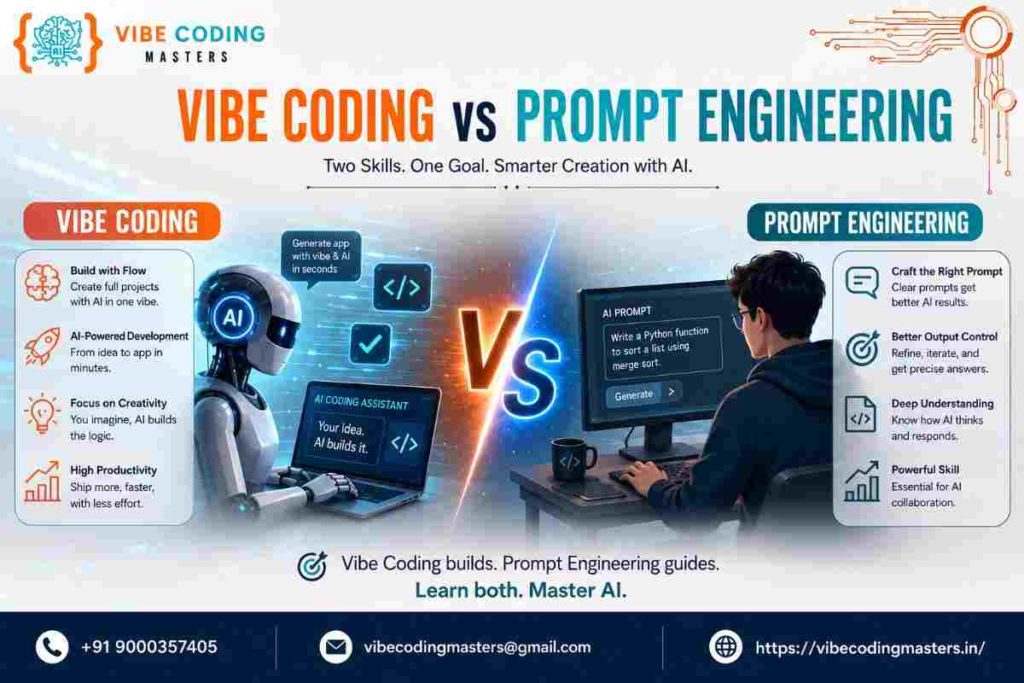
Vibe Coding is building software by describing what you want in natural language to an AI tool that writes and runs the code, while Prompt Engineering is the skill of crafting precise instructions to get accurate, useful outputs from any AI model. Vibe Coding focuses on shipping applications; Prompt Engineering focuses on communication quality with AI systems. Both skills increasingly overlap in real-world AI-assisted development work.
★★★★★
4.9/5 rated by 1329+ students · Google Verified
Table of Contents
Introduction
Artificial intelligence has changed how software gets built and how people interact with AI systems in general. Two terms come up constantly in this shift: Vibe Coding and Prompt Engineering. They sound related, and they do overlap, but they solve different problems and lead to different career paths.
Vibe Coding is about using AI tools like Cursor, Replit, Lovable, and Bolt to describe an application in plain language and have the AI generate, run, and refine the code. Prompt Engineering is about crafting the wording, structure, and context of instructions given to a large language model (LLM) so it produces the most accurate and useful response — whether that’s code, a chatbot reply, or a piece of content.
The term “Vibe Coding” itself became official in 2025, when Collins Dictionary named it Word of the Year, recognising how central AI-assisted development has become to modern software work.
Both skills sit inside the broader wave of generative AI adoption sweeping Indian enterprises and startups. Freshers and working developers are asking the same question: should I learn Vibe Coding, Prompt Engineering, or both? This guide breaks down the differences, the required skills, the tools, and realistic salary expectations in India, so you can decide where to focus your learning.
If you’re also exploring how Vibe Coding compares to autonomous AI development approaches, see our detailed breakdown of Vibe Coding vs Agentic Coding.
Vibe Coding vs Prompt Engineering
What is Vibe Coding?
Vibe Coding is a style of software development where a person describes the outcome they want — a landing page, a booking app, a dashboard — in everyday language, and an AI coding assistant writes, executes, and iterates on the actual code. The person guides the “vibe” or direction of the build rather than typing every line manually.
It doesn’t eliminate the need to understand software concepts, but it dramatically lowers the barrier to building working applications. Tools like Cursor, Replit, Lovable, and Bolt are built specifically around this workflow, letting users prompt, preview, and refine in tight loops.
Quick answer: Vibe Coding is AI-assisted app building through natural-language instructions, where the AI writes and runs the code while the human directs the outcome.
What is Prompt Engineering?
Prompt Engineering is the practice of designing inputs — prompts — that reliably get the best output from an AI model. This includes structuring instructions, providing context, giving examples, and iterating on wording to reduce ambiguity and errors in the model’s response.
Prompt Engineering applies far beyond coding. It’s used for content generation, customer support automation, data analysis, research summarization, and yes, guiding AI coding assistants more effectively too.
Quick answer: Prompt Engineering is the skill of writing clear, structured instructions so an AI model produces accurate and useful results.
Vibe Coding vs Prompt Engineering: Key Differences
The core difference is purpose. Vibe Coding is an application-building workflow; Prompt Engineering is a communication skill that supports many different AI workflows, including Vibe Coding itself.
Aspect | Vibe Coding | Prompt Engineering |
Goal | Build working software | Get accurate AI output |
Output | Applications, websites, tools | Text, code snippets, structured data |
Scope | Narrower — dev-focused | Broader — applies across AI use cases |
Depends on | AI coding assistants | Any LLM or AI system |
Vibe Coding vs Prompt Engineering for Beginners
For someone with zero coding background, Vibe Coding offers a faster route to building something tangible — a personal website, a simple tool, a prototype — without learning syntax first. Prompt Engineering, on the other hand, is easier to start immediately since it requires no technical setup, just an AI chat interface and practice.
Beginners often find Prompt Engineering the gentler starting point, then move into Vibe Coding once they’re comfortable directing AI tools toward more complex, multi-step outcomes.
Vibe Coding vs Prompt Engineering: Skills Required
Skill Area | Vibe Coding | Prompt Engineering |
Basic programming logic | Helpful, not mandatory | Not required |
Understanding of app architecture | Important for larger projects | Not required |
Clear written instructions | Essential | Essential |
Debugging mindset | Important | Occasionally useful |
Domain knowledge (business, content, etc.) | Helpful | Very important |
Familiarity with AI tool interfaces | Required | Required |
Tools Used in Vibe Coding and Prompt Engineering
Not every AI tool serves the same purpose. Some are built for coding, others for prompting, prototyping, or research.
Tool | Primary Use |
AI-native code editor for Vibe Coding | |
Replit | Cloud-based app building and hosting |
Lovable | Rapid prototyping of full web apps from prompts |
Bolt | Instant app scaffolding from natural language |
AI pair-programming inside existing IDEs | |
ChatGPT | General-purpose prompting, content, and reasoning |
Long-context reasoning, coding, and writing assistant | |
Google’s multimodal AI assistant | |
Git and GitHub | Version control for any AI-assisted project |
Developers researching editor-level AI tools often compare Cursor with newer standalone options — see our page on Vibe Coding with Cursor and Antigravity for how these tools differ.
Beyond the AI layer, real applications still rely on core technologies: JavaScript, TypeScript, and Python for logic; React and Node.js for building interfaces and servers; APIs to connect services; and databases to store data. Vibe coding tools generate this code, but debugging, software testing, and deployment still require human judgment to verify the AI’s output actually works as intended.
Vibe Coding Career Opportunities in India
Indian startups and IT services companies are increasingly hiring for roles that expect comfort with AI-assisted development. Titles include AI-Assisted Developer, Rapid Prototyping Engineer, and Full Stack Developer with AI tooling experience. Vibe Coding skills are especially valuable at early-stage startups that need to ship MVPs quickly.
Vibe Coding vs Prompt Engineering Salary in India
Prompt Engineering roles are emerging across IT services, product companies, and AI-first startups, often under titles like AI Prompt Specialist, Conversational AI Designer, or LLM Workflow Engineer. Many companies also fold prompt engineering responsibilities into broader roles like AI Product Analyst or Content Automation Specialist rather than hiring standalone prompt engineers.
Vibe Coding vs Prompt Engineering Salary in India
Salaries vary significantly by company, location, technical depth, and project complexity. The figures below are general industry estimates, not guaranteed outcomes.
Experience Level | Vibe Coding / AI-Assisted Development | Prompt Engineering / AI Roles |
Fresher (0–2 Years) | ₹3.5 LPA – ₹6 LPA | ₹3 LPA – ₹5.5 LPA |
Mid-Level (3–5 Years) | ₹7 LPA – ₹14 LPA | ₹6 LPA – ₹12 LPA |
Senior (6–10 Years) | ₹15 LPA – ₹28 LPA | ₹13 LPA – ₹24 LPA |
Lead / Expert (10+ Years) | ₹28 LPA+ | ₹24 LPA+ |
Industries Using Vibe Coding and Prompt Engineering
Startups, IT services firms, ed-tech companies, fintech products, e-commerce platforms, and digital marketing agencies across Hyderabad and other Indian tech hubs are adopting both skill sets — Vibe Coding for faster product builds, and Prompt Engineering for content, support automation, and internal AI workflows.
Vibe Coding vs Prompt Engineering: Job Roles
Vibe Coding Roles | Prompt Engineering Roles |
AI-Assisted Full Stack Developer | AI Prompt Specialist |
Rapid Prototyping Engineer | Conversational AI Designer |
No-Code/Low-Code AI Builder | LLM Workflow Engineer |
Startup MVP Developer | AI Content Strategist |
Vibe Coding vs Prompt Engineering: Learning Curve
Prompt Engineering has a gentler initial learning curve — anyone can start experimenting within minutes. Vibe Coding requires slightly more ramp-up to understand app structure, but AI tools compress what used to take months of coding practice into weeks of guided building.
Vibe Coding vs Prompt Engineering: Advantages and Limitations
Vibe Coding advantages: faster prototyping, lower entry barrier for non-programmers, quick MVP validation. Vibe Coding limitations: can produce fragile code without review, still needs debugging and testing knowledge for production use.
Prompt Engineering advantages: applies across every AI tool, no technical setup required, transferable across roles. Prompt Engineering limitations: output quality depends heavily on the underlying model, results can be inconsistent without structured iteration.
Vibe Coding vs Prompt Engineering for Developers
Developers benefit from Vibe Coding by speeding up repetitive scaffolding work — boilerplate, CRUD operations, UI components — while focusing their own expertise on architecture, security, and edge-case handling. Strong prompting skills make this collaboration with AI tools far more efficient, reducing back-and-forth correction cycles.
Vibe Coding vs Prompt Engineering for Non-Programmers
Non-programmers can use Vibe Coding tools like Lovable or Bolt to build functional websites, internal tools, or simple apps without writing code directly. Prompt Engineering pairs naturally with this — the clearer the instructions, the closer the AI’s output gets to what the non-programmer actually envisioned.
Future Scope of Vibe Coding and Prompt Engineering in India
Generative AI adoption in India has been accelerating across IT services, product startups, and enterprise digital transformation initiatives. As AI coding assistants and LLM-based tools become standard in development workflows, both Vibe Coding and Prompt Engineering are expected to shift from “nice-to-have” to expected baseline skills for developers and AI-facing roles alike, particularly in tech hubs like Hyderabad, Bengaluru, and Pune.
Why Vibe Coding and Prompt Engineering Are Important AI Skills
Together, these skills represent the two ends of working effectively with generative AI: knowing how to instruct it (Prompt Engineering) and knowing how to turn that instruction into a working product (Vibe Coding). Employers increasingly value candidates who can move fluidly between the two.
How to Start a Career in Vibe Coding
Begin with a beginner-friendly AI coding tool, build small real projects, then progressively tackle full-stack builds. Our full stack development with Vibe Coding project guide walks through a practical starting project.
How to Start a Career in Prompt Engineering
Start by practicing structured prompting on free AI tools, study prompt patterns (role-based prompts, few-shot examples, chain-of-thought instructions), and apply these to real tasks like content generation, coding assistance, or workflow automation.
Vibe Coding Career Path
Level | What to Learn | Practical Skills | Career Focus |
Beginner | Basic app concepts, chosen AI tool interface | Build a simple landing page or form app | Personal projects, portfolio building |
Intermediate | Frontend/backend basics, APIs, databases | Build a full CRUD app with AI assistance | Freelance or junior developer roles |
Advanced | Architecture, debugging, deployment | Ship production-ready multi-feature apps | Full stack / AI-assisted developer roles |
Expert | Scalability, security, team workflows | Lead AI-assisted product builds | Tech lead, startup CTO-track roles |
Prompt Engineering Career Path
Level | What to Learn | Practical Skills | Career Focus |
Beginner | Prompt basics, AI tool familiarity | Write clear single-turn prompts | Personal experimentation |
Intermediate | Prompt patterns, context design | Build multi-step prompt workflows | Content/AI support roles |
Advanced | Model behavior, evaluation methods | Design prompts for production AI systems | AI Prompt Specialist roles |
Expert | Prompt systems at scale, fine-tuning context | Architect AI workflows across teams | LLM Workflow Lead, AI Product roles |
Why Vibe Coding vs Prompt Engineering Matters for Your AI Career
Both skills are becoming relevant because AI is now embedded in nearly every stage of software and content work. Vibe Coding accelerates application development by turning ideas into working prototypes in hours instead of weeks. Prompt Engineering improves communication with AI systems, which directly affects output quality regardless of the task.
Developers benefit from prompt skills because it makes every AI coding tool they use more effective. Non-programmers benefit from Vibe Coding because it opens up building software as a viable skill without a computer science background. Combining both creates a stronger, more versatile AI career profile — someone who can both instruct AI precisely and turn that instruction into a real, working product.
Whether someone should learn one or both depends on their goals: those aiming purely for content, research, or AI-support roles can focus on Prompt Engineering; those aiming to build products should learn both, since Vibe Coding is far more effective when paired with strong prompting.
Key Takeaways
- Vibe Coding is an AI-assisted development workflow; Prompt Engineering is a broader communication skill for working with any AI model.
- The two skills complement each other — better prompts lead to better Vibe Coding results.
- Non-programmers can start with Vibe Coding tools like Lovable and Bolt; anyone can start Prompt Engineering immediately.
- Salaries in India for both skill areas vary widely by experience, company, and project complexity — no outcome is guaranteed.
- Learning both skills together creates a stronger, more adaptable AI career profile than focusing on just one.
Conclusion
Vibe Coding and Prompt Engineering represent two complementary sides of working with AI: one focused on building real applications, the other on communicating effectively with AI systems to get the best possible results. Neither replaces traditional software or domain expertise, but both are becoming increasingly important AI skills across Indian tech hubs.
Rather than treating Vibe Coding vs Prompt Engineering as a competition, most learners benefit from developing both — strong prompting makes AI-assisted coding more reliable, and hands-on Vibe Coding experience makes prompting skills more practical and grounded. If you’re ready to start building, begin with a small project, practice writing clearer prompts with every iteration, and start creating your first AI-powered application today.
FAQ
- What is the difference between Vibe Coding and Prompt Engineering?
Vibe Coding is about building applications through AI-guided coding, while Prompt Engineering is about crafting instructions that get better results from AI models in general.
- Is Vibe Coding the same as Prompt Engineering?
No. Vibe Coding is a development workflow; Prompt Engineering is a supporting communication skill used within that workflow and many others.
- Which is better, Vibe Coding or Prompt Engineering?
Neither is universally better — it depends on the goal. Vibe Coding suits people who want to build software; Prompt Engineering suits people focused on getting precise AI outputs across any task.
- Can I learn Vibe Coding without coding experience?
Yes, tools like Lovable and Bolt are designed for non-programmers, though understanding basic app concepts helps with more complex builds.
- Do Prompt Engineers need programming skills?
Not necessarily. Prompt Engineering focuses on language and structure, though technical prompt engineering for coding contexts benefits from some programming familiarity.
- Is Vibe Coding a good career in India?
It’s an emerging and growing skill area, especially valuable for startups and AI-assisted development roles, though outcomes depend on individual skill depth and portfolio quality.
- Is Prompt Engineering a good career in India?
Yes, demand is rising across AI-first companies and IT services, though it’s often combined with other AI or content-related responsibilities rather than a fully standalone role everywhere.
- What is the salary of a Vibe Coding professional in India?
Estimates range roughly from ₹3.5 LPA for freshers to ₹28 LPA+ for senior professionals, varying by company and project complexity.
- What is the salary of a Prompt Engineer in India?
Estimates range roughly from ₹3 LPA for freshers to ₹24 LPA+ for senior roles, depending on company and specialization.
- Should I learn Vibe Coding and Prompt Engineering together?
Yes, for most learners this combination is more valuable than either skill alone, since effective Vibe Coding depends heavily on strong prompting ability.