Offline vs Online Vibe Coding Course in Hyderabad: Which One Should You Choose?
AI Overview Summary: Choosing between an offline vs online vibe coding course in Hyderabad depends on your schedule, learning style, and career stage. Offline training suits beginners who want hands-on mentoring and networking, while online courses suit working professionals who need flexibility. Both paths teach AI-assisted development using tools like Cursor AI, GitHub Copilot, and Claude, and lead to similar job outcomes when the curriculum and mentorship quality are strong.
★★★★★
4.9/5 rated by 1329+ students · Google Verified
Table of Contents
Introduction
Vibe coding is the practice of building software by describing what you want in plain language and letting an AI coding assistant generate, refine, and debug the code with you. Rather than manually coding every line, developers use AI assistants such as Cursor AI, GitHub Copilot, Claude, ChatGPT, Gemini, and Windsurf by giving natural-language instructions, then refine, test, and improve the generated code.
This shift is happening fast in Hyderabad, a city with a dense concentration of product companies, GCCs (Global Capability Centers), and startups that are actively rebuilding their engineering workflows around AI-assisted development. As demand grows, so does the number of training options — and with it, a genuine question for learners: should you join an offline vibe coding course in Hyderabad, or is an online vibe coding course the smarter choice?
There isn’t a single right answer. Students who have flexible schedules and value face-to-face guidance often benefit most from classroom-based learning, while working professionals typically prefer online programs that fit around office hours and personal commitments. This guide breaks down both formats in detail — cost, mentoring quality, placement support, learning speed, and long-term career outcomes — so you can make a decision based on your own situation rather than marketing claims.
The demand for AI-assisted software development skills is not a passing trend. Companies across Hyderabad’s IT corridor are actively rewriting job descriptions to include “AI pair programming” and “prompt-driven development” as core competencies, which is exactly why this comparison matters right now. For more articles like this, check out our vibe coding blog.
Offline vs Online Vibe Coding Course in Hyderabad
What is Vibe Coding?
Vibe coding is the practice of describing what you want in plain language and letting an AI model generate, test, and refine the working code, while you review the output and steer it toward a clean, maintainable result. A vibe coding course is built to teach exactly that combination — enough programming fundamentals to judge AI output, plus hands-on fluency with the tools themselves.
For a deeper dive into the definition, history, and workflow, see our full guide: What is Vibe Coding? To see exactly how these skills are sequenced module by module, check the full vibe coding course syllabus.
Why Vibe Coding is Growing Rapidly in Hyderabad
Hyderabad has become one of India’s fastest-growing hubs for this shift for a few clear reasons
- A large GCC and product engineering base. Global companies with development centers in Hyderabad are piloting AI-assisted coding workflows to speed up delivery timelines.
- A strong existing developer population. The city already has a deep pool of full-stack and backend developers who are upskilling rather than starting from zero, which makes cohort-based and mentor-led training attractive.
- Startup density. Early-stage startups with lean teams are among the earliest adopters of AI coding tools, since they let small teams ship faster.
- Rising freelance and remote work. Independent developers are using vibe coding to take on more projects in less time, which increases demand for structured, practical training rather than scattered tutorials.
Offline vs Online Vibe Coding Course in Hyderabad
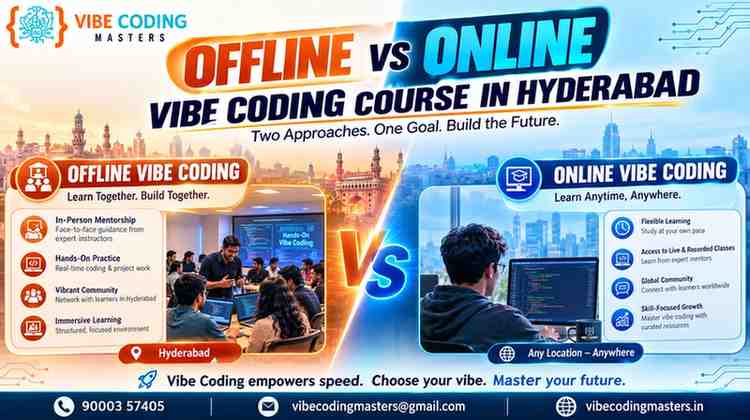
The primary distinction between offline and online learning lies in three key areas: the way you engage with instructors, the level of scheduling flexibility available, and your approach to hands-on practice.
An offline vibe coding course in Hyderabad typically means attending sessions at a physical training center, working alongside other learners, and getting real-time, in-person feedback while you build projects. An online vibe coding course delivers the same broad curriculum through live virtual classes or recorded sessions, with mentoring happening over video calls, chat, or scheduled doubt-clearing sessions instead of face-to-face.
Neither format is inherently “better” — they serve different learning needs. The ideal learning format is determined by your preferred learning style, the amount of guidance and accountability you need, and the time you can consistently dedicate each week.
Offline Vibe Coding Course Benefits
- Immediate, in-person feedback when you get stuck on a prompt, a bug, or an architectural decision.
- Peer accountability — showing up alongside classmates tends to keep learners more consistent.
- Stronger networking, since you’re building relationships with instructors and peers who may later share job leads or referrals.
- Structured pacing, which helps learners who struggle with self-directed schedules.
- Hands-on lab environments with dedicated systems and consistent setups, reducing time lost to configuration issues.
Online Vibe Coding Course Benefits
- Flexibility to learn around a job, especially useful for working professionals who can’t commit to fixed classroom hours.
- Lower travel overhead, which matters in a traffic-heavy city like Hyderabad.
- Recorded sessions that let you revisit difficult topics at your own pace.
- Access to instructors and cohorts beyond your immediate city, sometimes broadening the range of mentors available.
- Often lower course fees, since online programs don’t carry the same facility costs as classroom training.
Offline vs Online Vibe Coding Course Comparison Table
Factor | Offline Course | Online Course |
Mentoring style | In-person, real-time | Video calls, chat support |
Schedule flexibility | Fixed timings | Highly flexible |
Networking | Strong, in-person | Moderate, virtual |
Typical cost | Higher | Generally lower |
Best suited for | Freshers, students | Working professionals |
Doubt resolution speed | Immediate | Scheduled or asynchronous |
Commute required | Yes | No |
Live Classes vs Self-Paced Learning
Aspect | Live Classes | Self-Paced Learning |
Structure | Fixed weekly schedule | Learner-controlled |
Interaction | Real-time Q&A | Delayed or forum-based |
Discipline required | Lower (external structure) | Higher (self-motivation) |
Ideal for | Beginners, students | Professionals with variable schedules |
Classroom Mentoring vs Remote Mentoring
Aspect | Classroom Mentoring | Remote Mentoring |
Feedback speed | Instant | Slightly delayed |
Relationship depth | Personal, ongoing | Professional, scheduled |
Availability | Fixed hours | Often more flexible slots |
Practical Training vs Recorded Sessions
Aspect | Practical Training | Recorded Sessions |
Hands-on practice | Guided, real-time | Independent, self-checked |
Revisiting content | Limited | Unlimited replay |
Environment setup support | Provided on-site | Self-managed with guides |
Which Learning Mode is Best for Freshers?
Freshers and students generally benefit more from offline vibe coding courses, mainly because they haven’t yet built the discipline of independent, self-paced learning. Being physically present in a classroom, working through projects alongside peers, and getting immediate correction when a prompt or piece of logic goes wrong tends to accelerate the learning curve for beginners.
That said, a highly motivated fresher with strong self-study habits can absolutely succeed with an online program, especially if it includes live mentoring sessions rather than purely recorded content.
Which Option is Better for Working Professionals?
For working professionals, online vibe coding courses are usually the more practical choice. Balancing a full-time job with fixed classroom timings is difficult, and most professionals value the ability to attend sessions in the evening, on weekends, or at their own pace. Recorded sessions also let them revisit complex modules — like API integration or deployment — after work hours, without falling behind the rest of a cohort. If this describes your situation, our vibe coding course for working professionals is built specifically around this kind of schedule.
Skills You Will Learn in a Vibe Coding Course
A well-structured vibe coding course, whether offline or online, should cover
- AI Prompt Engineering — writing precise, context-rich prompts that get usable code on the first or second try, and iterating effectively when the output needs correction.
- Cursor AI — using an AI-native code editor to generate, refactor, and debug code within a real project structure.
- GitHub Copilot — pairing inline AI suggestions with your own code as you write, and reviewing suggestions critically.
- Claude AI — using conversational AI for planning architecture, reviewing code quality, and debugging logic errors.
- ChatGPT — using general-purpose AI assistance for research, documentation, and quick prototyping.
- Gemini AI — leveraging multimodal AI capabilities for tasks that combine text, code, and visual references.
- Windsurf — working within an agentic coding environment that can execute multi-step development tasks.
- Frontend Development — building responsive interfaces with modern frameworks, accelerated by AI-assisted component generation.
- Backend Development — designing APIs, handling business logic, and managing data with AI support for boilerplate and debugging.
- API Integration — connecting frontend applications to backend services and third-party APIs.
- Full Stack Development — combining frontend, backend, and database skills into complete, deployable applications.
- Git & GitHub — version control fundamentals, branching, and collaboration workflows.
- Deployment — shipping applications to production environments and understanding basic CI/CD concepts.
Career Opportunities After Learning Vibe Coding
The format you choose can shape how “job-ready” you feel on day one. Offline learners tend to leave with more polished communication and interview presence from constant in-person practice, while online learners often arrive with a stronger independent portfolio built by problem-solving on their own. Either path can lead to similar entry-level roles — what matters more is the depth of your project work than whether you trained in a classroom or on a laptop. For a full breakdown of specific roles, growth paths, and industry demand, see our dedicated guide on careers after vibe coding.
Vibe Coding Salary in Hyderabad
Salary outcomes depend far more on your skill depth, portfolio quality, and interview performance than on whether you trained offline or online — recruiters generally can’t tell the difference from a resume alone. What does move the needle is how well you can demonstrate real, deployed projects and explain your reasoning during a technical round. For a detailed breakdown of salary ranges by experience level, see our dedicated guide on salary after learning vibe coding.
Companies Hiring AI-Assisted Developers
Hyderabad’s hiring landscape for AI-assisted developers spans large GCCs and product engineering centers, mid-sized IT services firms building AI-enabled delivery teams, and a growing base of funded startups that build AI-native products from day one. Freelance platforms have also seen a steady rise in project listings specifically requesting experience with tools like Cursor AI and GitHub Copilot.
Future Scope of Vibe Coding in India
AI-assisted development is moving from an experimental practice to a standard expectation in job descriptions. As more companies adopt AI coding assistants as part of their default toolchain, the ability to work fluently with these tools — rather than avoid them — is becoming a baseline requirement rather than a differentiator. This trend is expected to deepen over the next several years as agentic coding tools take on more complex, multi-step development tasks.
How to Choose the Best Vibe Coding Training Institute in Hyderabad
When evaluating institutes — offline or online — check for
- A curriculum that covers real tools (Cursor AI, GitHub Copilot, Claude, ChatGPT, Gemini, Windsurf) rather than generic “AI coding” branding.
- Instructors with actual professional development experience, not just training experience.
- Project-based learning with a portfolio outcome, not just video lectures.
- Transparent placement support details rather than vague guarantees.
- Verified student reviews and outcomes.
Before you enroll anywhere, it’s also worth checking the eligibility criteria for a vibe coding course so you know exactly what’s expected going in.
Why Classroom Training Still Matters
Despite the rise of online learning, classroom training holds real value for learners who need structure, immediate feedback, and a community. Debugging a tricky prompt or logic error is often faster with someone physically looking at your screen, and the accountability of a fixed schedule keeps many learners from falling behind.
Why Online Training is Preferred by Many Learners
Online training has grown because it removes the two biggest barriers to consistent learning for working adults: commute time and fixed schedules. For professionals in Hyderabad’s traffic-heavy tech corridors, the ability to attend a live session from home in the evening — or catch up on a recording during the weekend — is often the deciding factor.
Who Should Choose Offline Training?
- College students and recent graduates with flexible daytime schedules
- Beginners who need frequent, hands-on correction
- Learners who thrive with peer accountability and in-person networking
- Anyone who has struggled with self-paced online courses before
Who Should Choose Online Training?
- Working professionals with fixed job hours
- Learners based outside Hyderabad who still want access to Hyderabad-based mentors
- Self-motivated learners comfortable with independent study
- Anyone prioritizing lower cost and schedule flexibility over in-person interaction
Which Option Offers Better Placement Support?
Placement support depends far more on the individual institute than on the offline-vs-online format itself. That said, offline institutes often have stronger local hiring partnerships and walk-in interview access with Hyderabad-based companies, while online programs sometimes offer broader (though less localized) placement networks, since they aren’t limited to a single city’s employer base. When comparing programs, ask directly about placement numbers, partner companies, and post-course support timelines rather than assuming one format is automatically better.
Why Vibe Coding is One of the Best Career Choices in Hyderabad
Hyderabad’s mix of established GCCs, a mature product engineering scene, and an active startup ecosystem makes it a strong environment for vibe coding careers — and the offline-vs-online decision plays into how you experience that opportunity
- Industry demand means openings exist across both classroom-trained and self-taught profiles, so neither path locks you out.
- AI adoption in Hyderabad-based teams means whichever format you choose, you’ll need hands-on practice with real tools, not just theory.
- Startup opportunities often favor candidates who can show a built portfolio — something both formats can produce if the course is project-heavy.
- Freelancing and remote work reward independent problem-solving, which online learners tend to practice more by default, though offline learners can build the same habit deliberately.
For a full rundown of what learners gain beyond salary and job titles, see our page on the benefits of a vibe coding course.
Key Takeaways
- Offline vibe coding courses suit freshers and learners who need hands-on, in-person mentorship and structure.
- Online vibe coding courses suit working professionals who need flexibility around a full-time job.
- Both formats can teach the same core toolset — Cursor AI, GitHub Copilot, Claude, ChatGPT, Gemini, and Windsurf.
- Salary and career outcomes depend more on skill depth and portfolio quality than on which format you choose.
- Evaluate institutes by curriculum, instructor experience, and transparent placement data — not marketing claims.
Conclusion
Choosing between an offline vs online vibe coding course in Hyderabad ultimately comes down to your own schedule, learning style, and career stage — not which format is objectively superior. Freshers and students who thrive on structure and in-person mentorship will likely get more from offline classroom training, while working professionals who need flexibility will find online programs a better fit. Whichever path you choose, focus on institutes with a genuine, tool-current curriculum, experienced instructors, and transparent placement outcomes. Take the time to compare a few offline and online vibe coding courses in Hyderabad directly, ask about real student outcomes, and enroll in the one that matches your goals, schedule, and long-term career aspirations.
Ready to get started? Explore our Vibe Coding Course in Hyderabad — with both offline and online batches, 100% placement support, and a free demo session to help you decide before you commit.
FAQ
- What is the difference between an offline and online vibe coding course in Hyderabad?
An offline course involves in-person classroom training with real-time mentoring, while an online course delivers the same curriculum through live or recorded virtual sessions with remote mentoring.
- Which is better for beginners — offline or online vibe coding training?
Offline training is generally better for complete beginners because of immediate feedback and peer accountability, though highly self-motivated beginners can also succeed online..
- How long does a vibe coding course typically take?
Most vibe coding courses range from 2 to 6 months, depending on whether they cover only AI tool usage or a full-stack development curriculum alongside it.
- What is the average fee for a vibe coding course in Hyderabad?
Fees vary widely based on institute reputation and course depth, with online courses generally priced lower than offline classroom programs due to lower overhead costs.
- Do vibe coding courses offer placement assistance?
Many institutes, both offline and online, offer placement support, but the quality varies significantly — always verify actual placement outcomes rather than promotional claims.
- Are online vibe coding certifications valued by employers?
Employers generally care more about demonstrated project skills and interview performance than the certificate itself, regardless of course format.
- What AI tools are taught in a vibe coding course?
Most courses cover Cursor AI, GitHub Copilot, Claude AI, ChatGPT, Gemini AI, and increasingly agentic tools like Windsurf.
- Who is eligible to join a vibe coding course?
Most courses accept beginners with basic computer literacy, though some full-stack-focused programs prefer at least foundational programming knowledge.
- What career opportunities are available after completing a vibe coding course?
Graduates can pursue roles like AI-assisted full stack developer, frontend/backend developer, freelance AI developer, or junior product engineer.
- Which learning mode is best overall — offline or online?
There’s no universal answer — the best mode depends on your schedule, learning style, and need for in-person mentorship versus flexibility.